
|
|
| ČESKÁ REPUBLIKA | CZECH REPUBLIC |
| Olomoucký kraj | Olomouc region |
| Okres: Prostějov |
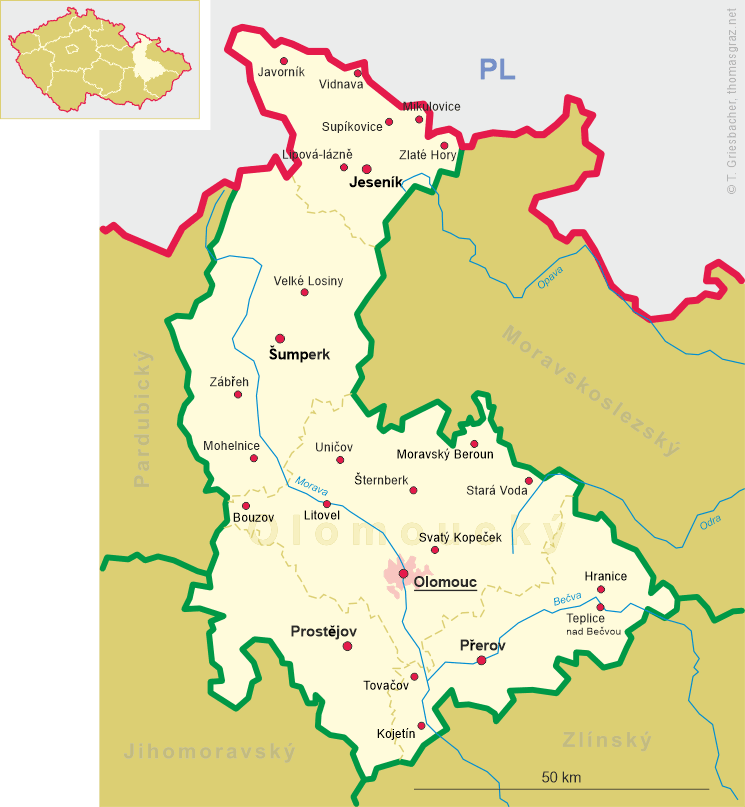
map →
Prostějov was first mentioned as a village in 1141 (as Prostějovice) and obtained the rights of a town 1390. During the 14th century the town was enlarged and fortified. From the end of the 15th century Prostějov was a seat of the Bohemian Brethren who maintained a school and a printing house here. Later also Anabaptists settled in Prostějov. The opening of the first Austrian railway line, the Kaiser-Ferdinand-Nordbahn (see Bohumín) 1838–1846 initiated a period of industrial growth. Prostějov is well-known for its Art Nouveau and Secession style buildings which originated at the beginning of the 20th century.
Prostějov is the birthplace of one of the most important architects of the Bohemia late gothic period, Matthias Rejsek (1450–1506), and one of the most important philosophers of the 20th century, Edmund Husserl (1859–1938), the founder of phenomenology.
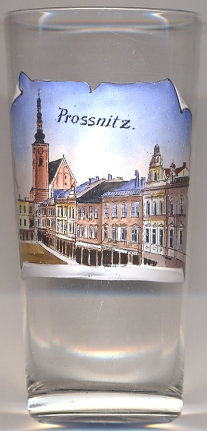
The  parish church of the Exaltation of the Holy Crosss (kostel Povýšení svatého kříže)
goes back to a church that was founded before 1200. In 1697 the church was destroyed ba a large fire which left the building in ruins, and, according to a legend,
only a wooden crucifix had survived unburnt. The church was rebuilt and given its present dedication. The Baroque tower was added in 1725–1726.
[http://cs.wikipedia.org/wiki/Kostel_Povýšení_svatého_kříže]
parish church of the Exaltation of the Holy Crosss (kostel Povýšení svatého kříže)
goes back to a church that was founded before 1200. In 1697 the church was destroyed ba a large fire which left the building in ruins, and, according to a legend,
only a wooden crucifix had survived unburnt. The church was rebuilt and given its present dedication. The Baroque tower was added in 1725–1726.
[http://cs.wikipedia.org/wiki/Kostel_Povýšení_svatého_kříže]
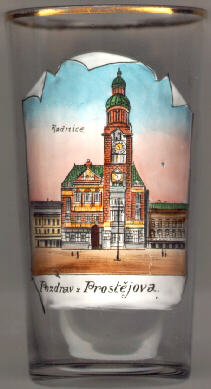
The new town hall (Nová radnice),
the seat of the municipal administation,
was built in 1909–1914 in Art Nouveau style according to a design by the architect Karl Hugo Kepka. The tower has a height of 66 m.
[http://cs.wikipedia.org/wiki/Prostějov]
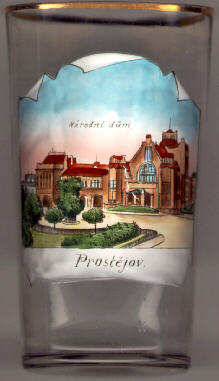
The National Hall (Národní dům)
was built in 1905–1907 in Art Nouveau style by the architect Jan Kotera from Prague.
The building is listed as a national cultural monument of the Czech Republic.
[http://cs.wikipedia.org/wiki/Národní_dům_(Prostějov)]
![[scale]](lineal.jpg)