
|
|
| POLSKA | POLAND |
| województwo: Pomorskie | voivodship: Pomerania |
| miasto na prawach powiatu: Gdańsk | city: Gdańsk |
map →
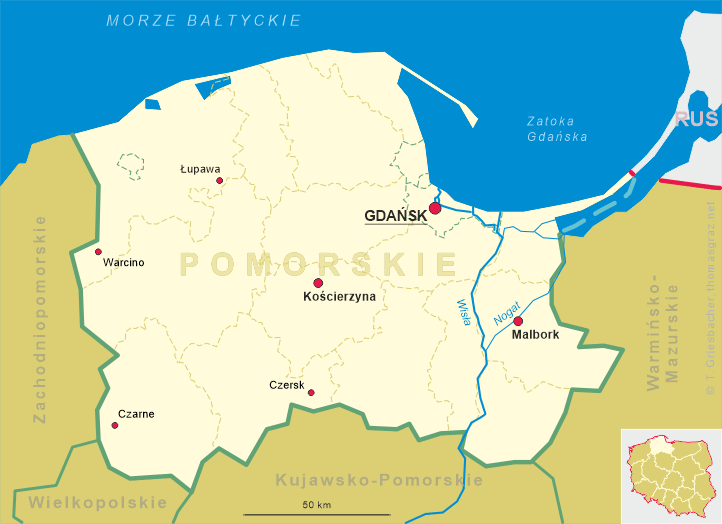
Gdańsk (German: Danzig) is situated at the river Motława (Mottlau) near its mouth into the river
Martwą Wisła (Dead Vistula, Tote Weichsel) and the Gdańsk Bay (Zatoka Gdańska, Danziger Bucht) of the Baltic Sea.
The earliest mention of Gyddanze is found in a document of AD 997; the harbour was first mentioned in the 12th century.
In 1236 Gdańsk obtained the status of a town with a town charter based on that of Lübeck.
From 1308 until 1454 Gdańsk was ruled by the Teutonic Knights who had their main seat at Marienburg (Malbork).
During that period Gdańsk became an official member of the Hanse federation of trading towns in 1358.
In 1454 the citizens of Gdańsk expelled the Teutonic Knights and took shelter under the Polish Crown; Gdańsk obtained the status of
a free and privileged town within the Polish Kingdom. Because almost all the goods that were imported into, or exported from, Poland
were shipped through Gdańsk, the town soon became one of the richest trading towns in Europe.
In 1793 (2nd Partition of Poland) Prussia annexed Gdańsk. After a short period of French rule during the times of the Napoleonic wars, Gdańsk became part of Prussia
again. After World War I Gdańsk obtained the status of a free town under the League of Nations (see map of Poland 1918/23).
 World War II began here on 1 September 1939, 4:45am, when the German warship 'Schleswig-Holstein' opened fire onto the Polish
ammunition depot at the Westerplatte (see below, Nowy Port) near Gdańsk. Near the end of the war in 1945 Gdańsk was destroyed by about 95% within just 2 weeks.
After the war Gdańsk became part of Poland. The historic parts of the old town were carefully reconstructed during the following decades.
World War II began here on 1 September 1939, 4:45am, when the German warship 'Schleswig-Holstein' opened fire onto the Polish
ammunition depot at the Westerplatte (see below, Nowy Port) near Gdańsk. Near the end of the war in 1945 Gdańsk was destroyed by about 95% within just 2 weeks.
After the war Gdańsk became part of Poland. The historic parts of the old town were carefully reconstructed during the following decades.
Among the many famous sons of Gdańsk are: • The astronomer Johannes Hevelius (1611–1687). • Gabriel Daniel Fahrenheit (1686–1736), inventor of the temperature scale today known as the Fahrenheit scale. • The philosopher Arthur Schopenhauer (1788–1860). • The German writer and poet Günter Grass (b. 1927), honorary citizen of Gdańsk 1993, Nobel Laureate for Literature 1999. • Lech Wałęsa (b. 1943), electrician at the Lenin shipyards of Gdańsk, founder of the trade union Solidarność, Nobel Laureate for Peace 1983, President of Poland 1990–1995.
The  Żuraw (Crane) [left] is the landmark of Gdańsk and probably the most often
photographed building of the city. The combination of a city gate and crane was built between 1442 and 1444 in place of an older, similar
construction of the 14th century. The brick towers flanking the wooden construction date back to the Middle Ages. The crane was the largest
harbour crane of its time and could lift loads of up to 4 tons. Two treadmills, wheels with a diameter of 5 m each, were put into motion by
prisoners. The crane was completely destroyed in 1945 but was carefully restored in 1955–1962. Today it houses the
Maritime Museum of Gdańsk, the largest of its kind in Poland.
Żuraw (Crane) [left] is the landmark of Gdańsk and probably the most often
photographed building of the city. The combination of a city gate and crane was built between 1442 and 1444 in place of an older, similar
construction of the 14th century. The brick towers flanking the wooden construction date back to the Middle Ages. The crane was the largest
harbour crane of its time and could lift loads of up to 4 tons. Two treadmills, wheels with a diameter of 5 m each, were put into motion by
prisoners. The crane was completely destroyed in 1945 but was carefully restored in 1955–1962. Today it houses the
Maritime Museum of Gdańsk, the largest of its kind in Poland.
The church of St. Catherine [below, no. 3809: top picture: background]
is one of the oldest churches in Gdańsk. The first, wooden, church probably was founded aroud 1185. The stone nave
was built between 1230 and 1240. Exxtensive enlargements were made in the 14th and 15th century. In 1380 the church received
a low tower, which was heightened in 1484–1488. The Baroque tower roof was created in 1634. During the Reformation in
the church in 1525 became Protestant. The church was destroyed in 1945 during World War II. After the war it was
reconstructed true to the original and returned to the Catholic church. The first services could be held after the completion
of the restoration of the church roof in 1966/1967.
[https://de.wikipedia.org/wiki/Katharinenkirche_(Danzig),
https://en.wikipedia.org/wiki/St._Catherine's_Church,_Gdańsk]
 The Millers' Guild House [near left, no. 3809: top picture: foreground]
(labeled here in German Müllergewerkshaus) on the Radunia Canal was built in 1894 under the patronage of the
church of St. Catherine. The building was, in fact, originally built in 1831 on ul. Na Piaskach (formerly
Am Sande in the Danzig period), the street which runs parallel to the Radunia Canal. This was deconstructed and
subsequently reconstructed in its current location, around the back of The Great Mill. The Guild House is a fine example of
the 'Prussian Façade' style of architecture that is more prevalent in Gdańsk (especially the buildings on
Granary Island) than in any other city in Poland. During the Russian siege of Gdańsk in 1945, the building was
completely destroyed and the site remained in ruins until its restoration in 1997. It is now 'The Chocolate Mill'
Café and Restaurant.
[https://www.inyourpocket.com/gdansk/the-millers-guild-house_166403v]
The Millers' Guild House [near left, no. 3809: top picture: foreground]
(labeled here in German Müllergewerkshaus) on the Radunia Canal was built in 1894 under the patronage of the
church of St. Catherine. The building was, in fact, originally built in 1831 on ul. Na Piaskach (formerly
Am Sande in the Danzig period), the street which runs parallel to the Radunia Canal. This was deconstructed and
subsequently reconstructed in its current location, around the back of The Great Mill. The Guild House is a fine example of
the 'Prussian Façade' style of architecture that is more prevalent in Gdańsk (especially the buildings on
Granary Island) than in any other city in Poland. During the Russian siege of Gdańsk in 1945, the building was
completely destroyed and the site remained in ruins until its restoration in 1997. It is now 'The Chocolate Mill'
Café and Restaurant.
[https://www.inyourpocket.com/gdansk/the-millers-guild-house_166403v]
The Artus Court [near left, no. 3809: bottom left picture]
(in Polish: Dwór Artusa, formerly in German: Artushof, also Junkerhof) used to be the meeting
place of merchants and a centre of social life. The name was taken from the very popular medieval legend of King
Arthur — a symbol of chivalry and gallantry. In Poland Artus courts were founded and visited by
bourgeoisie. There were several of these in Poland (in this collection see one other example in
Toruń) but the one in Gdańsk was by far the most famous. The name of the
building "curia regis Artus", which was built in 1348–1350, appeared for the first time in 1357 in a municipal
note. Another building was probably built in 1379. Its traces were probably found during the archeological excavations in
1991. This building of the Court burnt down in 1476. It was reconstructed few years later, and in 1552 a new façade
was constructed which was once more rebuilt in 1617 by Abraham van den Blocke adding especially the upper part in Dutch
Mannerism style. The interior is one big Gothic hall. Since 1531 it has been completely redecorated: the walls have been
covered with wainscot and friezes, the richly ornamented furniture and numerous paintings of the 15th and 16th century add
to the splendour of the hall. The 11-metre high furnace, covered by 520 tiles, was made by Georg Stelzner in
1545–1546. The Artus Court was designed as an exclusive meeting venue for the local elite. Only in 1742, it became the
town's stock exchange. Today it is a point of interest of numerous visitors and a branch of the Gdańsk History Museum.
[https://en.wikipedia.org/wiki/Artus_Court]
Neptun's Fountain (Fontana Neptuna) [near left, no. 3809: bottom right picture] is
located in front of Artus Court in the Long Market (Polish: Długi Targ; German: Langer Markt). Already in 1549 a
well was located by the entrance of Artus Court, slightly closer to the Motława. The new fountain was created in
1606–1615; the sculpture's project was designed by Abraham van den Blocke, with the statue made by the Flemish
sculptor Peter Husen, cast in bronze in 1615 by Gerdt Benning. The mass of the figure is 650 kilograms. The iron
lattice around the fountain dates from 1634. The water tanks were located on the rooftop of the Main Town Hall and Artus
Court. Until the second half of the 19th century, when the underground water system was modernised, the fountain was
only operational a few days of the year. The fountain was finally inaugurated in 1634. In 1927, the fountain was renovated.
The fountain was damaged during World War II, and moved to Parchau (Parchowo), near Bütow (Bytów); after
the war the fountain was renovated and put back to operation in 1957. In 1988, as part of renovation works the fountain's
genitals were covered with a fig leaf. A full renovation of the fountain occurred between September 2011 and April 2012.
[https://en.wikipedia.org/wiki/Neptune's_Fountain,_Gdańsk, https://de.wikipedia.org/wiki/Neptunbrunnen_(Danzig),
https://pl.wikipedia.org/wiki/Fontanna_Neptuna_w_Gdańsku]
Nowy Port (German: Neufahrwasser) is a district of the city of Gdańsk. It is located to the north of the old town centre at the Baltic Sea, just behind the peninsula Westerplatte. The city district covers an area of 2.3 km² and has about 10,700 inhabitants (2011). The district became part of the city of Danzig in 1814.
 After 1600 more and more sand was deposited at the nearby mouth of the Vistula. As a result, the former mouth of the Vistula
silted up more and more and instead a new fairway was formed between the Westerplatte and the mainland. In 1673 the Danzig
Council ordered the new fairway to be dredged, and the excavation was used to reclaim land. Initially the channel was called
Westerfahrt, in 1724 it was named on a map as "The new fairway". This name was later transferred to the neighboring
country as Neufahrwasser. Originally, the Neufahrwasser area belonged to the Oliva monastery, later it was leased by
the city of Danzig. In 1627 a fortress was built, which was finally completed in 1688. After the First Partition of Poland
(1772, see map), Neufahrwasser became part of Prussia and was thus separated from Danzig, which
only became part of Prussia twenty years later (Second Partition of Poland, 1793; see map).
A port was built in Neufahrwasser due to its strategically favorable location, so that the place grew. Barracks were built
in the 19th century and Neufahrwasser and its port became an important military base. As a result of the Treaty of
Versailles (1919), Neufahrwasser became part of the Free City of Danzig. During World War II, Neufahrwasser together
with Danzig were annexed by the German Reich. After the war, it was returned to Poland and the name was officially changed
to Nowy Port ('New Port').
After 1600 more and more sand was deposited at the nearby mouth of the Vistula. As a result, the former mouth of the Vistula
silted up more and more and instead a new fairway was formed between the Westerplatte and the mainland. In 1673 the Danzig
Council ordered the new fairway to be dredged, and the excavation was used to reclaim land. Initially the channel was called
Westerfahrt, in 1724 it was named on a map as "The new fairway". This name was later transferred to the neighboring
country as Neufahrwasser. Originally, the Neufahrwasser area belonged to the Oliva monastery, later it was leased by
the city of Danzig. In 1627 a fortress was built, which was finally completed in 1688. After the First Partition of Poland
(1772, see map), Neufahrwasser became part of Prussia and was thus separated from Danzig, which
only became part of Prussia twenty years later (Second Partition of Poland, 1793; see map).
A port was built in Neufahrwasser due to its strategically favorable location, so that the place grew. Barracks were built
in the 19th century and Neufahrwasser and its port became an important military base. As a result of the Treaty of
Versailles (1919), Neufahrwasser became part of the Free City of Danzig. During World War II, Neufahrwasser together
with Danzig were annexed by the German Reich. After the war, it was returned to Poland and the name was officially changed
to Nowy Port ('New Port').
The top picture on glass no. 3947 [left] shows a view of the
port at
The Lighthouse of Neufahrwasser (Nowy Port) was built in 1893. It was the first lighthouse
on the Baltic Sea to use electric light.
The bottom picture on glass no. 3947 shows a view of the
Kaisersteg
[https://de.wikipedia.org/wiki/Nowy_Port_(Gda%C5%84sk);
https://en.wikipedia.org/wiki/Westerplatte]
![[scale]](lineal.jpg)