
|
|
| DEUTSCHLAND | GERMANY |
| Bundesland: Freistaat Sachsen | Saxony |
| Landkreis: Mittelsachsen |
map →
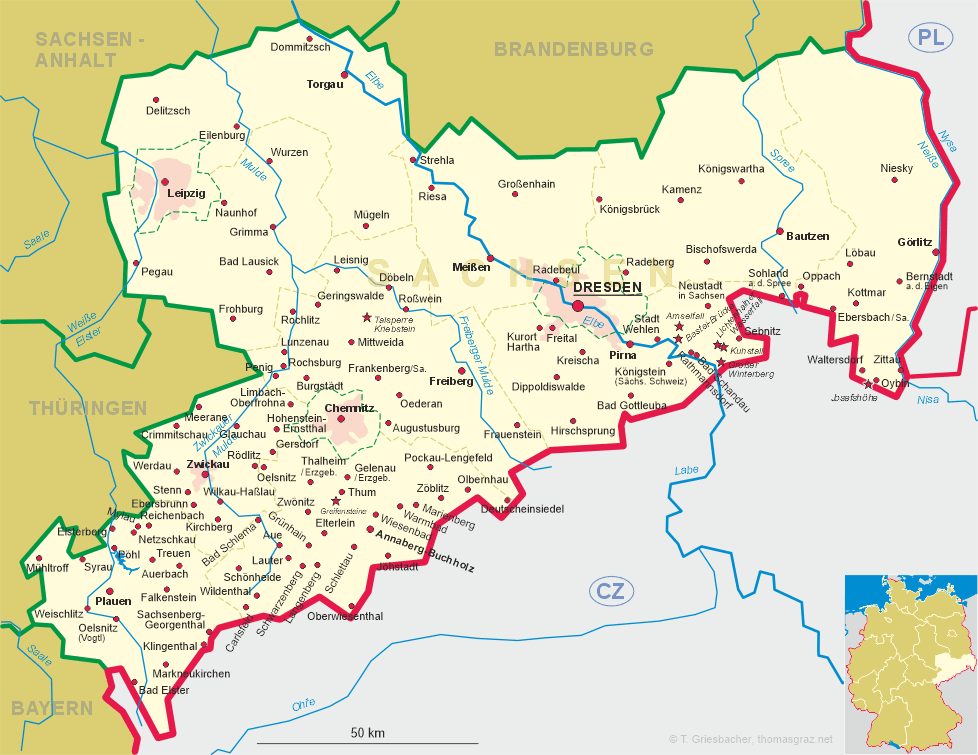
Freiberg is situated at an elevation of 400 m on the river Freiberger Mulde at the foot of the Erzgebirge mountains in central Saxony. Freiberg is the seat of the administration of the district Mittelsachsen; the municipality has a population of about 41,600 (2015).
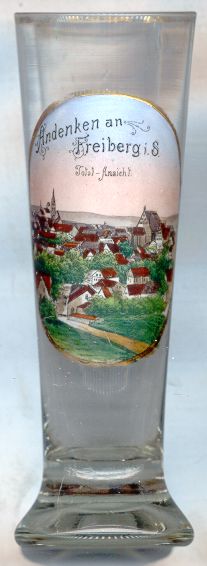 The first villages in the area were founded by Margrave Otto of Meißen between 1156 and 1162.
After silver had been discovered near Christiansdorf in 1168, a mining settlement was founded, which became the origin of Freiberg.
Due to the importance of the silver mining, the settlement received the status of a town in 1186/1188 and that of a free Imperial town in 1195.
The name Freiberg was first mentioned in a document of 1218. By the end of the 13th century, Freiberg was not only the most important
mining town of the margraviate, but also had become an important trading town.
In 1505, Freiberg became the residence of Duke Heinrich of Saxony (Henry 'the Pious').
His first son Moritz, one of the most important figures from the house of Wettin, was born in 1526 in Freiberg.
Moritz later became Duke of Saxony in 1541 and Elector in 1547.
In 1765, the famous Mining Academy, the world's first college of mining engineering, was founded.
The mining activities ended in 1913. Two of the old mines ('Reiche Zeche' und 'Alte Elisabeth') have been converted to a museum.
Today, the old mining academy has the status of a technical university.
The first villages in the area were founded by Margrave Otto of Meißen between 1156 and 1162.
After silver had been discovered near Christiansdorf in 1168, a mining settlement was founded, which became the origin of Freiberg.
Due to the importance of the silver mining, the settlement received the status of a town in 1186/1188 and that of a free Imperial town in 1195.
The name Freiberg was first mentioned in a document of 1218. By the end of the 13th century, Freiberg was not only the most important
mining town of the margraviate, but also had become an important trading town.
In 1505, Freiberg became the residence of Duke Heinrich of Saxony (Henry 'the Pious').
His first son Moritz, one of the most important figures from the house of Wettin, was born in 1526 in Freiberg.
Moritz later became Duke of Saxony in 1541 and Elector in 1547.
In 1765, the famous Mining Academy, the world's first college of mining engineering, was founded.
The mining activities ended in 1913. Two of the old mines ('Reiche Zeche' und 'Alte Elisabeth') have been converted to a museum.
Today, the old mining academy has the status of a technical university.
The  cathedral Sankt Marien [background right] was built in Romanesque style around 1180/90.
The church obtained the rank of a collegiate church and cathedral in 1480. After a fire in 1484, the church was rebuilt in Late Gothic style until 1501.
The community of the church converted to the Lutheran faith in 1537.
Among the treasures of the church are the famous west portal, the 'golden gate', which was created around 1230. It is one of the most important church portals in Late Romanesque style of Germany.
The wood-carved triumphant crucifixion group was created around 1225.
The 'tulip pulpit', a masterpiece of stone-carving, was created in 1508–1510 by the sculptor Hans Witten. The 'miners pulpit' was created in 1638.
The great organ was built in 1711–1714 and is one of the best-known works of the famous organ-builder Gottfried Silbermann.
cathedral Sankt Marien [background right] was built in Romanesque style around 1180/90.
The church obtained the rank of a collegiate church and cathedral in 1480. After a fire in 1484, the church was rebuilt in Late Gothic style until 1501.
The community of the church converted to the Lutheran faith in 1537.
Among the treasures of the church are the famous west portal, the 'golden gate', which was created around 1230. It is one of the most important church portals in Late Romanesque style of Germany.
The wood-carved triumphant crucifixion group was created around 1225.
The 'tulip pulpit', a masterpiece of stone-carving, was created in 1508–1510 by the sculptor Hans Witten. The 'miners pulpit' was created in 1638.
The great organ was built in 1711–1714 and is one of the best-known works of the famous organ-builder Gottfried Silbermann.
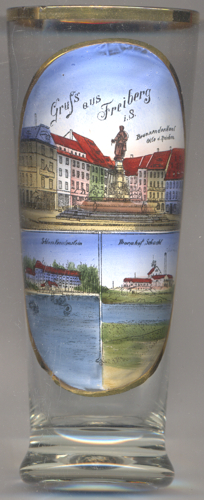
 The fountain monument [near left, no. 3256: top picture]
in the market square Obermarkt was created in 1897. It is topped by a bronze statue of the founder of the city, Margrave
Otto of Meißen (Otto 'the Rich') from the Wettin dynasty.
The fountain monument [near left, no. 3256: top picture]
in the market square Obermarkt was created in 1897. It is topped by a bronze statue of the founder of the city, Margrave
Otto of Meißen (Otto 'the Rich') from the Wettin dynasty.
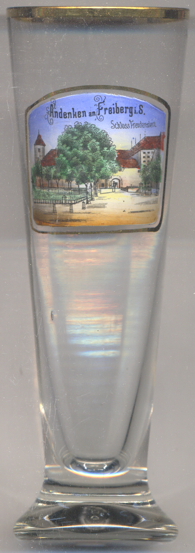
Freudenstein castle [near left, no. 3256: bottom left picture;
and right, no. 3257]
is located at the edge of the old town centre. It was originally founded in 1168 in order to protect the silver mines.
Its earliest mention as hus dates from 1312. The name Freudenstein first was mentioned in 1525. From 1505
onwards, Duke Heinrich of Saxony (Henry 'the Pious') resided most of his time in Freiberg. His sons, the later
Electors Moritz and August, were born in Freudenstein castle. The castle was rebuilt in Renaissance style in
1566–1577. Since 1784 the castle was used as a military depot, which caused a major change in its structure.
During the Napoleonic Wars it was used as a military hospital. Until 1979 it was used as a granary. After 1980
the façades were reconstructed in Renaissance style. Since 2004 the castle is in possession of the city of
Freiberg.
The former mine Turmhofschacht [near left, no. 3256: bottom right picture]
was created in 1842–1857.
[https://de.wikipedia.org/wiki/Freiberg, https://de.wikipedia.org/wiki/Geschichte_der_Stadt_Freiberg;
https://de.wikipedia.org/wiki/Obermarkt_(Freiberg), https://de.wikipedia.org/wiki/Schloss_Freudenstein_(Sachsen),
http://www.erlebnisland-erzgebirge.de/index.php?index=ausgabe_d-S&id=744]
![[scale]](lineal.jpg)