
|
|
| ROMÂNIA | ROMANIA |
| județ Arad | Arad County |
map →
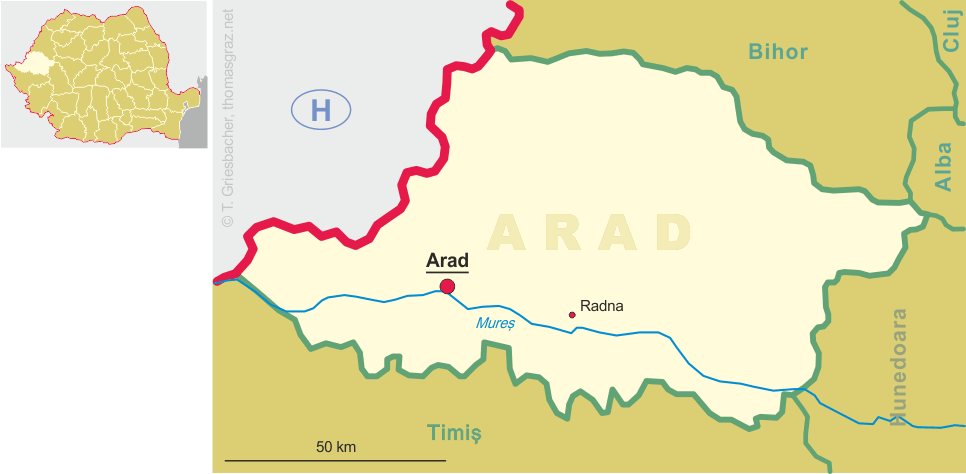
Arad is situated at an elevation of 116 m on the Mureș river in the historical Crișana region (Hungarian: Kórósvidék; German: Kreischgebiet), Transylvania, in western Romania. Arad is the capital city of Arad County and has a population of about 167,000 (2007). According to the 2002 census, the ethnic breakdown of the city was as follows: Romanians (82.7%), Hungarians (13.0%), Roma (1.7%), Germans (1.3%), and other nationalities (1.2%).
 Arad was first mentioned in documents in the 11th century. After the Mongol invasion of the Kingdom of Hungary in 1241 stone fortresses were built at
Soimos (Solymos), Siria (Világos) and Dezna (Dézna). The Ottoman Empire conquered the region from Hungary in 1551 and kept it until the Peace of Karlowitz
(today Sremski Karlovci, Serbia) of 1699. She was also an eyalet center, which compromised sanjaks of Varad (Arad), Logoș, Kacaș, Beșlek and Yanova
since 1660 until 1697, when she was captured by Austrians during the Ottoman-Habsburg wars (1683–1699). After 1699, the city was ruled by the Habsburg Monarchy.
According to 1720 data, the population of the city was composed of 177 German families, 162 Serbian, and 35 Hungarian.
The new fortress was built between 1763 and 1783. Although it was small, it proved formidable having played a great role in the Hungarian struggle for independence in 1849.
Bravely defended by the Austrian general Berger until the end of July 1849, it was captured by the Hungarian rebels, who made it their headquarters during the
latter part of the revolution. It was from Arad that Lajos Kossuth issued his famous proclamation (11 August 1849), and where he handed over the supreme military and
civil power to Artúr Görgei. The fortress was recaptured shortly after the surrender of Görgei to the Russians at Șiria (Világos).
Thirteen rebel generals were executed there on 6 October 1849, by order of the Austrian general Julius Jacob von Haynau. These men are known collectively as the "13 Martyrs of Arad",
and since then Arad is considered the "Hungarian Golgotha".
Arad enjoyed a great economic development. In 1834 it was declared a "free royal town" by Emperor Franz I of Austria.
Arad was first mentioned in documents in the 11th century. After the Mongol invasion of the Kingdom of Hungary in 1241 stone fortresses were built at
Soimos (Solymos), Siria (Világos) and Dezna (Dézna). The Ottoman Empire conquered the region from Hungary in 1551 and kept it until the Peace of Karlowitz
(today Sremski Karlovci, Serbia) of 1699. She was also an eyalet center, which compromised sanjaks of Varad (Arad), Logoș, Kacaș, Beșlek and Yanova
since 1660 until 1697, when she was captured by Austrians during the Ottoman-Habsburg wars (1683–1699). After 1699, the city was ruled by the Habsburg Monarchy.
According to 1720 data, the population of the city was composed of 177 German families, 162 Serbian, and 35 Hungarian.
The new fortress was built between 1763 and 1783. Although it was small, it proved formidable having played a great role in the Hungarian struggle for independence in 1849.
Bravely defended by the Austrian general Berger until the end of July 1849, it was captured by the Hungarian rebels, who made it their headquarters during the
latter part of the revolution. It was from Arad that Lajos Kossuth issued his famous proclamation (11 August 1849), and where he handed over the supreme military and
civil power to Artúr Görgei. The fortress was recaptured shortly after the surrender of Görgei to the Russians at Șiria (Világos).
Thirteen rebel generals were executed there on 6 October 1849, by order of the Austrian general Julius Jacob von Haynau. These men are known collectively as the "13 Martyrs of Arad",
and since then Arad is considered the "Hungarian Golgotha".
Arad enjoyed a great economic development. In 1834 it was declared a "free royal town" by Emperor Franz I of Austria.
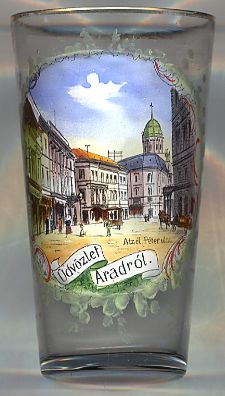
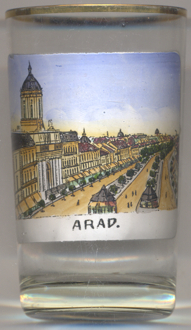
The picture on glass no. 2490 [left] shows a view of
 Péter
Péter
The church depicted in the background of glasses no. 2490 [left] and no. 3449 [above right] is the
church
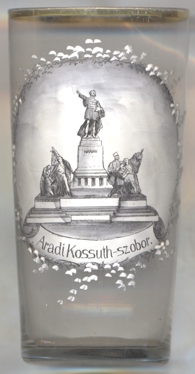
The monument for Lajos Kossuth [near left, no. 4391]
was erected in 1909 in what was then called Kossuth Park. The design was chosen in a contest held in 1907, which was won by the sculptor
Ede Kallós and the architect Géza Márkus. However, the winners were asked to submit a new design, which finally was approved
in the same year. The unveiling of the monument took place on the penultimate Sunday of September 1909 in the presence of the minister of trade of the
Hungarian government, Ferencz Kossuth, Lajos Kossuth's son. After 1918, when Arad had become part of Romania, the Romanian population of Arad began
to rebel against all monuments that reminded of the period of Hungarian domination. Subsequently the Kossuth monument and also that for the 13 generals
(the 'martyrs of Arad') were covered up with boards to protect them. The monuments were finally dismantled in 1925.
[Text adapted from http://en.wikipedia.org/wiki/Arad,_Romania;
https://www.aradon.ro/aradon-stirile-judetului-arad/povesti-nestiute-ale-unui-monument-disparut-statuia-lui-kossuth-1547909/]
![[scale]](lineal.jpg)