
|
|
| SAN MARINO | SAN MARINO |
map →
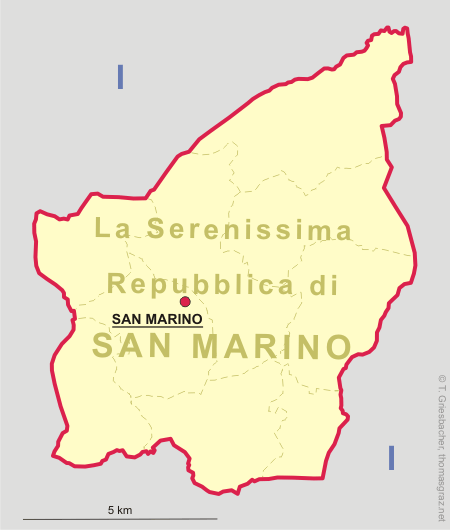
According to a legend, Marino, a stonemason from the island of Arbe in Dalmatia (today Rab, HR), fled from the persecution by the Roman Emperor Diocletianus (245–313) and took refuge here on Monte Titano where he founded a community of christians. Archeological finds show that the area already had been inhabited in prehistoric times, while the first proofs for organized communities date from the Middle Ages. Over the years, the community was named "Terra di San Marino", "Commune di San Marino", and finally "Repubblica di San Marino". In 1243 it was the first time that two members of the assembly (the Arengo) were elected as regents with equal authoriy (Capitani Reggenti). The oldest statutes date from 1300 and 1600. The Republic od San Marino has retained this constitution and its independence ever since. The 3rd of September AD 301 was officially declared the date of the foundation. Hence, San Marino is considered the world's oldest republic. The San Marino historic centre and Monte Titano were listed as a World Cultural Heritage site by UNESCO in 2008 (see also list of other World Cultural Heritage sites depicted on glasses of this collection).
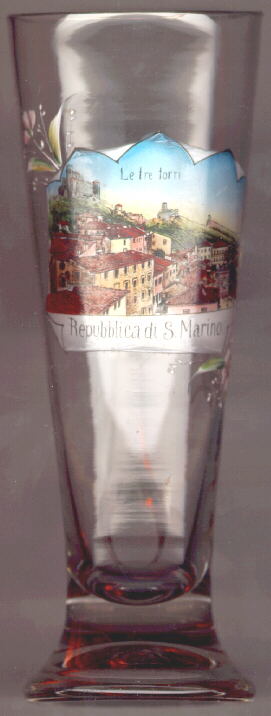
The landmark of San Marino Città are the three castles, Le Tre Torri, on Monte Marino above the town:
The first castle,  Prima Torre [background left],
called La Rocca or Guaita
was the first fortification built in San Marino and dates from the 10th century.
It was used as a guard tower and place for refuge. Up to 1970 it was also used as prison.
It obtained its present shape in the 15th century.
Prima Torre [background left],
called La Rocca or Guaita
was the first fortification built in San Marino and dates from the 10th century.
It was used as a guard tower and place for refuge. Up to 1970 it was also used as prison.
It obtained its present shape in the 15th century.
The second castle, Seconda Torre [background centre],
called La Cesta or Fratta
was built in the 13th century on the summit of Monte Titano (776 m). Just like La Rocca it also contained a few prison cells.
Today it houses the museum of ancient weapons, exhibiting weapons from the Middle Ages until the late 19th century.
The third castle, Terza Torre [background right],
called Montale, a turret on a pentagonal base, originated in the 14th century.
The prison cell, called 'the tower bottom' is 8 m deep.
![[scale]](lineal.jpg)