
|
|
| DEUTSCHLAND | GERMANY |
| Bundesland: Freistaat Bayern | Bavaria |
| Regierungsbezirk: Unterfranken | |
| Stadt: Würzburg |
map →
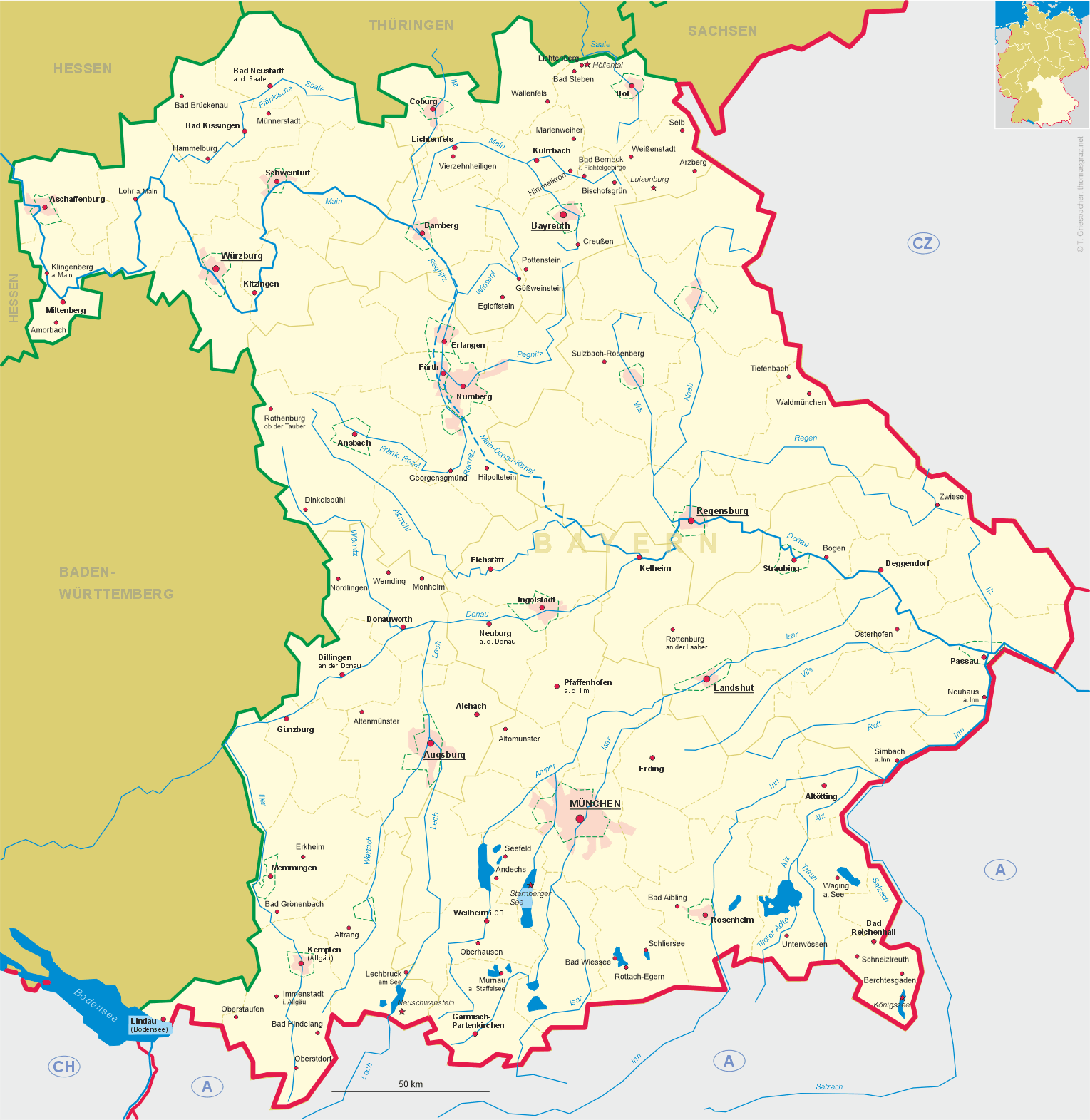
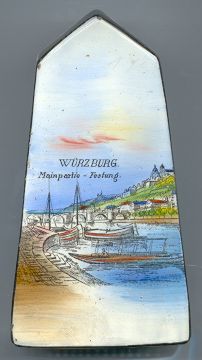 Würzburg is situated at an elevation of 209 m on the river Main and is the capital of the administrative region Unterfranken of Bavaria.
Around 1000 BC the Marienberg was the location of a Celtic stronghold. Around AD 650 it became the seat of a Frankish dukedom.
The Franks were converted to the Christian faith by the missionaries St. Kilian, Kolonat and Totnan, who were martyred
in Würzburg in 689. The bishopric of Würzburg was founded in 742 by St. Boniface. Bishop Adalbero
(c. 1010 – c. 1090), count of Lambach-Wels,
was venerated as a saint in Austria soon after his death and in Würzburg since about the 17th century;
in 1883, Pope Leo confirmed Adalbero a saint in the worldwide church.
The secular power of the bishops over the dukedom
was confirmed in 1168 by Emperor Friedrich I Barbarossa. The famous carver and sculptor Tilman Riemenschneider was elected burgomaster in 1520.
The university was founded in 1525. During the Thirty Years' War (1618–1648)
Würzburg was occupied in 1631 by the Swedish King Gustav II Adolf. The famous residence palace of the prince bishops was built in 1720–1744
in splendid Baroque style by Balthasar Neumann. After the secularisation of 1803 Würzburg at first was awarded to Bavaria, which exchanged it with
Tyrol and other territories after the Peace of Pressburg (Bratislava, SK) in 1805. Between 1806 and 1814 the territories of
Würzburg were ruled by Ferdinand III, who had been ousted as Grand Duke of Toscany by Napoleon in 1799 and as Elector had ruled
the secularised archbishopric of Salzburg between 1803 and 1805. Ferdinand at first took the
title of Elector of Würzburg in 1806 but in the same year changed it to Grand Duke of Würzburg. After the Congress of
Vienna in 1815 Ferdinand returned to Tuscany, and Würzburg finally became part of the Kingdom of Bavaria.
In 1945 the allied air raids destroyed about 90% of the historic town.
Luckily, most parts of the famous residence palace had survived. The damages were restored after the war
and the residence of Würzburg was listed as a World Cultural Heritage by the UNESCO in 1981
(see also list of other UNESCO heritage sites).
Würzburg is situated at an elevation of 209 m on the river Main and is the capital of the administrative region Unterfranken of Bavaria.
Around 1000 BC the Marienberg was the location of a Celtic stronghold. Around AD 650 it became the seat of a Frankish dukedom.
The Franks were converted to the Christian faith by the missionaries St. Kilian, Kolonat and Totnan, who were martyred
in Würzburg in 689. The bishopric of Würzburg was founded in 742 by St. Boniface. Bishop Adalbero
(c. 1010 – c. 1090), count of Lambach-Wels,
was venerated as a saint in Austria soon after his death and in Würzburg since about the 17th century;
in 1883, Pope Leo confirmed Adalbero a saint in the worldwide church.
The secular power of the bishops over the dukedom
was confirmed in 1168 by Emperor Friedrich I Barbarossa. The famous carver and sculptor Tilman Riemenschneider was elected burgomaster in 1520.
The university was founded in 1525. During the Thirty Years' War (1618–1648)
Würzburg was occupied in 1631 by the Swedish King Gustav II Adolf. The famous residence palace of the prince bishops was built in 1720–1744
in splendid Baroque style by Balthasar Neumann. After the secularisation of 1803 Würzburg at first was awarded to Bavaria, which exchanged it with
Tyrol and other territories after the Peace of Pressburg (Bratislava, SK) in 1805. Between 1806 and 1814 the territories of
Würzburg were ruled by Ferdinand III, who had been ousted as Grand Duke of Toscany by Napoleon in 1799 and as Elector had ruled
the secularised archbishopric of Salzburg between 1803 and 1805. Ferdinand at first took the
title of Elector of Würzburg in 1806 but in the same year changed it to Grand Duke of Würzburg. After the Congress of
Vienna in 1815 Ferdinand returned to Tuscany, and Würzburg finally became part of the Kingdom of Bavaria.
In 1945 the allied air raids destroyed about 90% of the historic town.
Luckily, most parts of the famous residence palace had survived. The damages were restored after the war
and the residence of Würzburg was listed as a World Cultural Heritage by the UNESCO in 1981
(see also list of other UNESCO heritage sites).
 The
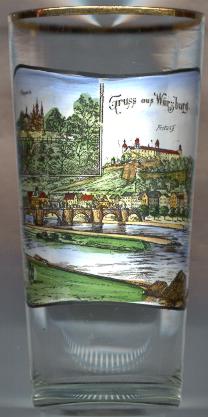
The  fortress Marienberg [left, no. 566: top right]
had already been a Celtic stronghold about 1000 BC. The first Lady church on the Marienberg was built in AD 706.
The castle keep goes back to the medieval castle and was constructed around 1200. In 1253 the castle became the residence
of the bishops and remained so until 1719. After 1600 it was remodelled into a splendid Renaissance residence.
After Würzburg had been occupied by Swedish troops in 1631, the castle
was fortified by an impressive Baroque fortress.
fortress Marienberg [left, no. 566: top right]
had already been a Celtic stronghold about 1000 BC. The first Lady church on the Marienberg was built in AD 706.
The castle keep goes back to the medieval castle and was constructed around 1200. In 1253 the castle became the residence
of the bishops and remained so until 1719. After 1600 it was remodelled into a splendid Renaissance residence.
After Würzburg had been occupied by Swedish troops in 1631, the castle
was fortified by an impressive Baroque fortress.
The old Main bridge [left, no. 566: bottom] was built in 1476 and 1543
on the foundations of the previous Romanesque bridge of around 1130.
Around 1730 the bridge was embellished by Baroque statues of saints. The middle part of the bridge was blown up in 1945 but was restored in 1950.
The Baroque pilgrimage chapel 'Käppele' [left, no. 566: top left] was built in 1748–1752 by Balthasar Neumann.
Today, Würzburg is not only known as the administrative centre of Unterfanken but is also renowned for its university. Eight members of the university received a Nobel Award: Wilhelm Conrad Röntgen (physics, 1901), Emil Hermann Fischer (chemistry, 1907), Wilhelm Wien (physics, 1911), Johannes Stark (physics, 1919), Hans Spemann (medicine, 1935), Klaus von Klitzing (physics, 1985) and Hartmut Michel (chemistry, 1988).
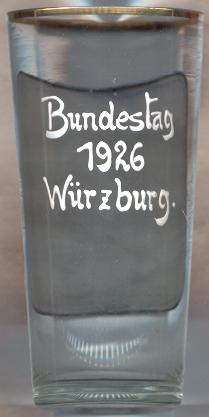
Glass no. 566 [left and right is inscribed "Bundestag 1926 Würzburg" ('federal assembly 1926 Würzburg') on the back. The glass was probably marked
in this way as a souvenir of a national assembly of a sports federation, a fraternity, or a similar organisation.
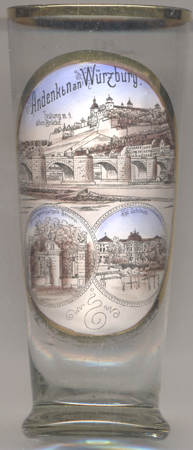
The Würzburg Residence [left, no. 3370: bottom right picture]
was built for the Prince-Bishops of Würzburg who until then had resided in the Marienberg fortress (see above).
Johann Lukas von Hildebrandt and Maximilian von Welsch, representatives of the Austrian/South German Baroque style,
were involved in the construction, as well as Robert de Cotte and Germain Boffrand, who were followers of the French Style.
Balthasar Neumann, court architect of the Bishop of Würzburg, was the principal architect of the Residence,
which was commissioned by the Prince-Bishop of Würzburg Johann Philipp Franz von Schönborn and his brother Friedrich
Karl von Schönborn in 1720, and completed in 1744. The Venetian painter Giovanni Battista Tiepolo, assisted by his son,
Domenico, painted frescoes in the building. Interiors considered masterworks of Baroque/Rococo or Neoclassical architecture
and art include the grand staircase, the chapel, and the Imperial Hall.
After the secularisation of the prince-bishopric in 1802/1803 (following the Peace of Lunéville
and the Reichsdeputationshauptschluss) it served for eight years as the residence of Grand Duke Ferdinand of Tuscany
(1806–1814 grand Duke of Würzburg). On 2 October 1806 Napoleon signed the declaration of war against Prussia
here. After 1814, when Würzburg had become part of Bavaria, the palace became a Bavarian royal palace.
The residence was heavily damaged during World War II,
and restoration has been in progress since 1945. Since 1981, the Residence has been a UNESCO World
Heritage Site.
The Prince Regent's monument [bottom left picture]
was created in 1903 as a monument for Prince Regent Luitpold (1821–1912), who had been born in the Würzburg
Residence. In 1943, the bronze statue was confiscated for being melted down. Although the statue survived the war unmelted,
after is rediscovery in 1948 it was not bought back and finally went missing. The stone parts of the monument were removed
in 1957. A new monument for the Prince Regent was created in 1964 in a different location.
[https://de.wikipedia.org/wiki/Würzburger_Residenz, https://en.wikipedia.org/wiki/Würzburg_Residence;
http://http://www.wuerzburgwiki.de/wiki/Prinzregentendenkmal]
![[scale]](lineal.jpg)