
|
|
| DEUTSCHLAND | GERMANY |
| Bundesland: Freistaat Bayern | Bavaria |
| Regierungsbezirk: Oberfranken | |
| Stadt: Bayreuth |
map →
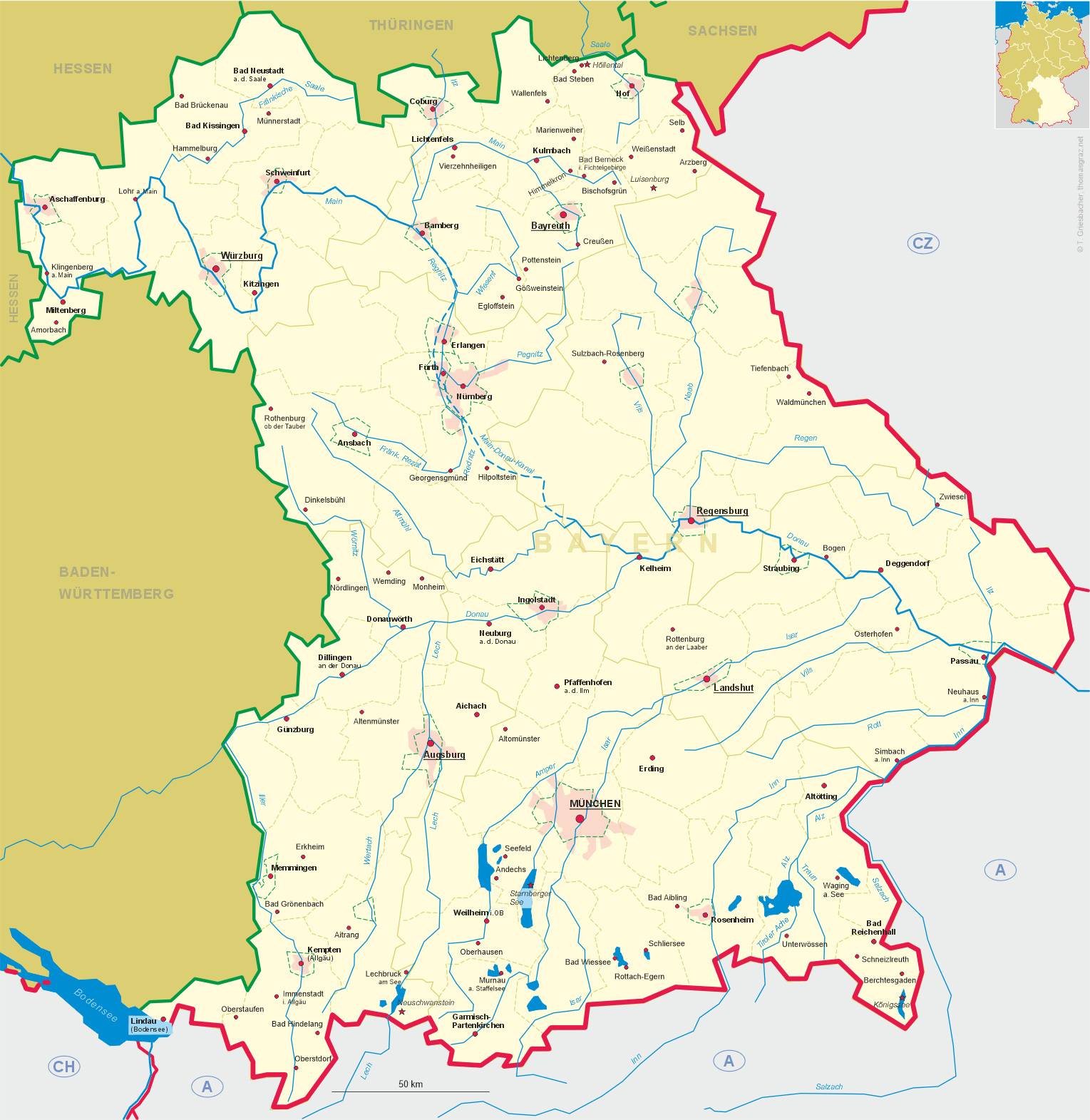
Bayreuth is situated at an elevation of 345 m on the river Roter Main. It was founded by the counts of Andechs after 1160 and was first mentioned as Baierrute in a document of 1194. In 1260 the counts of Andechs were succeeded by the burgraves of Nürnberg (later margraves of Brandenburg-Kulmbach). Upon his accession in 1603, Margrave Christian moved his residence from Kulmbach to Bayreuth. His son, Margrave Christian Ernst (ruled 1661–1712) took part in the relief of Vienna, which ended the second Turkish siege in 1683. In 1701 the town of Sankt Georgen (since 1811 part of Bayreuth) was founded by Prince (later Margrave) Georg Wilhelm. The most significant period for Bayreuth was the reign of Margrave Friedrich and his wife Wilhelmine, favourite sister of King Friedrich II (the Great) of Prussia. Friedrich founded the first university of Bayreuth (today the Friedrich-Alexander university Erlangen-Nürnberg) in 1742. The famous Margravial Opera House opened in 1748. Until 1871 it remained the largest stage in Germany and still is one of the most beautiful original Baroque theatres of Europe. In 2012 the theatre was insccribed in the UNESCO World Heritage list. The history of Bayreuth as a residence town ended in 1769 when the Margraves of Brandenburg-Ansbach succeeded the line Brandenburg-Bayreuth. In 1792 Bayreuth became part of Prussia and in 1810 became part of the Kingdom of Bavaria.
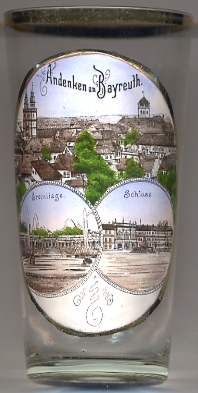 The Protestant
  Town Church of the Holy Trinity [top picture: left] was founded in the 12th or 13th century.
The present church was built in 1437–1495 in late Gothic style. When Margrave Christian moved his residence to Bayreuth in 1603, the church was
adapted as a church for the margravial court. The crypt holds the tombs of 26 members of the princely family. In 1614 the church was dedicated to the Holy Trinity.
[https://de.wikipedia.org/wiki/Stadtkirche_(Bayreuth)]
Town Church of the Holy Trinity [top picture: left] was founded in the 12th or 13th century.
The present church was built in 1437–1495 in late Gothic style. When Margrave Christian moved his residence to Bayreuth in 1603, the church was
adapted as a church for the margravial court. The crypt holds the tombs of 26 members of the princely family. In 1614 the church was dedicated to the Holy Trinity.
[https://de.wikipedia.org/wiki/Stadtkirche_(Bayreuth)]
The Castle Church [top picture: right] was built for Margrave Friedrich and his wife Wilhelmine
in 1753–1758 by the architect Joseph Saint-Pierre. The princely couple is buried in the church together with their daughter Friederike, duchess of Württemberg.
The tomb was designed by Carl Philipp von Gontard. The stucco decorations in the church were made by Giovanni Battista Pedrozzi.
The octogonal bell tower, also called 'Schlossturm' (castle tower), was built in 1656 by Caspar Fischer. A unique feature of the tower is a spiral staircase in the centre
which on its outside is accompanied by a spiral cartway which was used by farmers to transport their dues to the margravial goods storage. The tower is a beloved
landmark of Bayreuth.
[http://www.bayreuth.de/sehenswuerdigkeiten/schlosskirche_837.html]
The Eremitage [bottom left picture] is a representative park with fountains in Bayreuth.
It's construction began in 1715 when Margrave Georg Wilhelm built a small summer residence near the village St. Johannis. The festive inauguration
took place in 1719, but the construction works went on until 1722. When Margrave Friedrich acceded to the throne in 1735 he donated the Eremitage to his wife
Margravine Wilhelmine. In the following years the small residence was enlarged and further buildings were created in the park. The 'New Palace' ('Neues Schloss' or 'Sonnentempel'),
not to be confused with the 'New Palace' in the city centre (see below), was built in 1749–1753. The landscape park is a Rokoko gem and a masterpiece of
18th century garden architecture. In the spring of 1945 the Orangerie and the New Palace were almost competely destroyed by American forces; the Old Palace and
the stables suffered damages. After the war the Old Palace was repaired, while only the exterior walls of the Orangerie were reconstructed. An extensive renovation
of the Old Palace waw carried out in 2005.
[https://de.wikipedia.org/wiki/Eremitage_(Bayreuth)]
The New Palace (Neues Schloss) of Bayreuth [bottom right picture] was built in 1753–1758 by Joseph Saint-Pierre,
architect at court for Margrave Friedrich and Margravine Wilhelmine. Saint-Pierre received the commission for the new palace after a large fire had destroyed the former
palace in 1753. Several buidings that at the time of the fire had already existed or had been under construction were incorported into the new palace. The central part of the palace
was created by rebuilding the building shell of the Reformed church which at that time had been under construction. Although this resulted in a number of quite unusual
details, the new palace is a well-known example of the 'Bayreuth Rococo' style and is considered to be one of the most important masterpieces of 18th century architecture
in Germany.
[https://de.wikipedia.org/wiki/Neues_Schloss_Bayreuth]
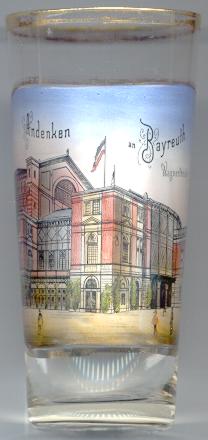
The Festspielhaus (Wagnertheater) [left] was built for Richard Wagner in 1872–1876 by
the architect Otto Brückwald. Funded by King Ludwig II of Bavaria, the theatre was opened in the presence of the German Emperor,
Wilhelm I, and Ludwig II on 13 August 1876 with a performance of "Rheingold" (followed by "Walküre" on 14 August, and the world premieres of
"Siegfried" on 16 August and "Götterdämmerung" on 17 August). The theatre's unique covered pit, which completely hides the orchestra, produces
an especially well-balanced acoustics. The building was extended in 1881/82 by the 'Königsbau', a staircase pavilion with enclosed Royal box.
The theatre had an original seating capacity of 1,645; today it has 1,925 seats. Until today it is used exclusively for performances of the works
of Richard Wagner (with the only exception of some performances of Beethoven's 9th symphony, and some entertainment performances during World War II).
![[scale]](lineal.jpg)