
|
|
| ČESKÁ REPUBLIKA | CZECH REPUBLIC |
| Jihomoravský kraj | South Moravia (Brno) region |
| Okres: Hodonín |
map →
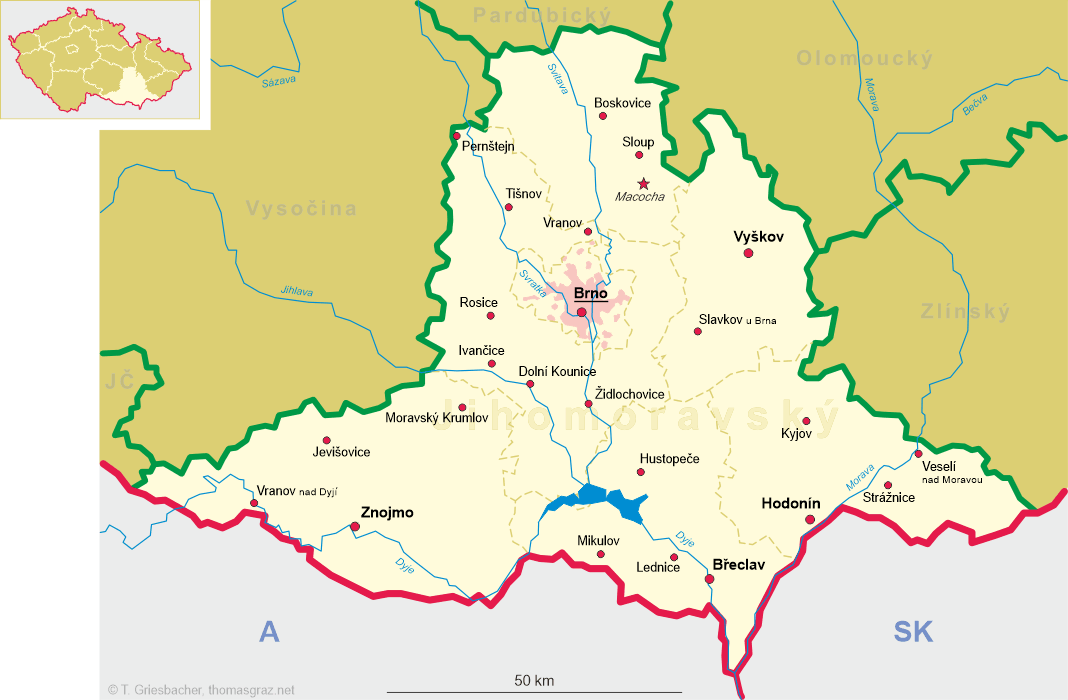
 The district town Hodonín is situated at an elevation of 167 m in southern Moravia close to the border to Slovakia.
It began to develop around 1030 as part of a border defense system against Hungary. Hodonín obtained the status of a town in 1228.
Since 1978 Hodonín is also recognized as a spa because of its iodine-containing mineral spring which is used for the treatment of
joint diseases.
The district town Hodonín is situated at an elevation of 167 m in southern Moravia close to the border to Slovakia.
It began to develop around 1030 as part of a border defense system against Hungary. Hodonín obtained the status of a town in 1228.
Since 1978 Hodonín is also recognized as a spa because of its iodine-containing mineral spring which is used for the treatment of
joint diseases.
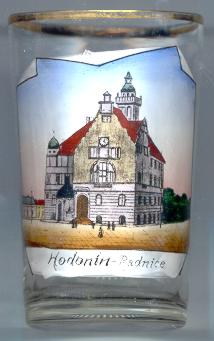
The picture on glass no. 995 [left] shows the  town hall
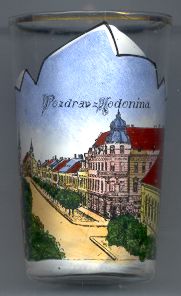
The view depicted on glass no. 995 [right] could be identified as a view of

The church of Saint Lawrence [near left, no. 4828] was originally built in
Gothic style in the first half of the 13th century. It was remodelled in Baroque style in 1780–1786.
Hodonín is the birth place of Tomáš Garrigue Masaryk (1850–1937), the first President
of the Czechoslovak Republic. During 1878–1882 he lectured at the University of Vienna
followed by being a professor of philosophy (1882–1914) at the Charles University in Prague.
He was a member of the Austrian Parliament (1891–1893 and 1907–1914). He advocated the reorganization of the
Austro-Hungarian Empire into a Federation in which all nationalities should have equal rights (The Romanian patriot Aurel
C. Popovici also advocated a federation based on nationalities, summarized in his book Die Vereinigten Staaten von
Groß-Österreich, The United States of Greater Austria, published in 1906; see the
map showing Popovici's plan). After the outbreak of World War I in 1914 Masaryk turned to
the idea of totally independent nation states. During the years of 1916–1918 he was the Chairman of the Czechoslovak
National Council in Exile. In October of 1918 he visited Philadelphia where the Proclamation of
Independence of the Czechoslovak Republic was to take place at Independence Hall. Masaryk was elected President three times,
in 1920, 1927 and 1934, and held this office until his resignation due to severe illness in December 1934. He died in 1937
at Lány.
Also born in Hodonín was the Austrian statesman and historian Joseph Redlich (1869–1936).
He studied law and history at the University of Vienna, after which he was appointed professor of constitutional law there in 1906.
He served as a German Liberal representative in the imperial Reichsrat of Austria-Hungary (1907–1918), and
in June 1917 he was asked to head a reform cabinet in the vain hope of establishing a
constitutional democracy within the empire. After the break-up of the Austro-Hungarian Monarchy in 1918
he remained in Vienna as an Austrian citizen, refusing further political participation except for brief service as
finance minister in 1931. Between 1926 and 1934 he was also Professor at Harvard University.
![[scale]](lineal.jpg)