
|
|
| FRANCE | FRANCE |
| région: Provence-Alpes-Côte d'Azur | |
| département: 13, Bouches-du-Rhône |
map →
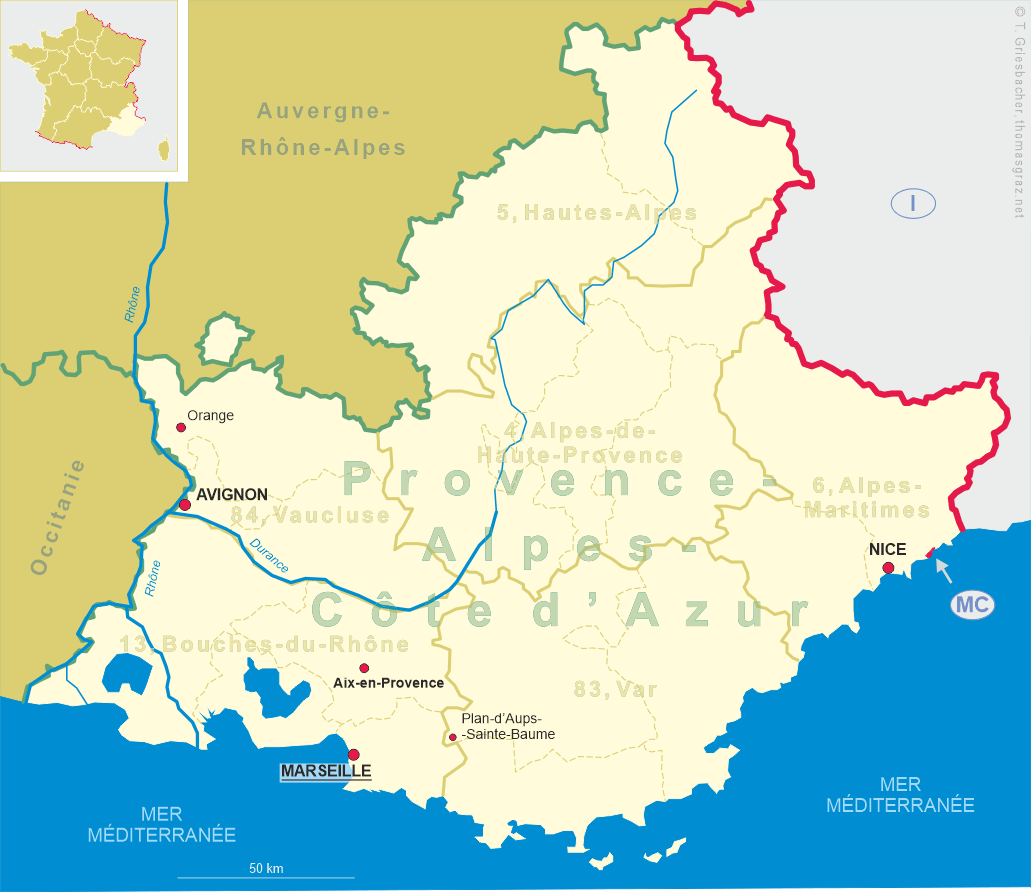
Arles is situated on the left, east, bank of the river Rhône, about 24 km upstream its mouth into the Atlantic. Just upstream of Arles, the river forks into two branches forming the Camargue delta. Because the Camargue is for a large part administratively part of Arles, the commune as a whole is the largest (758.93 km²) in Metropolitan France. The municipality has a population of about 51,800 (2023).
Arles was called Arelas or Arelate in antiquity (Celtic for "marshy place") and was probably first founded by the Salluvii. In the 6th century BC, the city of Massalia (modern-day Marseille), founded by Greek settlers, established a market place on this site. Toward the end of the 2nd century BC, the area came under Roman control and was established in 46 BC as the Roman military colony Colonia Iulia Paterna Arelate Sextanorum. The town soon rose to great importance, becoming a municipium in 22 BC, competing with Massalia in trade, and reaching its zenith under Emperor Constantine I, who enlarged and embellished Arles. In the 4th and 5th centuries AD, the city served several times as a residence of Roman emperors and was temporarily known as Constantia. In 395, it became the capital of Gaul. Then, in 402, the Praefectura Galliarum, the highest authority of the Western Roman Empire, was moved from Trier to Arles. Arles became a bishopric in the 3rd century and the metropolitan see of the Archdiocese of Arles in 400. In the late 5th century, the city served for a time as the residence of the Visigothic kingdom, in 508, it fell to the Ostrogothic kingdom and in 536 to the Frankish kingdom. In 879, Arles became the capital of the Kingdom of Burgundy and, with it, joined the Holy Roman Empire in 1033. From 933, the city was under the rule of the archbishop, becoming independent from him in 1220 and briefly a Free Imperial City in 1237. In 1251, the city submitted to Charles of Anjou and, in 1481, along with the County of Provence, fell to France. The archbishop moved to Aix-en-Provence in 1801/1822. Arles remained a bishopric until 1801. Arles remained economically important for many years as a major port on the Rhône. In the 19th century, the establishment of railways diminished river trade, leading to the city declining in prominence. Today, the city's main source of income is tourism.
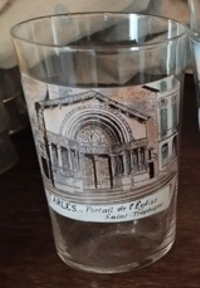
The former  Basilique primatiale Saint-Trophime [left, no. 0000] was built upon the site of
the 5th-century basilica, named for St. Stephen. The apse and the transept of the present church were probably built first, in the late
11th century, and the nave and bell tower were completed in the second quarter of the 12th century.
Though mainly notable for its outstanding Romanesque architecture and sculpture, the church contains rich groups of art from other periods,
including several important carved late Roman sarcophagi, reliquaries from various periods, and Baroque paintings.
The church is dedicated to Saint Trophime, the first bishop of Arles who died in the 3rd century.
The Archdiocese of Arles was temporarily dissolved by the Concordat of 1801. Although it was restored in 1817, this was only for five years.
The diocese was then permanently incorporated into the Archdiocese of Aix. Since then, the church has the status of a parish church.
In 1882, the church was raised to the level of a Basilica minor by Pope Leo XIII.
In 1981, it was listed by UNESCO as a World Heritage Site (see list other UNESCO World Heritage Sites
depicted on glasses of this collection).
Basilique primatiale Saint-Trophime [left, no. 0000] was built upon the site of
the 5th-century basilica, named for St. Stephen. The apse and the transept of the present church were probably built first, in the late
11th century, and the nave and bell tower were completed in the second quarter of the 12th century.
Though mainly notable for its outstanding Romanesque architecture and sculpture, the church contains rich groups of art from other periods,
including several important carved late Roman sarcophagi, reliquaries from various periods, and Baroque paintings.
The church is dedicated to Saint Trophime, the first bishop of Arles who died in the 3rd century.
The Archdiocese of Arles was temporarily dissolved by the Concordat of 1801. Although it was restored in 1817, this was only for five years.
The diocese was then permanently incorporated into the Archdiocese of Aix. Since then, the church has the status of a parish church.
In 1882, the church was raised to the level of a Basilica minor by Pope Leo XIII.
In 1981, it was listed by UNESCO as a World Heritage Site (see list other UNESCO World Heritage Sites
depicted on glasses of this collection).
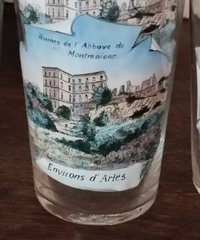
The Abbaye Saint-Pierre de Montmajour [near left, no. 0000] is located about 5 km
north of the city centre of Arles, today within the boundaries of the municipality.
Until the late Middle Ages, Montmajour was an island protected by marshes and accessible only by boat. As early as the 3rd millennium BC
the island was used as a cemetery, with individual graves carved into the rock. In the 9th and 10th centuries the island also served as a
sanctuary for the local residents during invasions of the Saracens and the Normans. During the Middle Ages, several legends arose about
Montmajour and its founding. Until 943 the island belonged to the Church of St. Trophime in Arles (see above). A monastery was founded
in the late 10 century. The first abbey church was built in 1030–1069. The second abbey church was built in the 12 century,
likely on the site of the previous one, but this church was left in ruins after the Wars of Religion (1562–1598). In 1693, the church
was given to a new Benedictine congregation, the Maurists, a Benedictine reform based at the Abbey of Saint-Germain-des-Prés in
Paris, who reconstructed the church.
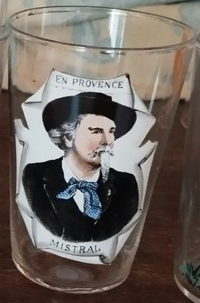
Glass no. 0000 [near left] shows a portrait of
Joseph
[https://de.wikipedia.org/wiki/Arles, https://en.wikipedia.org/wiki/Arles;
https://en.wikipedia.org/wiki/Church_of_St._Trophime,_Arles, https://de.wikipedia.org/wiki/St-Trophime_(Arles), https://fr.wikipedia.org/wiki/Basilique_primatiale_Saint-Trophime_d%27Arles,
https://en.wikipedia.org/wiki/Trophimus_of_Arles, https://de.wikipedia.org/wiki/Erzbistum_Arles;
https://en.wikipedia.org/wiki/Montmajour_Abbey]
![[scale]](lineal.jpg)