
|
|
| NEDERLAND | NETHERLANDS |
| Noord-Holland | North Holland |
map →
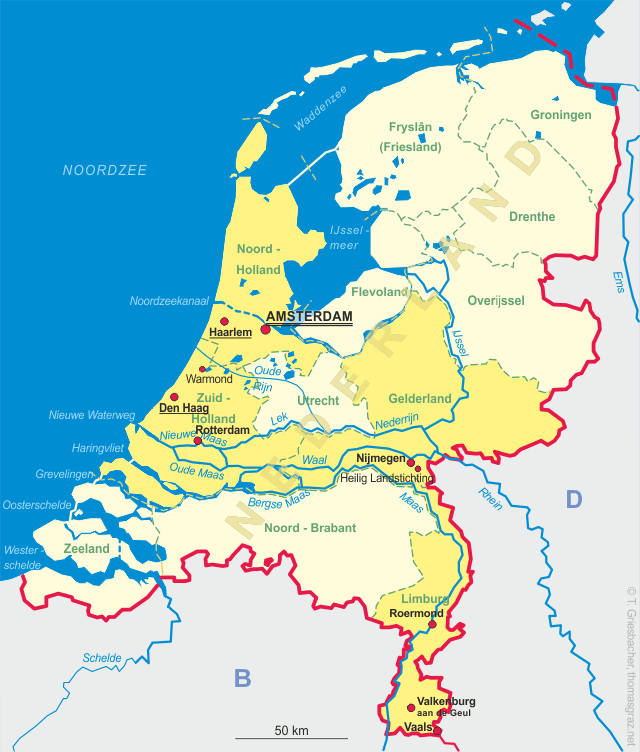
Amsterdam is the capital (though not seat of the government, which is Den Haag) and largest city of the Netherlands, located in the province of North Holland in the west of the country. The city, which had a population (including suburbs) of 1.36 million on 1 January 2008, comprises the northern part of the Randstad, the sixth-largest metropolitan area in Europe, with a population of around 6.7 million.
Amsterdam's name is derived from Amstellerdam, indicative of the city's origin: a dam in the river Amstel. Settled as a small fishing village in the late 12th century, Amsterdam became one of the most important ports in the world during the Dutch Golden Age (the 17th century), a result of its innovative developments in trade. During that time, the city was the leading centre for finance and diamonds. In the 19th and 20th centuries, the city expanded, and many new neighbourhoods and suburbs were formed. Amsterdam was selected to be European City of Culture for 1987 by the Council of the European Union. The seventeenth-century canals of Amsterdam (in Dutch: 'Grachtengordel'), located in the heart of Amsterdam, were added to the UNESCO World Heritage list in July 2010
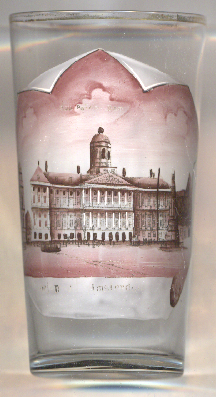
The  Royal Palace (Koninklijk Paleis) or Paleis op de Dam [left, no. 4977;]
is one of three palaces in the Netherlands which are at the disposal of the monarch by Act of Parliament. It is situated on the west side of
Dam Square in the centre of Amsterdam, opposite the War Memorial and next to the Nieuwe Kerk. The palace building was commissioned by as a
large-scale construction project for a new stadhuis (city hall), even before the old one burned down in 1652, and was completed in 1656. The
main architect was Jacob van Campen, who took control of the construction project in 1648. During the Batavian Republic (1795–1806),
the public floors of the building became the first Amsterdam museum under Louis Bonaparte. When Bonaparte was made king by Napoléon I,
the building was used as the royal palace. After the fall of Napoleon, it became a palace of the Dutch Royal House. The public floors still
function as a museum and are open to the public most days of the year. It was completed in 1656.
Royal Palace (Koninklijk Paleis) or Paleis op de Dam [left, no. 4977;]
is one of three palaces in the Netherlands which are at the disposal of the monarch by Act of Parliament. It is situated on the west side of
Dam Square in the centre of Amsterdam, opposite the War Memorial and next to the Nieuwe Kerk. The palace building was commissioned by as a
large-scale construction project for a new stadhuis (city hall), even before the old one burned down in 1652, and was completed in 1656. The
main architect was Jacob van Campen, who took control of the construction project in 1648. During the Batavian Republic (1795–1806),
the public floors of the building became the first Amsterdam museum under Louis Bonaparte. When Bonaparte was made king by Napoléon I,
the building was used as the royal palace. After the fall of Napoleon, it became a palace of the Dutch Royal House. The public floors still
function as a museum and are open to the public most days of the year. It was completed in 1656.
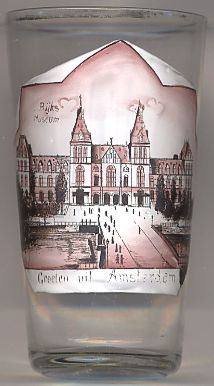
The Rijksmuseum [left, no. 2604],
a Dutch national museum, is located on the Museumplein. The museum is dedicated to arts, crafts, and history. It has a large collection of paintings from the
Dutch Golden Age and a substantial collection of Asian art. It also displays the stern of the HMS Royal Charles which was captured in the Raid on the Medway in 1667.
The museum was founded in 1800 in Den Haag (The Hague) to exhibit the collections of the Dutch stadtholders. It was inspired by French example. By then it was known as
the National Art Gallery (Dutch: Nationale Kunst-Gallerij). In 1808 the museum moved to Amsterdam on the orders of King Louis Napoléon Bonaparte (Lodewijk I),
brother of Napoléon Bonaparte. The paintings owned by that city, such as The Night Watch by Rembrandt, became part of the collection.
In 1863 there was a design contest for a new building for the Rijksmuseum, but none of the submissions was considered to be of sufficient quality. Pierre Cuypers also
participated in the contest and his submission reached the second place. In 1876 a new contest was held, and this time Pierre Cuypers won. The design was a combination of
Gothic and Renaissance elements. The construction began on October 1, 1876. On both the inside and the outside, the building was richly decorated with references to
Dutch art history. Another contest was held for these decorations. The winners were Bart van Hove and Frantz Vermeylen for the sculptures, Georg Sturm for the tile tableaus
and painting and W.F. Dixon for the stained glass. The museum was opened at its new location on July 13, 1885.
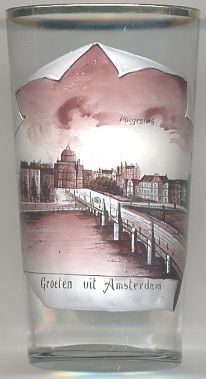
The Hogesluis ('Tall Lock', bridge no. 246) [near left, no. 2680: foreground right]
is a monumental double bascule bridge spanning the river Amstel as part of Saphartistraat. It was built in 1883 by the Amsterdam city architect
Willem H. Springer, replacing an older bridge from the 17th century.
The Paleis voor Volksvlijt ('Palace of Industry') [near left, no. 2680: foreground right]
was a large glass building on the Frederiksplein in Amsterdam.
It was built in 1855–1864 by the architect Cornelis Outshoorn, inspired by the Crystal Palace in London.
After the Amsterdam physician and city planner Samuel Sapharti had visited the Great Exhibition (World Fair) of 1851 in London, he founded the Association of Industry
with the aim of achieving for Amsterdam a building similar to the Crystal Palace. When the Amsterdam city council approved the petition for such a building
in 1855, a competition was held in the following year; however, none of submitted designs were chosen. Instead, Outshoorn was commissioned with the
design of the building. Construction began in 1859 and the building was opened in 1864. The square immediately adjacent to the Palace of Industry (on the picture
on glass no. 2680 hidden by the block of houses to the left of the Palace of Industry) was enclosed on the three other sides by a gallery of shops.
The Palace of Industry was destroyed by fire in 1929 and was not rebuilt. The gallery houses were largely spared from the fire but in 1960 were replaced
by the building of the Nederlandsche Bank. Since the Nederlandsche Bank has lost many of its functions since the introduction of the Euro, there are now petitions
to rebuild the Palace of Industry. In 2002 even a Foundation for Reconstruction and Exploitation of the Palace of Industry was established.
A replica of a small part of the Palace of Industry was included in the new wing of Amsterdam Schiphol Airport.
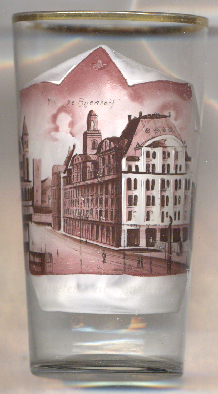
The department store De Bijenkorf, depicted on glass no. 4978 [left], is the
flagship store of the De Bijenkorf chain on Dam Square in central Amsterdam. De Bijenkorf was founded in 1870, starting as a
small haberdashery shop at Nieuwendijk, one of Amsterdam's oldest streets and to this day a main shopping street. Initially limited to yarn
and ribbons, and employing a staff of four, the stock expanded gradually. In 1909, it was decided to replace the separate buildings with new
construction on the site at Nieuwendik. In 1912, a temporary wooden building was occupied on the vacant site of the former Zocher Stock Exchange
on the Damrak, initially with the intention of returning to the Nieuwendijk after the completion of the new building. However, because business
developed particularly favorably on the Damrak, it was decided to remain at this location. The haberdashery shop was converted into a department
store, partly because this was more favorable for securing financing from mortgage banks. Due to the scarcity of building materials during the
World War I, construction was delayed somewhat, meaning the department store could not open until 1915. Today, the chain is owned by
Selfridges Group.
[http://en.wikipedia.org/wiki/Amsterdam;
https://en.wikipedia.org/wiki/Royal_Palace_of_Amsterdam;
http://en.wikipedia.org/wiki/Rijksmuseum_Amsterdam;
http://nl.wikipedia.org/wiki/Hogesluis;
http://nl.wikipedia.org/wiki/Paleis_voor_Volksvlijt;
https://en.wikipedia.org/wiki/De_Bijenkorf, https://nl.wikipedia.org/wiki/De_Bijenkorf_(warenhuis)]
![[scale]](lineal.jpg)