
|
|
| DEUTSCHLAND | GERMANY |
| Bundesland: Freistaat Thüringen | Thuringia |
| Landkreis: Schmalkalden-Meiningen |
map →
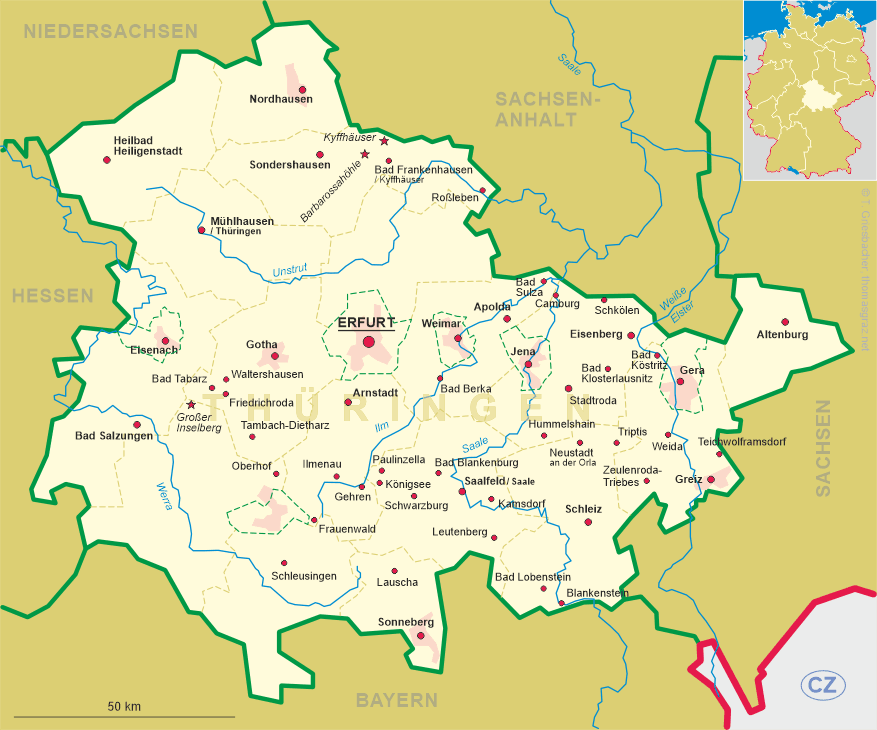
Meiningen is situated at an elevation of 287 m on the river Werra in the eastren foothills of the Rhön mountains, about 63 km southwest of Erfurt, the capital of Germany's state of Thuringia. Meiningen is the adinistrative seat of the district Schmalkalden-Meiningen. The municipality has a population of about 25,000 (2024).
Meiningen (…in villis Meininga in Meiningermarca…) was first mentioned in the year 982. The village was
first a crown land in the Duchy of Franconia and later a possession of the king. In 1008 Emperor Heinrich II
donated it to the Catholic diocese of Würzburg. In 1222, Würzburg and the
House of Henneberg fought for possession of Meiningen. Meiningen was first mentioned in 1230 as a town and was
granted wide-ranging autonomy in 1344. The town joined together with ten other towns of the bishopric of
Würzburg and participated in 1396–1399 in the "Franconian town war" against the diocese. However,
Meiningen was forced to capitulate in 1399. In 1583, with the extinction of the Henneberg family, the town went
to the Wettin family. Between 1680 and 1918, Meiningen was the capital of the Duchy of Saxe-Meiningen.
In the reshuffle of Ernestine territories that occurred following the extinction of the
Saxe-Gotha-Altenburg line in 1825, Duke Bernhard II
of Saxe-Meiningen received the lands of the former Duchy of Saxe-Hildburghausen (which in turn was given
Altenburg) as well as the Saalfeld territory of the former duchy of
Saxe-Coburg-Saalfeld (compare maps of the Thuringian states in
1815 and 1826).
The Duchy was abolished at the end of World War I in 1918. Meiningen then became the capital of the
Free State of Saxe-Meiningen. From 1920, it was a district town in the newly created state of Thuringia.
During the period of the German Democratic Republic, from 1952 to 1990, Meiningen, as the district capital
of the Meiningen district, belonged to the Suhl district. After German reunification in 1990, Meiningen became
the district town of Schmalkalden-Meiningen.
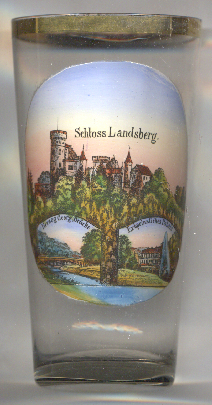
 Landsberg castle [left, no. 4926: top picture] was built
on the ruins of Landeswehre castle, which was destroyed in the Peasants' War, between 1836 and 1840 and is
located on the northern outskirts of the district town of Meiningen on a 378-meter-high mountain cone that
juts into the Werra valley between the Meiningen district of Walldorf and Meiningen. The castle is a neo-Gothic
building modeled after 19th-century English aristocratic residences. It consists of three parts: the castle
itself with three towers, the gatehouse, and the steward's house. The complex is surrounded by a crenellated
wall.
Landsberg castle [left, no. 4926: top picture] was built
on the ruins of Landeswehre castle, which was destroyed in the Peasants' War, between 1836 and 1840 and is
located on the northern outskirts of the district town of Meiningen on a 378-meter-high mountain cone that
juts into the Werra valley between the Meiningen district of Walldorf and Meiningen. The castle is a neo-Gothic
building modeled after 19th-century English aristocratic residences. It consists of three parts: the castle
itself with three towers, the gatehouse, and the steward's house. The complex is surrounded by a crenellated
wall.
The bridge Georgsbrücke [left, no. 4926: bottom left picture]
spans the Werra River and is considered the oldest surviving reinforced concrete bridge in Germany built
according to the "Melan system". The original name of the bridge was Herzog-Georg-Brücke
– after Duke Georg II of Saxe-Meiningen (r. 1866–1914). The bridge was built in 1899
as the second reinforced concrete bridge in Germany constructed as an arch structure consisting of iron truss
girders reinforced in concrete, a system devised by the Austrian engineer Joseph Melan – the first bridge
of this type was built in Königsberg, East Prussia (today Kaliningrad), where it
collapsed during a load test. The bridge has a span of 40 metres and a total length of 63 metres.
To protect the bridge and due to the narrow roadway, traffic today is managed in a one-way system in both
directions, controlled by traffic lights. The bridge is a listed historical monument.
The Großes Palais (Grand Palace), also known as
Erbprinzenpalais (Hereditary Prince's Palace) [left, no. 4926: bottom right picture] is located in the city center, not far from the
old town and on the edge of the English Garden. The palace was built between 1821 and 1823 in the Neoclassical
style by the architect Johann Andreas Schaubach as a widow's palace. In 1863, a renovation and expansion took
place, and the building received its dominant and representative form in the Neo-Renaissance style, which it
still has today. After the forced abdication of Duke Bernhard II in 1866, the palace became his residence.
In 1890, the former Hereditary Prince (since 1866 Duke) Bernhard III took up residence in the palace. Even after the
end of the duchy in 1918, it remained in the possession of the House of Saxe-Meiningen until 1945. The palace
survived World War II unscathed. After the expropriation of the ducal estates, it initially housed a
teacher training college. Subsequently, the Meiningen district administration moved in. The building served as
the district council from 1952 until 1999. After standing empty for several years, the building underwent
extensive renovations from 2007 to 2009. Since then, it has housed a health center with several medical practices
and other healthcare facilities.
[https://de.wikipedia.org/wiki/Meiningen, https://en.wikipedia.org/wiki/Meiningen;
https://en.wikipedia.org/wiki/Saxe-Meiningen;
https://de.wikipedia.org/wiki/Schloss_Landsberg_(Meiningen);
https://de.wikipedia.org/wiki/Georgsbr%C3%BCcke_(Meiningen);
https://de.wikipedia.org/wiki/Gro%C3%9Fes_Palais_(Meiningen)]
![[scale]](lineal.jpg)