
|
|
| DEUTSCHLAND | GERMANY |
| Bundesland: Baden-Württemberg | |
| Regierungsbezirk: Karlsruhe | |
| Landkreis: Rastatt |
map →
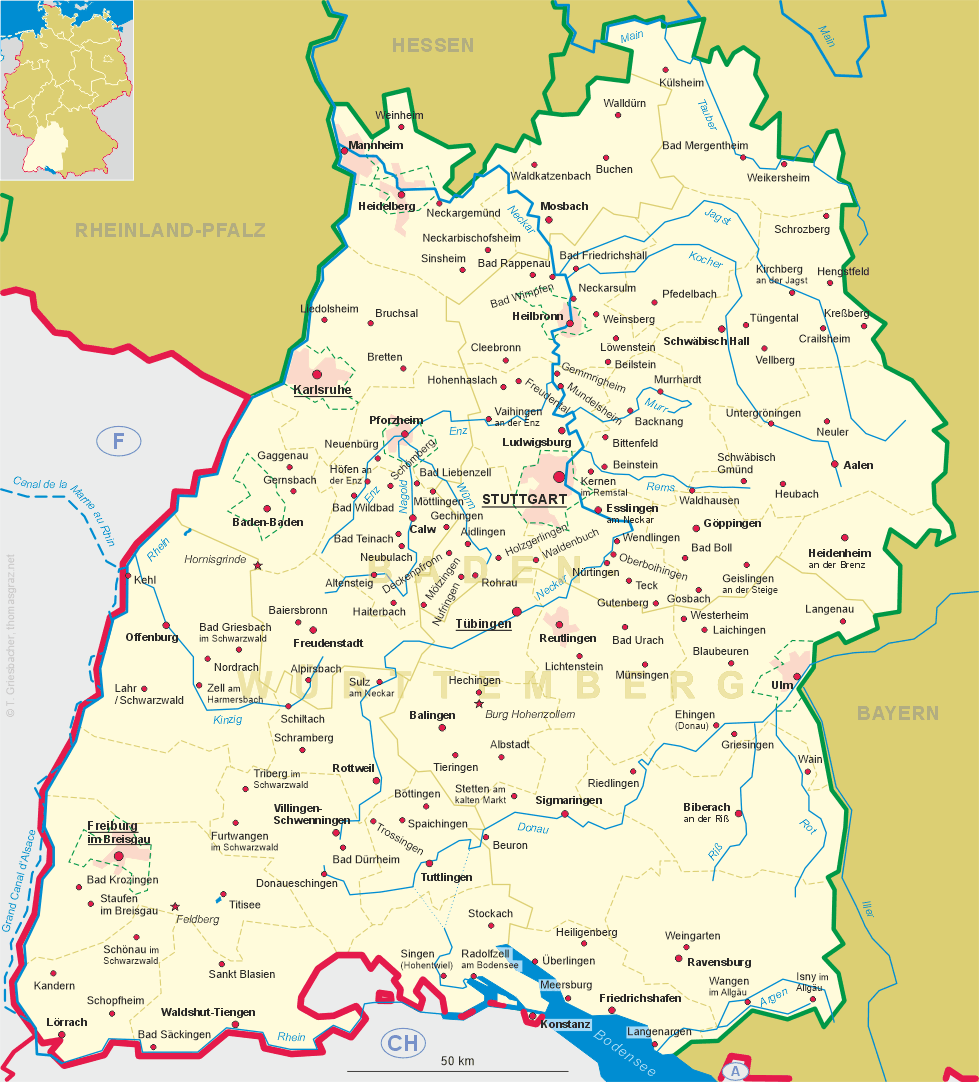
Bühl is situated at an elevation of 138 m at tha edge of he Schwarzwald region of Germany's state of Baden-Württemberg, about 11 km southwest of Baden-Baden, about 40 km southwest of Karlsruhe and about 50 km west of Baden-Württemberg's capital, Stuttgart. The municipality has a population of about 28,600 (2024).
The earliest confirmed mention of Buhel dates from 1283. The privilege as a market place was granted in 1403.
During the Thirty Years' War (1618–1648) Bühl was occupied and looted several times (in 1622, 1632–1634,
and 1632). The town was destroyed again during the War of the Palatine Succession in 1689. In 1776 the town in its entirety
became part of the Margraviate of Baden. In 1813 it became the administrative seat of a district. In 1846, Bühl was
connected to the newly opened railway line between Oos and Offenburg. The district (Landkreis)
 Bühl was dissolved in 1973; Bühl and the northern part of the former district became part of the newly created
district Rastatt while the southern part of the district became part of the Ortenaukreis district (with seat in Offenburg).
Bühl was dissolved in 1973; Bühl and the northern part of the former district became part of the newly created
district Rastatt while the southern part of the district became part of the Ortenaukreis district (with seat in Offenburg).
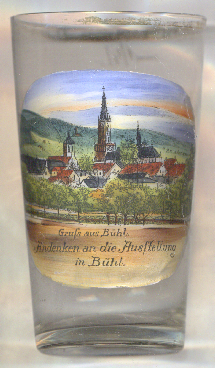
The  minster church of St. Peter and Paul [left, no. 4960: background
centre] was built in the Neo-Gothic style in 1872–1877 by the architect Karl Dernfeld in place of an older
church that had been built between 1514 and 1524. The church was severely damaged during World War II. Much of the
Neo-Gothic furnishings and paints were removed during restorations works carried out between 1952 and 1958.
minster church of St. Peter and Paul [left, no. 4960: background
centre] was built in the Neo-Gothic style in 1872–1877 by the architect Karl Dernfeld in place of an older
church that had been built between 1514 and 1524. The church was severely damaged during World War II. Much of the
Neo-Gothic furnishings and paints were removed during restorations works carried out between 1952 and 1958.
Glass no. 4960 is labeled Andenken an die Ausstellung in Bühl ('Souvenir from the Exhibition at Bühl'),
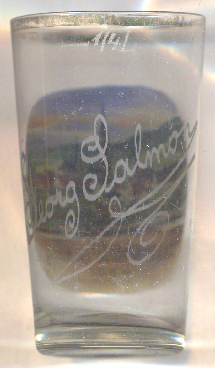
probably refering to the "Gewerbeausstellung" (trade fair) of 1905. The glass is engraved on the back side with the name
Georg Salmon.
[https://en.wikipedia.org/wiki/B%C3%BChl_(Baden);
https://de.wikipedia.org/wiki/St._Peter_und_Paul_(B%C3%BChl)]
![[scale]](lineal.jpg)