
|
|
| DEUTSCHLAND | GERMANY |
| Bundesland: Sachsen-Anhalt | Saxony-Anhalt |
| Landkreis: Burgenlandkreis |
map →
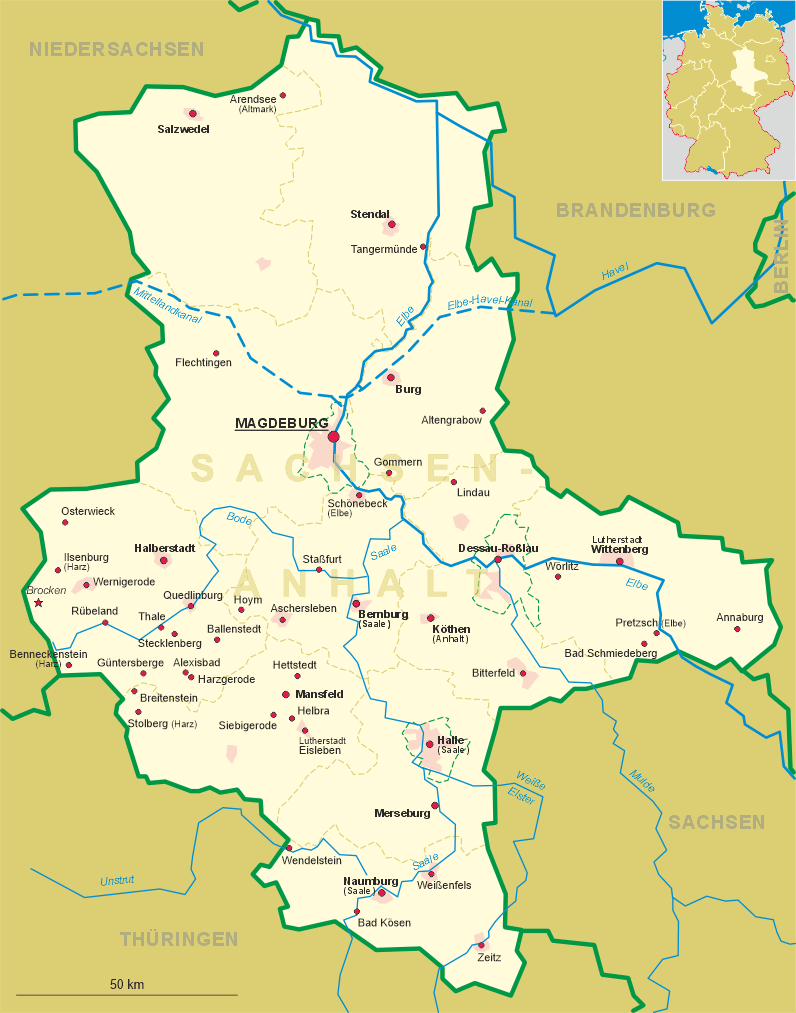
Bad Bibra is situated at an elevation of 152 m in the valley of the Biberbach stream, about 17 km northwest of the district town Naumburg (Saale) and about 101 km south of Magdeburg, the capital of Germany's state of Saxony-Anhalt. The municipality has a population of about 2,500 (2025).
 Bibraho was first mentioned at the beginning of the 9th century in a register of the monastery of Hersfeld.
In the 10th century (after 919), a castle belonging to the royal Old Saxon dynasty of the Liudolfings stood here. In 963, a Benedictine
monastery was founded here, but which, around 1107 or perhaps even earlier, was replaced by an Augustinian Canons Regular monastery. Bibra
obtained the privileges of a market town in 1124. The monastery was dissolved during the Reformation. From 1485 it was part of the Albertine
Duchy, and from 1547 of the Electorate of Saxony. In 1656/57, the district, along with Bibra itself, fell to the Duchy of
Saxe-Weißenfels. After that, Bibra developed into a fashionable spa town of the duchy. In 1831, Bibra obtained
the status of a town. Spa tourism flourished again in the 19th century. the predicate Bad ('spa') was added to the official name
of the town in 1925. From 1952 to 1994, Bad Bibra was part of the district Nebra (from 1952 to 1990 in the GDR district of
Halle, and then, after the german re-unification, in the state of Saxony-Anhalt). Since the district reform of 1994,
the town has been part of the Burgenland district.
Bibraho was first mentioned at the beginning of the 9th century in a register of the monastery of Hersfeld.
In the 10th century (after 919), a castle belonging to the royal Old Saxon dynasty of the Liudolfings stood here. In 963, a Benedictine
monastery was founded here, but which, around 1107 or perhaps even earlier, was replaced by an Augustinian Canons Regular monastery. Bibra
obtained the privileges of a market town in 1124. The monastery was dissolved during the Reformation. From 1485 it was part of the Albertine
Duchy, and from 1547 of the Electorate of Saxony. In 1656/57, the district, along with Bibra itself, fell to the Duchy of
Saxe-Weißenfels. After that, Bibra developed into a fashionable spa town of the duchy. In 1831, Bibra obtained
the status of a town. Spa tourism flourished again in the 19th century. the predicate Bad ('spa') was added to the official name
of the town in 1925. From 1952 to 1994, Bad Bibra was part of the district Nebra (from 1952 to 1990 in the GDR district of
Halle, and then, after the german re-unification, in the state of Saxony-Anhalt). Since the district reform of 1994,
the town has been part of the Burgenland district.
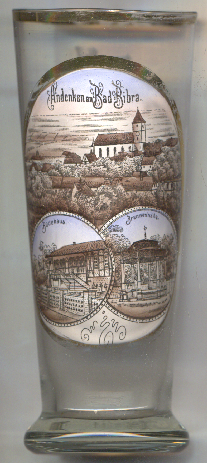
The  church of Sankt Maria Magdalena [left, no. 5020: top picture] goes back to a previous
church of the Augustinian Canons' monastery, of which the west tower has been preserved. An inscription dates the tower to the year 1402.
Between 1868 and 1871, it was integrated into the present-day neo-Gothic church building.
church of Sankt Maria Magdalena [left, no. 5020: top picture] goes back to a previous
church of the Augustinian Canons' monastery, of which the west tower has been preserved. An inscription dates the tower to the year 1402.
Between 1868 and 1871, it was integrated into the present-day neo-Gothic church building.
The other two pictures on the glass show views of two spa buildings:
The Badehaus (bathhouse), which was originally established in the 17th century,, rebuilt in 1713, and
finally replaced by the current structure in 1874.
The Brunnenhalle (spring hall) houses the mineral spring that was first sourced in 1686. The entrance portal
bears an inscription that dates it to 1779. The characteristic reddish-brown-colored water of the spring owes its color to the high iron oxide
content.
[https://de.wikipedia.org/wiki/Bad_Bibra;
https://pages.et4.de/de/saale-unstrut-tourismus/streaming/detail/Tour/t_100267198/stadtrundgang-bad-bibra;
https://www.thueringer-wald.com/w/opendata/poi/gesundbrunnen-bad-bibra-historisches-wahrzeichen-und-kurtradition]
![[scale]](lineal.jpg)