
|
|
| DEUTSCHLAND | GERMANY |
| Bundesland: Freistaat Sachsen | Saxony |
| Landkreis: Nordsachsen |
map →
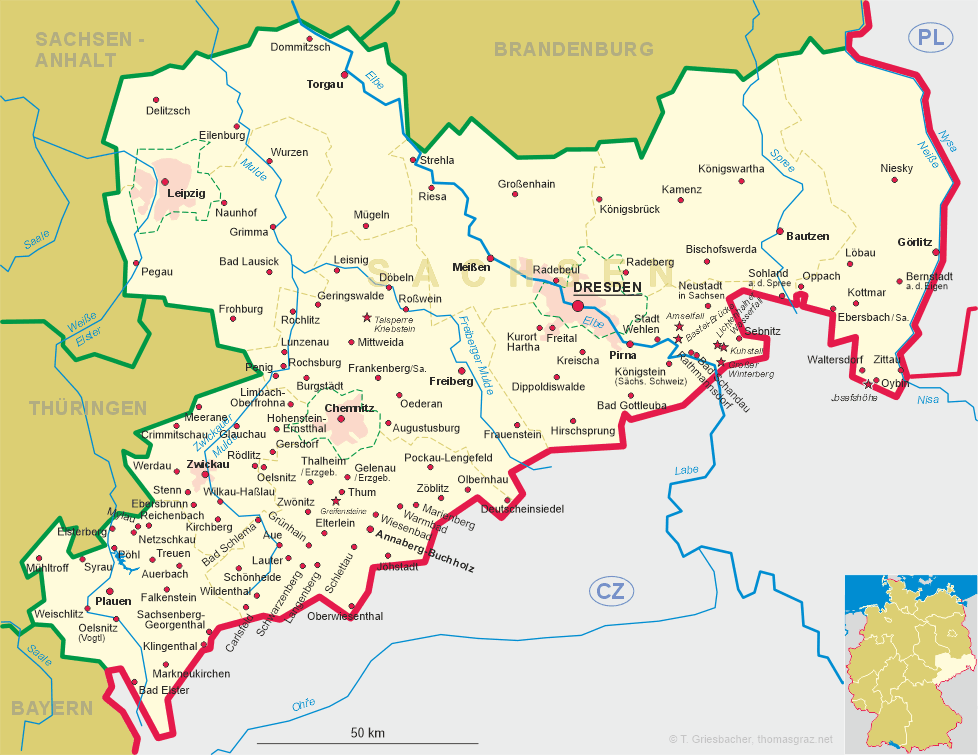
Oschatz is situated at an elevation of 120 m on the river Döllnitz in northern Saxony, about 30 km south-southeast of the district town Torgau, about 51 km east of Leipzig, and about 53 km northwest of Dresden, the capital of German's state of Saxony. The municipality has a population of about 14,100 (2025).
The area of the present-day town has been settled since Neolithic times. The first written mention of Ossestz dates from 1200, however the association to Oschatz is uncertain. The first definite mention of the town dates from 1238, as Ozzechz is mentioned in a document from the Henry III, Margrave of Meißen. In 1344, the civic army known as "Die Geharnischten" was mentioned for the first time by the urban league of Oschatz, Torgau, and Grimma. A fort in Oschatz was first mentioned in 1377, and the town received market rights in 1394. During the Reformation Oschatz, like many towns in the region, turned Protestant. A large fire destroyed large parts of the town in 1616. The town was looted several times during the Thirty Years' War (1618–1648). With the completion of the “Zschöllau/Oschatz” railway station in 1838, the town gained a connection to the first long-distance railway in Germany — the Leipzig–Dresden Railway, which was then still under construction and was finally completed in 1839. Zschöllau was merged into Oschatz in 1934, followed by Altoschatz and Striesa in 1950, Lonnewitz in 1973, Merkwitz, Schmorkau and Thalheim in 1974, and Limbach and Leuben in 1994. The districts Torgau and Oschatz were merged into the current district Torgau-Oschatz in 1994.

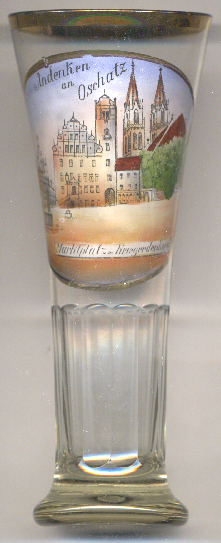

The  town hall [background left] was built between 1538 and 1546 on the site of a private house
that the city had acquired in 1477 and used as a town hall. Following the fire of 1842, the structure was rebuilt according to plans by
Gottfried Semper; during this process, the tower was raised by several stories, while the stepped gable was reduced by one storey.
The church of Sankt Aegidien [background right] goes back to a church that was founded most
likely in the 11th century. The oldest extant structural components of the present church — the perimeter walls, piers,
and several other architectural elements &mash; originate from an early stone church building dating back to the 14th century.
This earlier church was completely destroyed during the Hussite invasion in 1429. Reconstruction began in 1443 in the Gothic style, featuring
two towers. In 1464, the Gothic crypt was built beneath the altar choir. Following the large fire of 1842, the current, imposing structure was
built between 1846 and 1849, essentially as a new construction—in the Neo-Gothic style, featuring two towers 75.7 meters in height, based
on designs by the Nuremberg architect Carl Alexander Heideloff.
The Fountain in Neumarkt (previously Marktplatz) [foreground left], was created in 1589.
The picture on glass no. 5072 is labelled Marktplatz m[it] Kriegerdenkmal (Market Square with Sodiers' Monument), but the
monument is not really visible in the image.
[https://de.wikipedia.org/wiki/Oschatz, https://en.wikipedia.org/wiki/Oschatz]
