
|
|
| ČESKÁ REPUBLIKA | CZECH REPUBLIC |
| Plzeňský kraj | Plzeň region |
| Okres: Domažlice |
map →
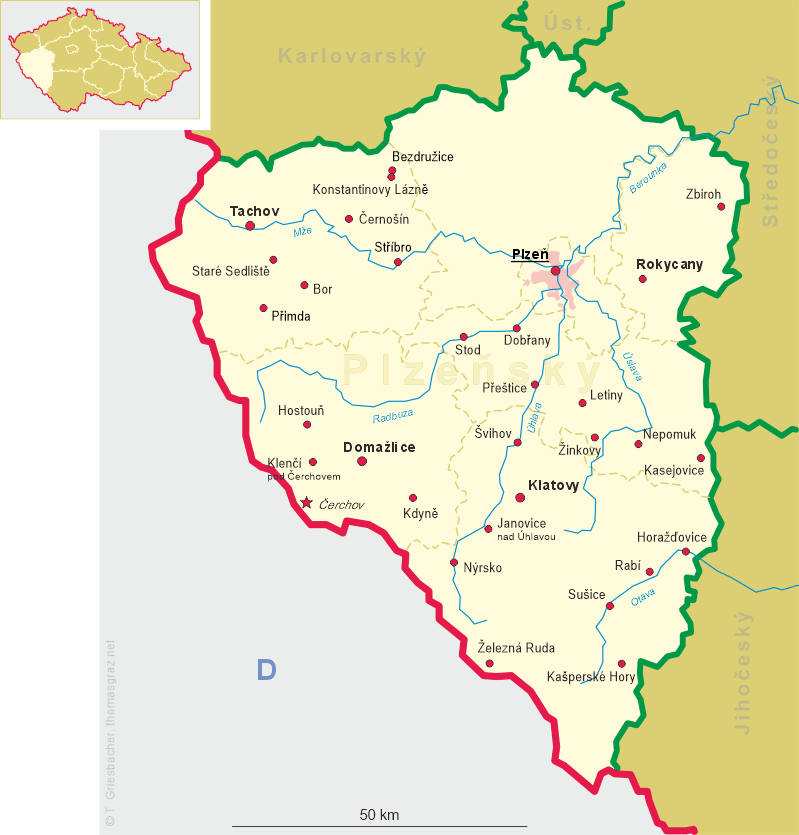
 Domažlice is situated at an elevation of 422 m in the foothills of the Šumava (Bohemian Forest) mountains
of western Bohemia.
Domažlice is situated at an elevation of 422 m in the foothills of the Šumava (Bohemian Forest) mountains
of western Bohemia.
The earliest mention of the village dates from 1231. In 1262–1265 Domažlice was fortified as a town by order of King Přemysl Otakar II for the purpose of protecting the border with Bavaria. The Chodes (free farmers) who settled in this area were recruited as border guards. The town was pawned to Bavaria in 1331, lasting, with some interruptions, until 1419. During the Hussite period, the German citizens were expelled from Domažlice (German: Taus) and since then the population was predominantly Czech. In 1431, the Hussite general Andreas Prokop (a.k.a. Prokop the Great or Prokop the Bald) defeated the crusaders of the Holy Roman Empire near Domažlice. During the 15th and 16th century Domažlice changed hands frequently, and its importance diminished after the Thirty Years' War (1618–1848). It was not until 1770 that it recovered, largely due to the development of textile industry. In 1850 Domažlice became the administrative seat of the district of the same name.
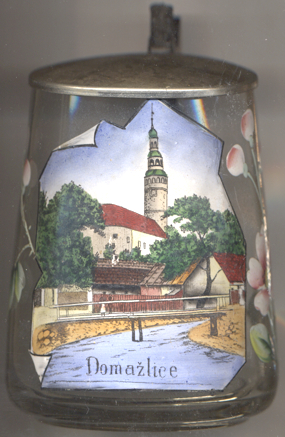

The  Chodes' castle [left and below left, nos. 4706 and 546; and near right and far right,
nos. 2854 and 612: top pictures] dates back to the 13th century.
After a thorough renovation the castle was opened again to the public and today houses a museum on the history,
ethnography and nature of the region.
Chodes' castle [left and below left, nos. 4706 and 546; and near right and far right,
nos. 2854 and 612: top pictures] dates back to the 13th century.
After a thorough renovation the castle was opened again to the public and today houses a museum on the history,
ethnography and nature of the region.
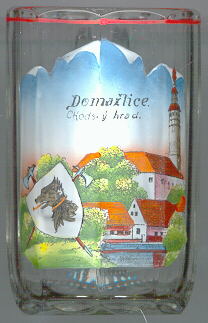
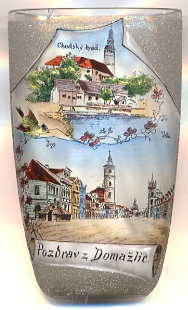
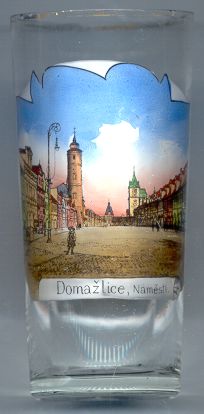

The early Gothic deanery church of the Nativity of Our Lady [left, no:1756, and right, no. 4731: left,
also above right, nos. 2854 and 612: bottom picture: left]
dates from the 13th century. The cylindrical tower has a height of 56 m and is a popular landmark of Domažlice.
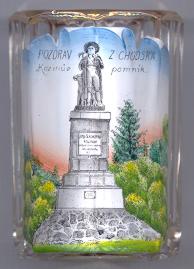
The monument for Jan Sladký Kozina [near left, no. 722]
on the Hrádek hill at Újezd near Domažlice was erected in 1895. Kozina (1652–1695) was made famous
by the book Psohlavci by Alois Jirásek which was published in 1885. Kozina was a leader of the Chodes in their struggle
to retain their traditional privileges. Kozina was executed in 1695 in Plzeň.
Next to him the monument also shows the typical Chodsko dog.
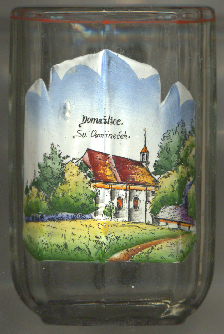
The chapel of St. Lawrence (kostel svatého Vavřince)
[near left, no. 4937] is a well-known pilgrimage church located on Veselá hora about
2.5 kilometers southwest of Domažlice. The church is protected as a cultural monument.
According to legend, the first chapel on this site was built by Prince Boleslav I in memory of the victory over the
Hungarians after their defeat in 995. However, the only documented chapel was built in connection with the fire that struck
Domažlice in 1683. Construction began in 1685 and the chapel was consecrated in 1695. Later, the chapel began to fall
into disrepair and was completely closed in 1761. Its reconstruction and expansion at the city's expense resulted in a Baroque
church, consecrated in 1775. However, as part of the reforms of Emperor Joseph II, it was already closed in 1788, sold at
auction and used as a barn. In 1810, its exterior and interior were repaired, but it was not consecrated again until another
repair in 1851. Since then, a pilgrimage has been held there every year, which over time has become the most important
pilgrimage in the Chodsko region. Pilgrimages were held here until 1949, after which they were banned again by the communist
regime. The first pilgrame event after that could only take place in 1968/1969 and the tradition could then be resumed in
1990 and gradually became the largest church event in the Chodsko region.
[https://cs.wikipedia.org/wiki/Kostel_svat%C3%A9ho_Vav%C5%99ince_(Doma%C5%BElice)]
![[scale]](lineal.jpg)