
|
|
| DEUTSCHLAND | GERMANY |
| Bundesland: Baden-Württemberg | |
| Regierungsbezirk: Tübingen | |
| Landkreis: Alb-Donau-Kreis |
map →
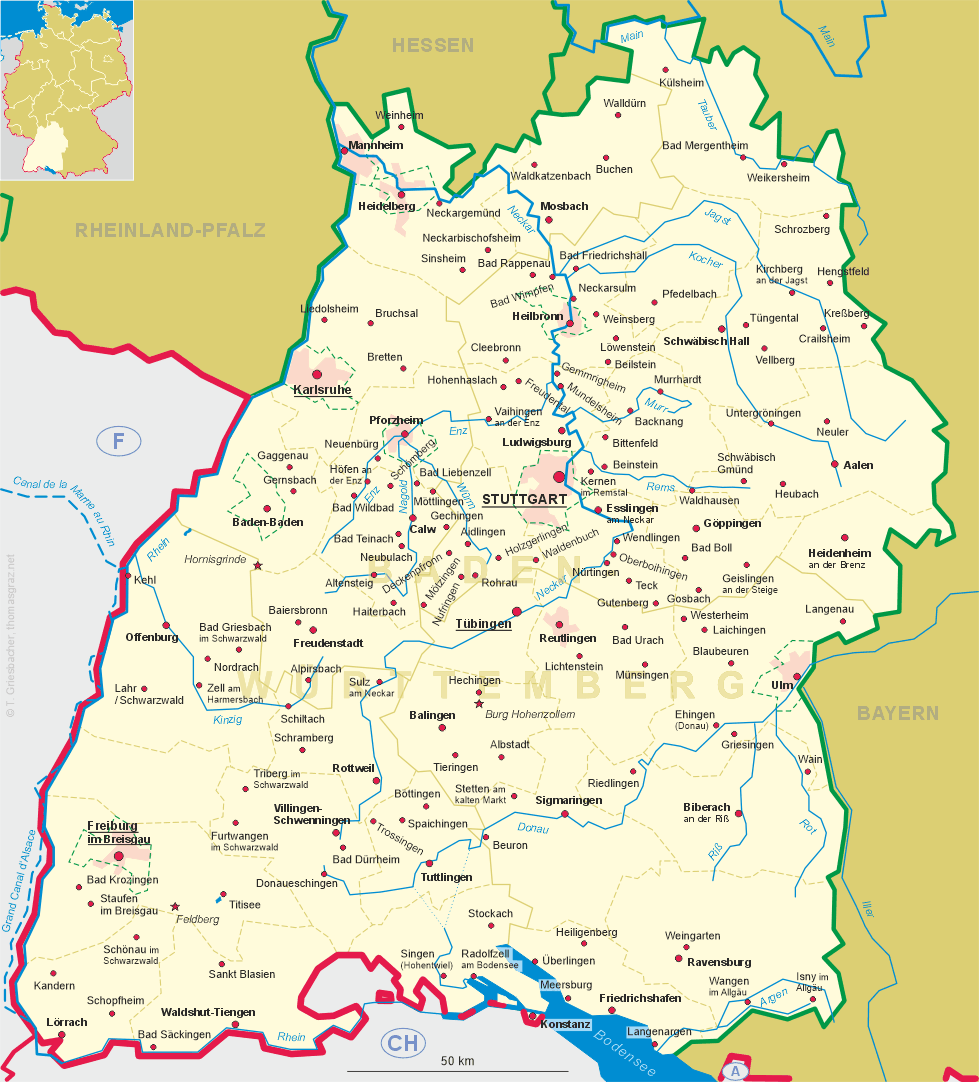
Ehingen is situated at an elevation of 515 m on the Schmiech stream near its mouth into the river Danube in the southeast of Germany's state of Baden-Württemberg, about 24 km southeast of Ulm, the administrative seat of the Alb-Donau district, about 56 km southwest of Tübingen and about 69 southwest of Baden-Württemberg's capital, Stuttgart. The municipality has a population of about 202,400 (2024).
Ehinga was first mentioned in a written document dating from the year 961 and most likely waslocated what today is known as the Lower Town, while Berkach, today also part of Ehingen, had already been mentioned in 787. The new town was founded by the Counts of Berg-Schelklingen next to their castle above the Schmiech stream. It is belived that it obtained the privileges of a town in 1253 or 1267. In 1346 the town came in possession of the house of Habsburg and for more than 300 years remained part of Austria Anterior (see map). When Austria lost the war against Napoleon, Anterior Austria was ceased to the French allies accoring to the Peace Treaty of Pressburg (Bratislava) in 1805. Ehingen subsequently became part of the newly-founded Kingdom of Württemberg in 1806.
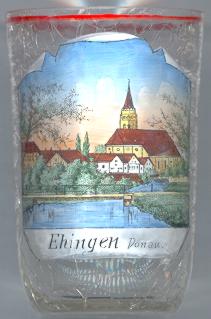
The  catholic parish church Sankt Blasius [left, no. 740: background right]
was built in the 15th century and incorporates some parts of an older church of the 14th century.
The church was rebuilt in Baroque style between 1736 and 1758. The church tower, rebuilt in 1888, was restored in 1958.
catholic parish church Sankt Blasius [left, no. 740: background right]
was built in the 15th century and incorporates some parts of an older church of the 14th century.
The church was rebuilt in Baroque style between 1736 and 1758. The church tower, rebuilt in 1888, was restored in 1958.
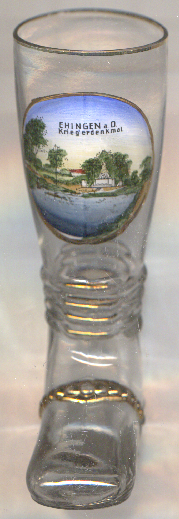
The soldiers' monument at the Groggensee [near left, no. 5011: background right] was
originally designed by the sculptor Franz Sieferle. After several modifications, the monument was inaugurated on 1 July 1934.
[https://de.wikipedia.org/wiki/Ehingen_(Donau);
https://www.ehingen.de/kultur-freizeit/galerien-museen-stadtgeschichte/stadtgeschichte;
https://www.ehingen.de/kultur-freizeit/galerien-museen-stadtgeschichte/stadtarchiv/kriegerdenkmal]
![[scale]](lineal.jpg)