If you came to this page directly and do not see a navigation frame on top, please go to the home page.
| ÖSTERREICH | AUSTRIA |
| Bundesland: Wien | Vienna |
| 1. Bezirk, Innere Stadt | 1st district, Inner City |
The Hofburg (Imperial Palace) was the seat of the Austrian sovereigns from the 13th century up until 1918.
Around 1215/1220 it became the new residence of the Babenbergs (Duke Leopold VI of Austria), and was used also by
King Ottokar II and Rudolf of Habsburg, and was enlarged and extended throughout the following centuries.
The Hofburgkapelle (palace chapel) was first mentioned in 1296 and was rebuilt in 14471449.
The Schweizertrakt, which received its current form in the Renaissance period (Schweizertor gate, 1552/53),
houses the world-famous treasury with the insignia of the Holy Roman Empire, the insignia of the House of Habsburg
(after 1804 the insignia of the Austrian Empire) and numerous other precious items.
The Stallburg stables were built 15581568 is home of the famous Spanish Riding School (existing since 1572),
the Winterreitschule (winter riding school) was built in 1735.
Opposite the Schweizertrakt, the Late Renaissance Amalienburg was finished in 1605.
The Leopoldinischer Trakt was built in 16601666 and rebuilt and enlarged in 16681681. It houses splendidly decorated state rooms later inhabited
by Emperor Franz I and Maria Theresia which now constitute the office of the Austrian Federal President.
The Reichskanzleitrakt (Imperial chancellery tract) was built in 17231730 by Johann Lukas von Hildebrandt and Joseph Emanuel Fischer von Erlach.
This tract houses the state rooms used later by Emperor Franz Joseph I and Empress Elisabeth.
The Hofbibliothek (now Nationalbibliothek) was built in 1735 by Joseph Emanuel Fischer von Erlach after plans made by his father, Johann Bernhard, for
Emperor Karl VI. The side wings of the library were built by Nikolaus Pacassi in 17631769. The Redoutensäle halls in the right wing were destroyed by
a fire in 1992 and were restored, partly using modern designs, in 1997. The left wing incorporates the façade of the Augustine church.
The
Michaelertrakt
The
Erzherzog-Karl-Denkmal [right] was created by the sculptor Anton Dominik von Fernkorn in 18531859.
It was the first monumental equestrian monument that is supported only by the two hind legs. The pedestal was designed by the architects Eduard van der Nüll and
August Sicard von Sicardsburg.
Archduke Karl (17711847) was a younger brother of Emperor Franz II/I. On 21/22 May 1809, Karl defeated Napoleon in the battle of Aspern (today part of Vienna's 22nd district). This was the first defeat of Napoleon. However, Napoleon remained victorious in the battle of Wagram only a few weeks later (5/6 July 1809). Archduke Karl subsequently had to sign the armistice of Znaim (now Znojmo, CZ) and resigned as commander of the Austrian army. He retired to live in his palace Weilburg at Baden.
The unveiling of the monument originally was planned for the year 1859, the 50th anniversary of Archduke Karl's victory at Aspern. However, as Austria in 1859 had lost the battles of Magenta and Solferino, which caused the loss of Lombardy, the unveiling was postponed to 1860.
The
Äußeres Burgtor [left] was built in 18211824 in place of an older gate that had been
destroyed by French troops in 1809. The gate was remodelled in 1934 to serve as a war memorial.
The buildings in the background are the
Kunsthistorisches Museum (Museum of Art History) [background left] and the
Naturhistorisches Museum (Museum of Natural History) [background right]. The museums
were built in 18711891 by the architects Gottfried Semper und Carl Hasenauer for the Imperial Collections.
The
Burgtheater [left] is certainly the most famous and prestigious theater in Austria.
Its history goes back to 1741, when Maria Theresia of Austria gave permission to convert a ballroom within the Imperial palace into a theatre.
This 'Theater nächst der Burg' opened in 1748. In 1776 Emperor Joseph II declared the theatre the
'Nationaltheater nächst der Burg' and entrusted a joint committee of actors and directors with its management.
Thus, 1776 is generally considered the date of the foundation of the Burgtheater as a proper theatre. The old theatre closed in 1888
and moved to the new representative building (Kaiserlich-königliches Hofburgtheater) which was designed by the architects
Gottfried Semper and Carl von Hasenauer. Due to bad acoustics the auditorium had to be remodelled in 1897. Most of the auditorium of the
theatre was destroyed in 1945 by a bomb raid and by a further fire one month later. After the war, the Burgtheater company temporarily
moved to the Varieté Ronacher. The Burgtheater was rebuilt in 19531955.
The
Parlament (originally Reichsrathsgebäude) was built in 18731883 by Theophil von Hansen in Neo-Renaissance style with austere classical elements.
Between 1883 and 1918 it was the seat of the upper chamber of the Reichsrat (Imperial Council) and the Abgeordnetenhaus (House of Representatives). In the First Republic
it housed the Nationalrat (National Council) and the Bundesrat (Federal Council) and between 1934 and 1938 was called 'Haus der Bundesgesetzgebung'
('House of Federal Legislation'). The building was severely damaged in 1945 and was rebuilt after the war. Today it again houses the two chambers of
the Austrian parliament, Nationalrat and Bundesrat.
Austria's First Republic was proclaimed on the steps of the parliament on 12 November 1918.
The stretch of the Ringstraße in front of the parliament (originally named Franzensring for Emperor Franz I of Austria) was renamed
Ring des 12. November in 1919. In 1934 it was renamed Dr.-Ignaz-Seipel-Ring for I. Seipel, Federal Chancellor 19221924 and 19261929.
[Note that the two glasses no. 154, left, and no.1160, right, show the identical picture of the parliament, but the name of the Ringstraße was erased on the latter glass.]
The street was renamed Josef-Bürckl-Ring in 1940 (for J. Bürckl, Reichsstatthalter of the Ostmark and Gauleiter of Vienna 19391940),
Dr.-Ignaz-Seipel-Ring for a second time in 1945, Parlamentsring in 1949, and finally Dr.-Karl-Renner-Ring in 1956 for K. Renner,
Federal President of Austria 19451950.
The
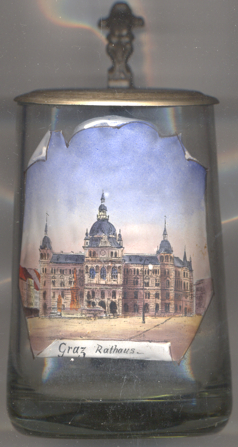
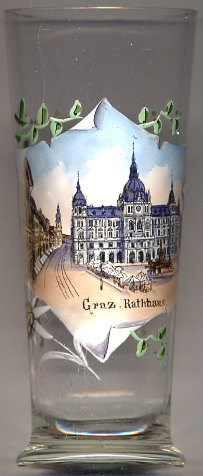
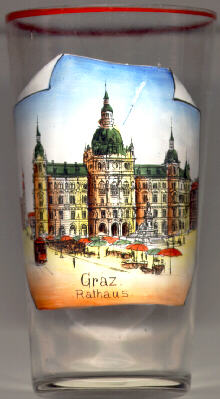
Rathaus (Town Hall) was built in 18721883 in Neogothic style
by the architect Friedrich von Schmidt who had won an international competition for the building.
The height of the middle tower had been limited to 98 m so as not to surmount the towers of the nearby Votivkirche (99 m; see below).
The statue of the 'Rathausmann', an armoured knight carrying a lance, on top of the tower is 3.4 m high, so that the town hall
in the end overtopped the church in height.
The square in front of the town hall is named 'Dr.-Karl-Lueger-Platz' [see glass no.884 below] for Karl Lueger, who had been mayor of Vienna between 1897 and 1910. Lueger is best known as a charismatic and popular politician, but he also displayed anti-semitic tendencies in conflicts with his political opponents. (Before he finally became mayor, Emperor Franz Joseph I refused to accept his election three times.) On the other hand he was responsible for considerable communal achievements during his term (gas and electricity supply, the "Green belt" forest and meadow reserve around large parts of Vienna, the 2nd water supply pipeline, social welfare and public transport). Most of the square is occupied by a park ('Rathauspark').
The
Staatsoper (State Opera) was built in Neo-Romantic style 18611869 by August Sicard von Sicardsburg and Eduard von der Nüll
as the first monumental representative building on the Ringstraße, which had been laid out after the old fortifications of the city had been torn down.
The architecture of the opera house was severely criticized at the time, which caused the suicide of van der Nüll in 1868, and the death of Sicardsburg from a heart attack only two months later.
The predecessors of the State Opera (Kaiserlich-Königliche Hofoper) was the ''Kärntnertortheater', which had been built in 1709 and was located
behind the State Opera approximately at the site of today's famous Hotel Sacher. The State Opera was heavily damaged by a bomb raid and fire in 1945. Only
the foyer and the loggia, with frescoes by Moritz von Schwind, the main stairways, the vestibule and the tea room were spared. Almost the entire décor and properties,
the equipment for more than 120 operas with around 150,000 costumes were destroyed. Already on 6 October 1945, the State Opera opened its temporary stages
at the Theater an der Wien and at the Volkoper. The State Opera was reconstructed between 1948 and 1955, and re-opened on 5 November 1955.
Among its directors were Gustav Mahler (18971907), Richard Strauss (19191924), Clemens Krauss (19291934),
Karl Böhm (19431945), Herbert von Karajan (19561964) and Lorin Maazel (19821984).
The
Stephansdom (St. Stephen's Cathedral) is one of the most important churches of the High and Late Gothic period in Central Europe.
Characteristic are the lateral position of the two towers, the integration of the Romanesque western façade, the hall choir of the High Gothic period, and the
impressive steep roof covered with a decorative pattern of glazed tiles. The church measures 107 m in length, the south tower has a height of nearly 137 m.
When Vienna finally was granted the status of a diocese in 1469, St. Stephen's became a cathedral. Since 1723 it is the
metropolitan church of the archdiocese of Vienna.
The oldest parts of the church (the lower floors of the west towers called 'Heidentürme', 'heathens' towers') already were part of the first church which
had been built in 11371160.
The original church was replaced by a new, Romanesque, church between 1230 and 1263. From this church, the impressive west façade with the Riesentor
('Giant's Gate'), the upper floors of the west towers and the west chancel are still extant. The construction of the three-aisled hall choir between 1304 and 1340 marked the
beginning of the Gothic period. In 1359, the foundations for the nave, a staggered hall, the two-storied chapels on the west side, and the construction of the south tower
('Hoher Turm', 'high tower') were laid out. The south tower (137 m high) was finished by Hans of Prachatitz (Prachatice, CZ) in 1433.
The vaulting of the nave was completed by Hanns Puchspaum (Puchsbaum) in 1446. The attic, a masterpiece of Gothic carpentry was destroyed in 1945, and was reconstructed in steel on the model of the original after the war.
Puchspaum also created the vestibule of the Singertor (before 1450) and designed the north tower ('Adlerturm', 'eagle's tower').
The construction of the north tower started in 1467, but was discontinued in 1511, and was finally topped with a bell-shaped dome (height of the north tower: 61 m).
Anton Pilgram was the master-builder of St Stephen's from 1510 until 1514.
Only during the 19th century some additions and alterations were made by Friedrich von Schmidt.
In 1945, St. Stephen's Cathedral was heavily damaged by bombs and by fire. Immediately after the war, the church was reconstructed. The nave was
finished in 1952, the large new organ and the bells were finally dedicated in 1960.
Among the many treasures of art within the church are the stone-carved pulpit of the late 15th century with the famous self-portrait of Anton Pilgram (1513/1515), the Wiener Neustädter Altar (1447, purchased from the monastery of Neukloster at Wiener Neustadt in 1884), and the red marble tomb of Emperor Friedrich III (14671513, designed and begun by Niclas Gerhaert van Leyden). The Maria-Pötsch-Altar holds the painting of the Weeping Madonna, which was brought to St Stephen's cathedral from Máriapócs in Hungary in 1697. Until 1945 it was exhibited in the high altar.
The north tower holds the 'Pummerin', the largest bell of Austria. The bell was originally cast in 1711 after the second siege of Vienna by the Turks (1683)
out of the metal of Turkish canons. It originally weighed 22,511 kg and had hung in the south tower. The bell was destroyed in 1945.
The present bell was cast in 1951 out of the metal of the old bell. It weighs 21,383 kg and thus is the second-largest bell in western Europe (after that of the cathedral of
Cologne) and the fifth-largest bell in the world. Since 1957 it hangs in the north tower. It is rung only at the principal feast days of the
ecclesiastical calendar (Easter night, Pentecost, Corpus Christi, the Assumption of the Virgin Mary, Christmas Eve), on the feast day of St. Stephen (Boxing Day),
on midnight of New Year's eve, on the death of a pope or the Archbishop of Vienna or the announcement of a new papacy or a new Archbishop of Vienna, and
on All Souls' Day for the victims of World War II.
The
Graben, an elongated square between Stock-im-Eisen-Platz/Stephansplatz and Kohlmarkt,
is situated at the site of the moat (German: Graben) that protected the southeastern wall of the Roman settlement Vindobona.
The moat was filled in around 1200. The area later served as market place for flour and vegetables, in the 17th century it was also
used as apleasureground for the Imperial court. The oldest building lining the squire is No.11,
Palais Bartolotti-Partenfeld, built in 1720. Most other building date from the 19th century.
The
Pestsäule
Leopopldsbrunnen
The bridge
Marienbrücke across the Donaukanal connecting Vienna's 1st district (Innere Stadt; Inner City) and 2nd
district (Leopoldstadt) was built in 1905/06. The bridge was rebuilt in 195153.
| 2. Bezirk, Leopoldstadt | 2nd district, Leopoldstadt |
The Prater (Latin 'pratum' = meadow, pasture) is a large park in the area of the previous pastures of the river Danube. The first written mention in a document dates from 1403. Since 1560 is was used as hunting grounds for the Imperial court. In 1766 it was opened to the public by Emperor Joseph II. The original character of a pasture was changed to that of a park when the course of the Danube in Vienna was straightened in 18691875. The amusement park (Volksprater, also called Wurstelprater after the comical figure Hans Wurst) in the western part of the Prater has been popular ever since around 1800.
The
Riesenrad ('Giant Wheel') (65 m high)
was erected in 1896/97 after a plan of the english engineers Walter B. Bassett and H. Hitchins.
The picture on glass no.099 [left] shows the original shape of the
wheel with 30 cars. In 1945 they were destroyed by fire. After the war only 15 cars
were mounted on the wheel as the steel cable construction had been weakened by the fire.
Ferris wheels were invented by the Pittsburgh engineer George Washington Gale Ferris who built the
first wheel (76 m high with 36 cars) for the World's Columbian Exposition in Chicago 1893.
Of all the giant Ferris wheels built around the turn of the century (Chicago, London, Blackpool, Paris, Vienna etc.)
the Riesenrad in Vienna is the only one that has not been scrapped and is still in use.
The tallest Ferris wheels as of 2008 are in Singapore (165 m with 28 capsules, opened in february 2008),
Nanchang (60 m with 61 capsules, opened in May 2006)
and the Millenium Wheel ('London Eye') in London (135 m high with 32 capsules, opened in March 2000).
These will be surpassed in 2009, when the Beijing Great Wheel is completed. Currently planned at
208 meters it is predicted to accommodate 1,920 passengers.
| 3. Bezirk, Landstraße | 3rd district, Landstraße |
The Belvedere was created by Prince Eugène (Eugen) of Savoy (16631736) as his summer residence in Vienna.
The name, which refers to the splendid view on Vienna, however, originated later in the times of Maria Theresia of Austria (17171780).
The lower palace (Unteres Belvedere) was built in 17141716. The construction of the upper palace
Oberes
| 4. Bezirk, Wieden | 4th district, Wieden |
The
Karlskirche was built by Emperor Karl VI
after the plague of 1713. It is dedicated to St. Karl Borromäus
who was frequently invoked in times of the plague. The church is one of the
most important examples of high baroque in Austria. It was started by the architect
Johann Bernhard Fischer von Erlach 17161722 and comleted 17241739 by his son Joseph Emanuel
who also added the dome (72 m high) to the design.
The two triumphal columns (33 m high) erected 17241730 are decorated with scenes from the life of
St. Charles Borromeo. They are also an allusion to the Imperial status
of Karl VI as they are designed to resemble the column of Emperor Traianus in Rome.
| 7. Bezirk, Neubau | 7th district, Neubau |
The
Volkstheater (the original name until 1945 was Deutsches Volkstheater)
was built 18871889 by the architects Ferdinand Fellner and Hermann Helmer for
the citizens of Vienna as a counterpart to the Hofburgtheater. The two architects
became famous for this type of building and built more than 50 theatres and
opera houses in numerous cities in and outside the Austro-Hungarian Monarchy.
The dome of the building was destroyed in 1945 and reconstructed in 1980/81.
(See also list of further buildings by Fellner and Helmer
that are depicted on glasses of this collection.)
| 9. Bezirk, Alsergrund | 9th district, Alsergrund |
The
Votivkirche was built in 18551879 by the
architect Heinrich von Ferstel (18281883) in French Neogothic style in order
to commemorate the failure of the attempted assassination of the young Emperor Franz Joseph I
in 1853. The church became the garrison church of Vienna in 1862 and was
elevated to a provost church in 1878. Today it is also the church of the
university of Vienna. The two church towers have a height of 99 m.
An art-historical treasure of the church is the renaissance tomb (prior to 1546) of
Count Niklas Salm (14591530) who defended Vienna against the Turks in 1529. The original location of
the tomb (until 1879) was the church of St. Dorothea which had been pulled down.
| 10. Bezirk, Favoriten | 10th district, Favoriten |
The
parish church Sankt Anton [left] was conceived when towards the end of the 19th century the population of Favoriten,
Vienna's 10th district, began to grow rapidly and soon was too large for a single parish. The parish was subsequently divided and St. Anton was to become
the church of the new parish. The foundation stone was laid in 1896 in the presence of Emperor Franz-Joseph I. Named for Saint Anthony of Padua,
the patron saint of Archbishop Anton Gruscha, the church was built as a mighty construction in Historicist Romanesque-Byzantine style by the architect
Franz Ritter von Neumann. The church was completed exactly six years after the start of construction. World War II caused severe damages to the church.
Although the restoration works were begun shortly after the war, it took until 1961 to complete the reconstruction. The dome of the church has a height of 48.5 m,
the two flanking towers are 51 m high, the width of the front façade is 25 m.
Further building designed by Franz von Neumann depicted on glasses of this collection are the church of the parish Donaufeld in Vienna (see below), the Villa Erzherzog Eugen
in Baden, and the town hall of Liberec.
| 13. Bezirk, Hietzing | 13th district, Hietzing |
The first castle on this site was bought in 1559 by Emperor Maximilian II as a hunting seat. 1683 the castle was destroyed by the Turks. Johann Bernhard Fischer von Erlach designed a plan for a new palace in 1688 following Versailles Palace as ideal model. However, between 1695 and 1711 only a simplified plan was realized. 1744-49 the palace was remodelled in Baroque style by Empress Maria Theresia. After the death of her husband, Emperor Franz I Stephan, several rooms were decorated in Rococo style. In 181719 the façades were renewed in Classicist style. The palace and gardens were listed as a UNESCO World Cultural heritage Site in 1996 (see also list of other UNESCO heritage sites).
After the defeat of Archduke Karl by Napoleon
at Wagram in 1809, the Peace of Schönbrunn stipulated that Austria had to accept
the loss of Tyrol and Vorarlberg to Bavaria. Salzburg and parts of Upper Austria
also had to be ceded to Bavaria. Western Carinthia, Carniola, Croatia south of the river Sava,
Görz (Gorizia), Trieste, Fiume (Rijeka) and Dalmatia
were lost to France, East Galicia came to Russia,
West Galicia to the Grand Duchy of Warsaw (personal union with the Kingdom of Saxony).
The park of Schloss Schönbrunn covers an area of about 2 km2 and is one of the most important and best-preserved
Baroque gardens in French style. The original layout of 1706 was completely redesigned after 1765.
The
Neptunbrunnen [left, bottom] was created by Franz Anton Zauner in 1740.
The
Gloriette [left, top] is located on top of the hill, some 45 m above the lower part of the park.
The open pillared hall was created by Ferdinand von Hohenberg in 1775 as a monument for the victory of the troops of Maria Theresia against Prussia in the
Battle of Kolín in 1757.
The
parish church of Ober-Sankt-Veit [left, no.311]
was first mentioned in 1365. The present church was originally built in 1433
and reconstructed after destructions in 1529 and 1683. The church was enlarged
in 1742 by adding a Baroque nave to the Gothic chancel.
The small village of Ober-Sankt-Veit gained importance when the Archbishops
of Vienna had a summer palace built here in 1742. Since 1890/92 Ober-Sankt-Veit
is part of Vienna (13th district, Hietzing).
| 14. Bezirk, Penzing | 14th district, Penzing |
The
parish and pilgrimage church Mariabrunn
was built 16391645. The vestibule was added in 1729, the church tower was
erected in 1872. The church became a popular site of pilgrimages from 1616, especially
for the Imperial court of Vienna. The wooden statue of Our Lady in the high altar dates from the
first half of the 16th century.
An epitaph for the famous Baroque architect
Johann Lukas von Hildebrandt (16681745) was erected in the church after his death.
The kermis of Mariabrunn was portrayed by the Austrian writer Adalbert Stifter (18051868)
in his book "Wien und die Wiener in Bildern aus dem Leben" (1844).
The former monastery of the Discalced Augustinians was founded in 1636. The well-known preacher Abraham a Sancta Clara (16441709, real name Matthias Megerle) joined the monastery as a novice in 1662 and completed his theological studies here in 1666. The monastery was dissolved in 1785/86. Since 1813 it is the seat of the forestry school (founded 1805 in Purkersdorf) which became a section of the Vienna University for Agriculture in 1875.
The village of Mariabrunn became part of Vienna (14th district, Penzing) in 1938.
| 21. Bezirk, Floridsdorf | 21st district, Floridsdorf |
The
church of Sankt Leopold, church of the parish Donaufeld,
was built in 19051914 Neo-Gothic style by the architect Franz von Neumann.
Before 1905 Floridsdorf was not yet part of Vienna and there had been plans to make the Floridsdorf
the capital of Lower Austria. The church thus was designed to become the seat of a new diocese.
The plans did not become reality so that the large church in 1914 became the parish church of the
newly established parish of Donaufeld. The church spire (96 m) is the third-highest in Vienna after the spires
of St. Stephen's Cathedral and the Votivkirche (both above). St. Leopold is also the third-largest church
of Vienna in terms of capacity after St. Stephen's and the church Am Hof.
The old name of the Floridsdorf area was Am Spitz. In 1786 it was renamed Floridsdorf for
Floridus Leeb, abbot of Klosterneuburg, who had donated grounds for a new settlement.
The first houses in the Donaufeld area were built in the early 1860's. At first the area received the name Neu-Leopoldau,
but in 1885 the name Donaufeld was introduced and was made official in 1886.
In 1895 Donaufeld was merged with Floridsdorf (1894 incorporated as a town), Neu-Jedlersdorf and Jedlesee to become the municipality of Floridsdorf.
In 1904 Floridsdorf became part of Vienna (21st district) together with Leopoldau, Kagran, Hirschstetten, Stadlau and Aspern,
and in 1910 it was expanded by the incorporation of Strebersdorf. In 1938 Kagran, Stadlau, Hirschstetten, Aspern and
the Lobau area were separated from Floridsdorf to become the 22nd district, Donaustadt.
In 1954 the boundary between the 21st and 22nd district were rearranged, and Stammersdorf was incorporated into Floridsdorf.
| 23. Bezirk, Liesing | 23rd district, Liesing |
The village of Kalksburg is situated on the Liesingbach stream, and is part of Vienna's 23rd district, Liesing.
The Jesuit school, founded in 1856, was nicknamed 'the Oxford of the Old Monarchy'. Kalksburg was an independent municipality until 1938 when it
became part of 'Groß-Wien' (Greater Vienna) .
The
Devil's Mill (Teufelsmühle) on the Wienerberg on the road from Vienna to Wiener Neustadt was already mentioned in 1477.
An old legend tells the story of the owner, a cruel man who killed his pious wife by
throwing her into the mill's well when she criticized his evil way of life. For a long time the spirits of the two haunted the mill. A long time later a noble knight took
shelter in the haunted mill. In the middle of the knight the ghost of the wife appeared and asked the knight to recover her body from the bottom of the well and
bury her in blessed ground. When he did so the next morning the haunted spirits of the man and his wife found peace and the knight is said to have found a
large fortune when he returned to his home.
The mill was destroyed by fire in 1902. After that it was rebuilt as a country inn [right, no.726].
It still serves as a restaurant today and bears the name Gasthaus zur Teufelsmühle.
The village of Siebenhirten became part of Vienna (25th district [see inscription on the glass], Liesing) in 1938 when a total of 96 municipalities were incorporated into
the city of Vienna. In 1954, 80 of these former villages were returned to Lower Austria again. The district Liesing with Siebenhirten, however, remained part of Vienna (now 23rd district).