
|
|
| ÖSTERREICH | AUSTRIA |
| Bundesland: Niederösterreich | Lower Austria |
| Bezirk: Neunkirchen |
map →
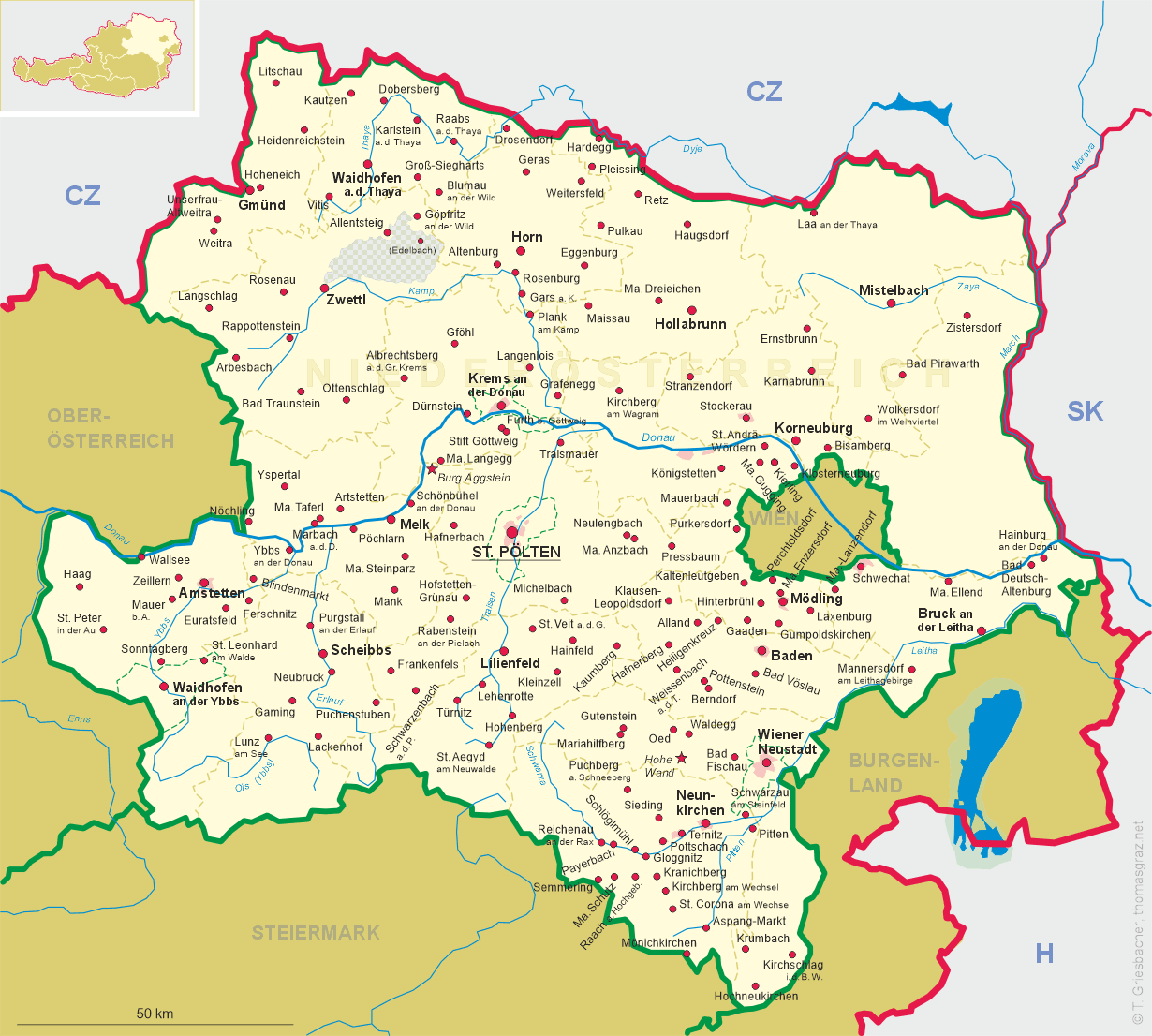
 The municipality of Semmering is situated at an elevation of 950 m just below the Semmering pass (984 m).
The first path across the Semmering connecting Lower Austria and Styria was laid out in the 12th century under Margrave
Otakar III of Styria. At that time, the Pitten county had just become part of Styria in 1158
(today it is part of Lower Austria). The first road across the Semmering was built under Emperor Karl VI in 1728 and
was extended and improved under Emperor Ferdinand I of Austria. Since 1956/58, a new route was built. The Semmering
region is well-known for its famous railway line, built by the engineer Carl Ritter von Ghega (1802–1860) between 1848
and 1854. The Semmering railway line (41 km) is part of the Südbahn railway (1839–1857) from
Vienna via Graz, Maribor and
Ljubljana to Trieste. Ghega's plan was daring at that time. The line was
laid out as a pure adhesion railway with a maximum gradient of 1 in 40 (25 m over a distance of 1,000 m); previous
railways had a maximum gradient of only 1 in 200. Carried by 16 viaducts that are supported by several arches, the Semmering
railroad crosses gorges, runs through 15 tunnels and reaches its highest point at 897 metres in the main tunnel
(1,430 m long, then considered the most famous building of its kind). In 1851, Ghega was promoted to the nobility
(Ritter, Knight). Semmering became well-known as a climatic resort at the end of
the 19th century. Many fashionable hotels were built at that time.
The Semmering railway was listed as a World Cultural heritage by the UNESCO in 1998.
(see also list of other UNESCO heritage sites depicted on glasses of this collection)
The municipality of Semmering is situated at an elevation of 950 m just below the Semmering pass (984 m).
The first path across the Semmering connecting Lower Austria and Styria was laid out in the 12th century under Margrave
Otakar III of Styria. At that time, the Pitten county had just become part of Styria in 1158
(today it is part of Lower Austria). The first road across the Semmering was built under Emperor Karl VI in 1728 and
was extended and improved under Emperor Ferdinand I of Austria. Since 1956/58, a new route was built. The Semmering
region is well-known for its famous railway line, built by the engineer Carl Ritter von Ghega (1802–1860) between 1848
and 1854. The Semmering railway line (41 km) is part of the Südbahn railway (1839–1857) from
Vienna via Graz, Maribor and
Ljubljana to Trieste. Ghega's plan was daring at that time. The line was
laid out as a pure adhesion railway with a maximum gradient of 1 in 40 (25 m over a distance of 1,000 m); previous
railways had a maximum gradient of only 1 in 200. Carried by 16 viaducts that are supported by several arches, the Semmering
railroad crosses gorges, runs through 15 tunnels and reaches its highest point at 897 metres in the main tunnel
(1,430 m long, then considered the most famous building of its kind). In 1851, Ghega was promoted to the nobility
(Ritter, Knight). Semmering became well-known as a climatic resort at the end of
the 19th century. Many fashionable hotels were built at that time.
The Semmering railway was listed as a World Cultural heritage by the UNESCO in 1998.
(see also list of other UNESCO heritage sites depicted on glasses of this collection)
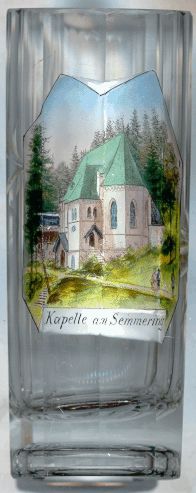
The  parish church Heilige Familie (Holy Family) [left]
was built in 1894–1895 by the architect Gustav von Neumann in Neogothic style. Originally it was a filial church of the
parish of Maria Schutz. In 1934 it obtained the rank of a parish church.
parish church Heilige Familie (Holy Family) [left]
was built in 1894–1895 by the architect Gustav von Neumann in Neogothic style. Originally it was a filial church of the
parish of Maria Schutz. In 1934 it obtained the rank of a parish church.
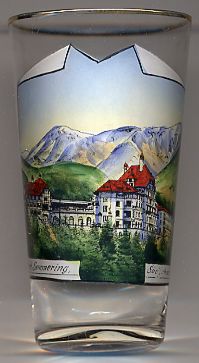
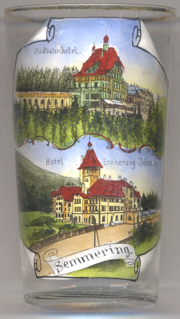 The Südbahnhotel (Southern Railway Hotel) [left, no. 2510, and right,
no. 3354: top picture] was built in 1880–1881 as the first of a series of railroad hotels along the
Southern Railway, which was completed in the 1870s (see below). The architect was Wilhelm von Flattich who in 1873 also had
built the Southern Railroad Station in Vienna. The hotel was opened in 1882. Between 1900 and 1903
the hotel was enlarged. As the hotel can be seen from afar, it soon became the landmark of Semmering. The new Grand Hotel
Südbahn was a truely luxurious palace hotel. In 1912/1913 a restaurant and ballroom wing was added. Between the two
World Wars the hotel was modernised. The original interior decorations in the bar area are still almost completely intact
today. An indoor swimming pool in the New Objectivity style was built in 1932. After World War II, however, the
popularity of the Semmering area dwindled. In the 1960s the hotel business was successively discontinued. The original hotel
was transformed into freehold flats in 1974. Almost nothing of the original interior design of 1882 has survived. Only the
façade, the mosaic floor in the entrance hall and the central wooden staircase with its cast iron balustrade remained.
The Südbahnhotel (Southern Railway Hotel) [left, no. 2510, and right,
no. 3354: top picture] was built in 1880–1881 as the first of a series of railroad hotels along the
Southern Railway, which was completed in the 1870s (see below). The architect was Wilhelm von Flattich who in 1873 also had
built the Southern Railroad Station in Vienna. The hotel was opened in 1882. Between 1900 and 1903
the hotel was enlarged. As the hotel can be seen from afar, it soon became the landmark of Semmering. The new Grand Hotel
Südbahn was a truely luxurious palace hotel. In 1912/1913 a restaurant and ballroom wing was added. Between the two
World Wars the hotel was modernised. The original interior decorations in the bar area are still almost completely intact
today. An indoor swimming pool in the New Objectivity style was built in 1932. After World War II, however, the
popularity of the Semmering area dwindled. In the 1960s the hotel business was successively discontinued. The original hotel
was transformed into freehold flats in 1974. Almost nothing of the original interior design of 1882 has survived. Only the
façade, the mosaic floor in the entrance hall and the central wooden staircase with its cast iron balustrade remained.
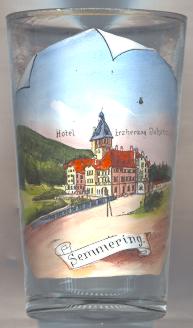 Grand Hotel Erzherzog Johann [left, no. 822, and right, no. 3354:
bottom picture], situated at the highest point of the pass, was built in 1898/99 by architects Ferdinand Felner and
Hermann Helmer, and replaced an earlier inn of the same name. It has been replaced itself by a modern building in the 20th
century.
Grand Hotel Erzherzog Johann [left, no. 822, and right, no. 3354:
bottom picture], situated at the highest point of the pass, was built in 1898/99 by architects Ferdinand Felner and
Hermann Helmer, and replaced an earlier inn of the same name. It has been replaced itself by a modern building in the 20th
century.
(See also list of further buildings by Fellner and Helmer
that are depicted on glasses of this collection.)
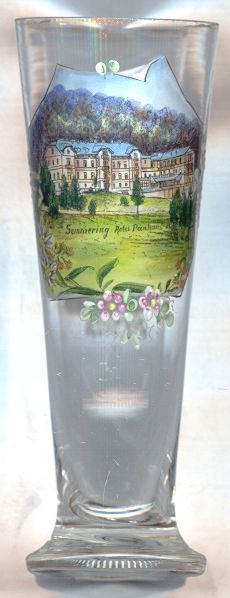
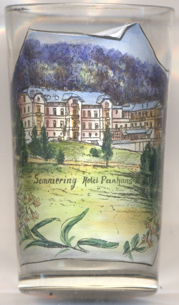 Hotel Panhans [left, nos. 1292 and 3898] is probably the best-known of
all traditional hotels in Semmering. The hotel was founded in 1888 and was transformed to a Grand Hotel in 1913 by Ferdinand
Felner and Hermann Helmer. With 400 rooms it was one of the largest hotels in Europe at that time. After the end of World
War I and the break-up of the Austrian Empire, the hotel had to be sold off. It took until the 1930s that the hotel
could regain its former position among the leading hotels in Europe. The great popularity ended after World War II.
Finally, in 1969, the hotel had to close. In 1978, a joint venture of a private investment group, the municipality of
Semmering and the state of Lower Austria began to revitalise the hotel, which was reopened in 1983.
Hotel Panhans [left, nos. 1292 and 3898] is probably the best-known of
all traditional hotels in Semmering. The hotel was founded in 1888 and was transformed to a Grand Hotel in 1913 by Ferdinand
Felner and Hermann Helmer. With 400 rooms it was one of the largest hotels in Europe at that time. After the end of World
War I and the break-up of the Austrian Empire, the hotel had to be sold off. It took until the 1930s that the hotel
could regain its former position among the leading hotels in Europe. The great popularity ended after World War II.
Finally, in 1969, the hotel had to close. In 1978, a joint venture of a private investment group, the municipality of
Semmering and the state of Lower Austria began to revitalise the hotel, which was reopened in 1983.
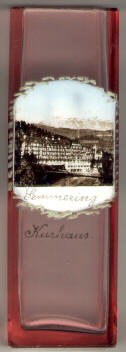
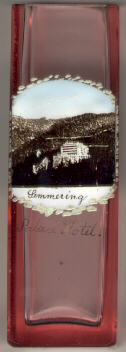
The two glasses on the left show two other hotels,
Kurhaus Palace
![[scale]](lineal.jpg) contact: webmaster
contact: webmaster