
|
|
| DEUTSCHLAND | GERMANY |
| Bundesland: Freie Hansestadt Bremen | |
| Stadt: Bremerhaven |
map →
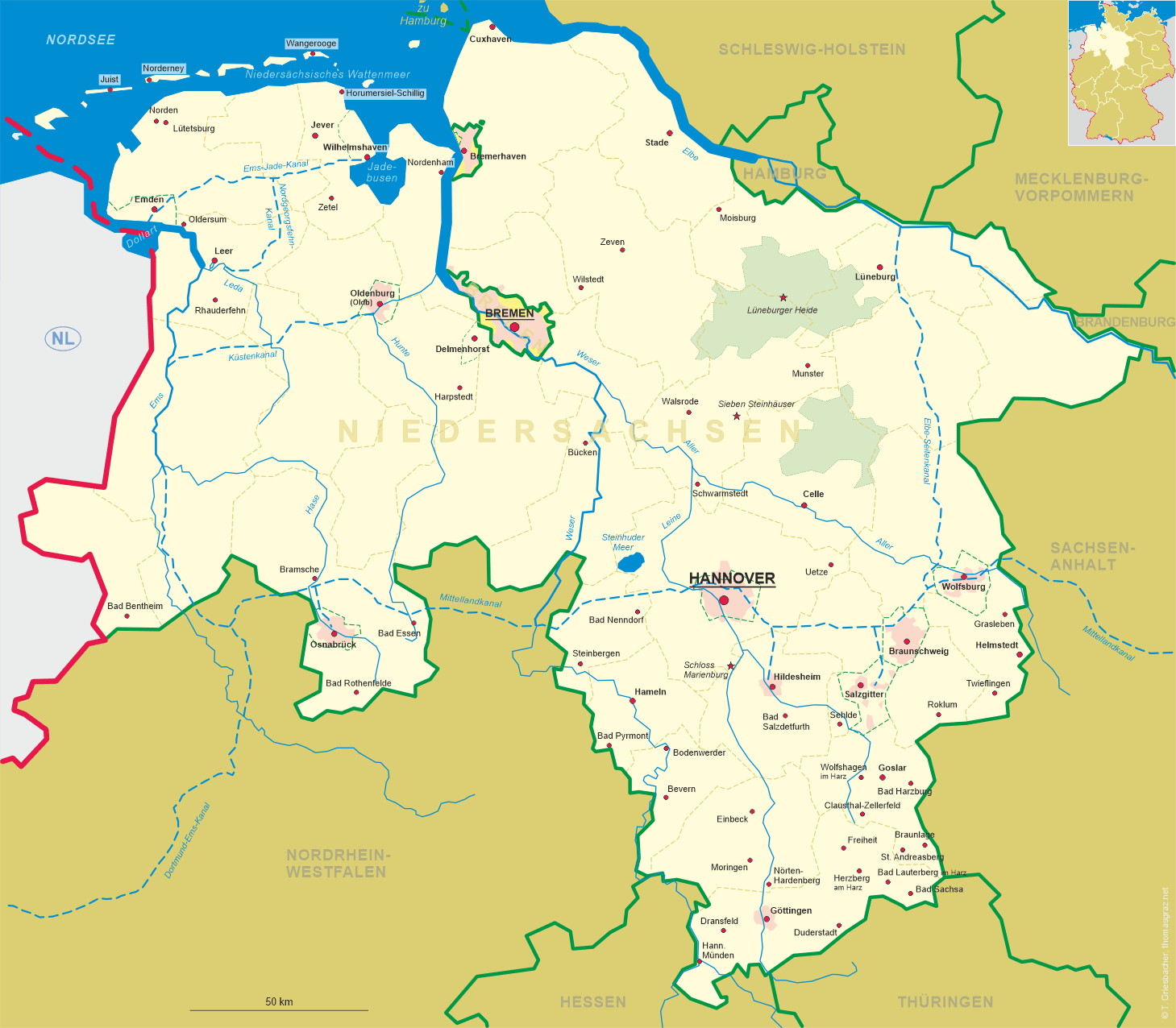
 Bremerhaven is situated on the mouth of the Weser river and is Germany's biggest North Sea coastal town.
It is part of the state of the Free Hanseatic town Bremen (although separated from it by a distance of 60 km).
Bremerhaven was founded in 1827 as a new outer port of Bremen on water deep enough for ocean-going ships. The port was chartered as a city in 1851.
The neighbouring towns of Lehe and Geestemünde were united in 1927 under the name Wesermünde. In 1939 Bremerhaven was annexed to
Wesermünde and thus became part of the Prussian Province Hannover (only the sea port remained with Bremen).
During World War II Wesermünde and the port Bremerhaven were severly destroyed by allied bombings.
After the war Wesermünde and Bremen (with the port Bremerhaven) were part of the American occupation zone and formed an enclave within the British zone
(see map of the allied occupation zones in 1945).
In 1947 Wesermünde and the port Bremerhaven were united under the name Bremerhaven and the united city was transferred back to Bremen.
Today Bremerhaven has a population of about 130,000 people and is Europe's biggest car transhipment centre with
more than 750,000 vehicles exported and imported through it per year.
Bremerhaven is situated on the mouth of the Weser river and is Germany's biggest North Sea coastal town.
It is part of the state of the Free Hanseatic town Bremen (although separated from it by a distance of 60 km).
Bremerhaven was founded in 1827 as a new outer port of Bremen on water deep enough for ocean-going ships. The port was chartered as a city in 1851.
The neighbouring towns of Lehe and Geestemünde were united in 1927 under the name Wesermünde. In 1939 Bremerhaven was annexed to
Wesermünde and thus became part of the Prussian Province Hannover (only the sea port remained with Bremen).
During World War II Wesermünde and the port Bremerhaven were severly destroyed by allied bombings.
After the war Wesermünde and Bremen (with the port Bremerhaven) were part of the American occupation zone and formed an enclave within the British zone
(see map of the allied occupation zones in 1945).
In 1947 Wesermünde and the port Bremerhaven were united under the name Bremerhaven and the united city was transferred back to Bremen.
Today Bremerhaven has a population of about 130,000 people and is Europe's biggest car transhipment centre with
more than 750,000 vehicles exported and imported through it per year.
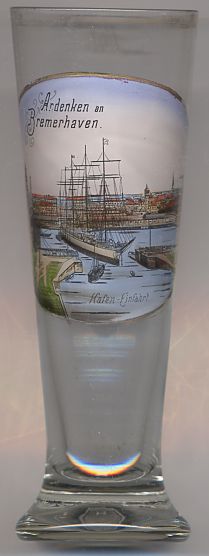
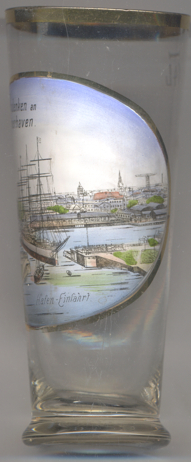
Glasses no. 2204 [left] and 3488 [right] show the
 harbour
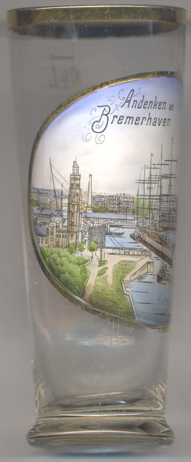
The Bremerhaven lighthouse [right, no. 3488: left],
also known as the Simon Loschen tower or Loschen-lighthouse, is the rear light of a pair of Leading lights at
the "New Harbour" of Bremerhaven. It is the oldest operative lighthouse on the mainland along Germany's North Sea shore and
is counted among the city's landmarks. From 1853 to 1855 the lighthouse was built in the style of northern German Brick
Gothic at the northern side of the harbour's lock from 1852, using plans by architect Simon Loschen from
Bremen. It went operational in 1856. Next to the lighthouse there is another brick house that used
to serve as a quarters and service building for the lighthouse and lock keepers and was partially destroyed during World
War II. The fire was first lit by a gas flame and was later electrified in 1925. It was automated in 1951.
The original range of leading lights pointing down the river Weser was replaced by another lighting in 1959. For the
upstream range that is still in use today, the tower still serves as the rear light. The corresponding front light is
situated in a small red and white lighthouse on the southern pier of the lock, also called "the minaret" by locals.
[https://en.wikipedia.org/wiki/Bremerhaven_lighthouse]
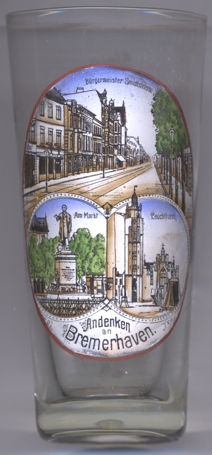
The top picture on glass no. 4412 [near left] shows a view of
Bürgermeister-Smidt-Straße Bürgermeister-Smidt-Denkmal
[https://www.bremerhaven.de/de/tourismus/architektur-denkmaeler/buergermeister-smidt-denkmal.21363.html;
https://de.wikipedia.org/wiki/B%C3%BCrgermeister-Smidt-Stra%C3%9Fe_(Bremerhaven)]
The Bremerhaven Lighthouse [lower right picture], also known as the Simon Loschen Tower or
Loschen Lighthouse, is the rear light of a pair of leading lights at the New Harbour of Bremerhaven, Germany. It is the oldest operative lighthouse
on the mainland along Germany's North Sea shore and is counted among the city's landmarks. It was built in 1853–1855 in the style of northern German
Brick Gothic at the northern side of the harbour's lock and went operational in 1856. The fire was first lit by a gas flame and was later electrified in
1925. It was automated in 1951.
 Geestemünde was first mentioned in 1139. When Bremen founded its new sea port Bremerhaven
to the north of the mouth of the river Geeste into the Weser, the Kingdom of Hannover also built a new port,
Geestemünde, on the southern bank of the Geeste in 1845/47. The port was enlarged and modernized in 1856–1863. With Hannover,
Geestemünde became part of Prussia (Province Hannover) in 1866. In 1927 Geestemünde and Lehe were united under the new name Wesermünde.
Bremerhaven was annexed to Wesermünde in 1939. After World War II Wesermünde was renamed Bremerhaven and was returned to the state of Bremen (see above).
Geestemünde was first mentioned in 1139. When Bremen founded its new sea port Bremerhaven
to the north of the mouth of the river Geeste into the Weser, the Kingdom of Hannover also built a new port,
Geestemünde, on the southern bank of the Geeste in 1845/47. The port was enlarged and modernized in 1856–1863. With Hannover,
Geestemünde became part of Prussia (Province Hannover) in 1866. In 1927 Geestemünde and Lehe were united under the new name Wesermünde.
Bremerhaven was annexed to Wesermünde in 1939. After World War II Wesermünde was renamed Bremerhaven and was returned to the state of Bremen (see above).
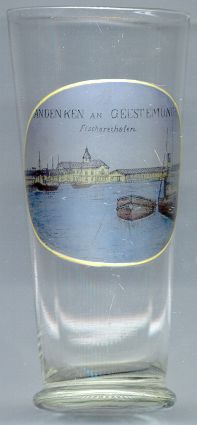
The Fischereihafen I (fishing harbour I) [left, no. 1486] was built in 1891–1896 in
Geestemünde. At the same time a sailor's home was opened. The Royal Prussian Nautic Engineers' School (Königlich Preussische Seemaschinistenschule)
opened in 1899. In 1908 the Fischereihafen-Betriebsgenossenschaft (FBG; Fishing Port Operation Cooperative)
became in charge of unloading the fishing trawlers. The fishing port grew rapidly and as a consequence the village of Geestemünde obtained
the status of a town in 1913. The Institut für Seefischerei (Institute for Sea Fishing), founded in 1919, became the precursor of the
Alfred Wegener Institute for Polar and Marine Research (formed in 1980). After the incorporation in 1920 of Wulsdorf into Geestemünde,
the Fischereihafen II was built in 1921–1925. Around 1938, the fishing port was the most important of its kind in continental Europe,
with 21 shipping companies operating 193 fish trawlers and 194 fish wholesalers and 56 factories processing some 280,000 tons of fish.
After 1960 the port lost much of its former importance. In 1971 Fischereihafen became a city district of Bremerhaven.
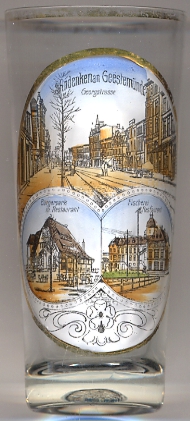
The former Bremer Landstraße was renamed Georgstraße in 1860. The former country road was developed to become the
main street of Geestemünde.
The lower left picture on glass no. 2884 shows the restaurant in the
Bürgerpark
The bilding depicted on the lower rightpicture of glass no. 2884 is labeled
Fischerei
[https://de.wikipedia.org/wiki/Geestemünde; https://de.wikipedia.org/wiki/Fischereihafen_(Bremerhaven);
https://de.wikipedia.org/wiki/ürgerpark_(Bremerhaven);
http://www.koester-modelle.de/ausstell/dauermog/fishholl.htm, http://www.nordsee-zeitung.de/region/bremerhaven_artikel,-Der-Stolz-der-Geestemuender-_arid,947620.html]
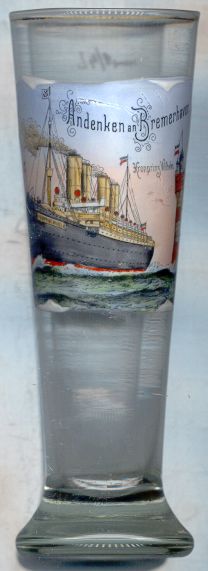 The picture on glass no. 1425 [left] shows the
steamship
The picture on glass no. 1425 [left] shows the
steamship
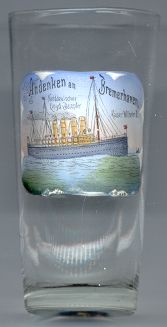 The picture on glass no. 1394 [right] shows the
steamship
The picture on glass no. 1394 [right] shows the
steamship
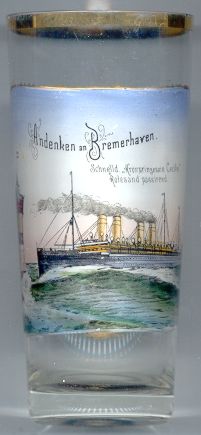 The steamship
The lighthouse "Roter Sand" ('Red Sand') [far left, barely visible]
is located in the North Sea 6 nautic miles northeast of the island of Wangerooge, about three hours off the estuary of the Weser river.
At the time of its construction in 1882–1885 it was the world's first off-shore building.
The total height of the tower including its underwater foundation is 52.5 m; at low tide it rises almost 31 m above the water.
For 79 years the lighthouse guided the ships to the port of Bremerhaven and also warned them from the dangerous shoal Roter Sand.
For thousands of German emigrants it also was the last greating of the country they left.
Because the weak foundations precluded a modernisation the new lighthouse 'Alte Weser' went on duty in 1965.
Original plans to leave 'Roter Sand' to the forces of the sea were abandoned since the tower was a beloved off-shore landmark of Bremerhaven.
In 1982/83 the lighthouse was protected as a historical monument.
The foundations were secured in 1987, the tower was newly painted in 1989 and further restoration works were carried in the following years.
Since 1999 the former lighthouse is used as a romantic lodge.
Several glasses of this collection show other ships.
![[scale]](lineal.jpg)