
|
|
| ÖSTERREICH | AUSTRIA |
| Bundesland: Steiermark | Styria |
| Bezirk: Murtal |
map →
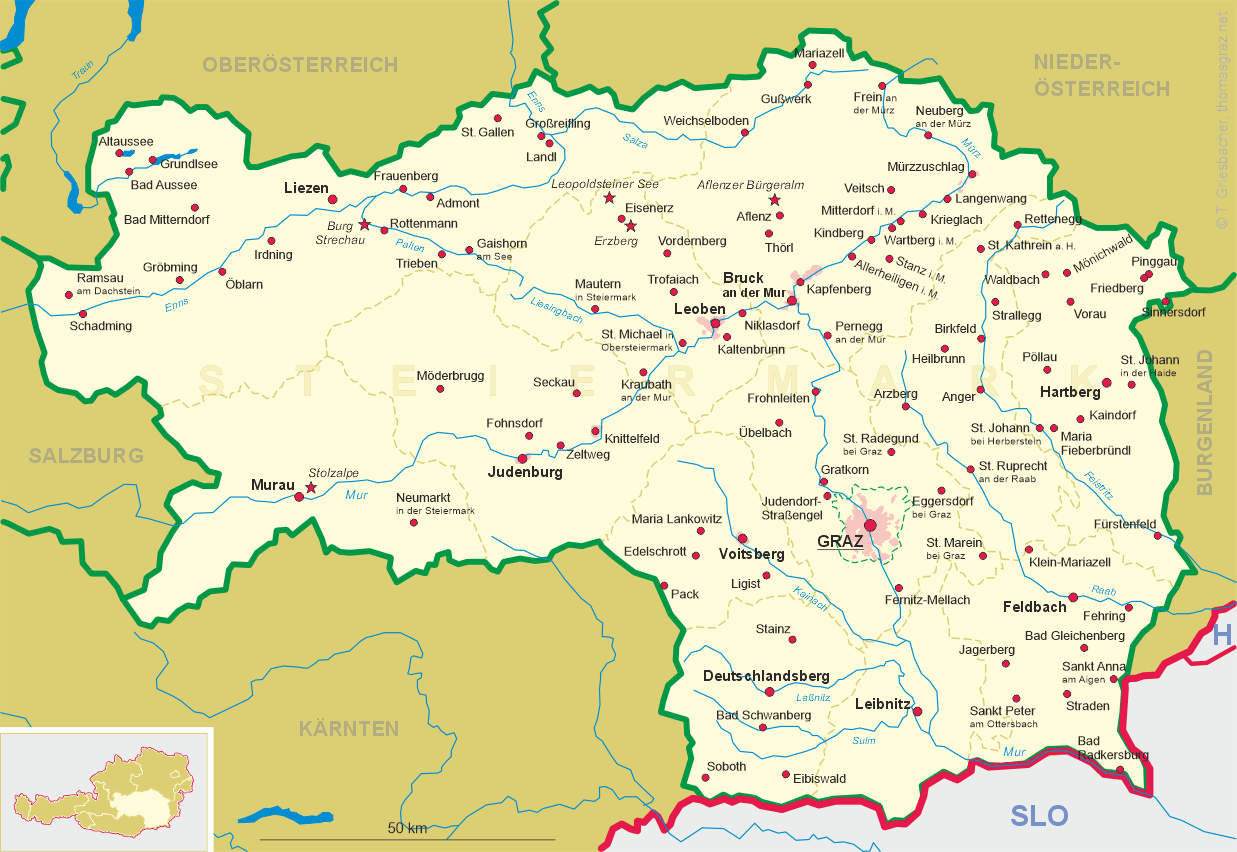
Pöls is situated at an elevation of 790 m on the eponymous river in the southern foothills of the Rottenmann, Wölz and Seckau Tauern mountains, about 9 km northwest of Judenburg, the administrative seat of the district Murtal, and about 60 km northwest of Graz, the capital of Austria's state of Styria. In 2013, Pöls had a population of about 2,400. Since the Styria municipal structural reform of 2015, Pöls is part of the new municipality of Pöls-Oberkurzheim.
 Numerous finds of tools and everyday objects from this period provide evidence of settlement in this area as early as the
2nd millennium BC. There is also considerable evidence to suggest Roman settlement. Pöls is first mentioned in a
document in the year 860 (as curtis ad pelisam) and is thus one of the oldest settlements in Styria. In the 12th
and 13th centuries, large-scale deforestation took place and many new farms were established, a trend that reached its
peak around 1300. Industrialisation began with the hammer mills in the Pölstal valley (early 16th century);
these were later followed by scythe-making workshops, and iron was also smelted there from 1865 to 1901. In 1660 the first
paper mill was founded here and since then, the history of the municipality of Pöls has seemingly been inextricably
linked to the paper and pulp production based in the town. On 1 June 1951, Pöls was renamed Pöls ob Judenburg,
and on 1 January 1976 it reverted to the name Pöls. In 2015, Pöls was merged with the neighbouring
municipality of Oberkurzheim. The new municipality is named Pöls-Oberkurzheim.
Numerous finds of tools and everyday objects from this period provide evidence of settlement in this area as early as the
2nd millennium BC. There is also considerable evidence to suggest Roman settlement. Pöls is first mentioned in a
document in the year 860 (as curtis ad pelisam) and is thus one of the oldest settlements in Styria. In the 12th
and 13th centuries, large-scale deforestation took place and many new farms were established, a trend that reached its
peak around 1300. Industrialisation began with the hammer mills in the Pölstal valley (early 16th century);
these were later followed by scythe-making workshops, and iron was also smelted there from 1865 to 1901. In 1660 the first
paper mill was founded here and since then, the history of the municipality of Pöls has seemingly been inextricably
linked to the paper and pulp production based in the town. On 1 June 1951, Pöls was renamed Pöls ob Judenburg,
and on 1 January 1976 it reverted to the name Pöls. In 2015, Pöls was merged with the neighbouring
municipality of Oberkurzheim. The new municipality is named Pöls-Oberkurzheim.
The Catholic  parish church of the Ascension of Our Lady [left, no. 0000: background left]
was most likely founded in the 9th/10th century. The oldest known document that mentions the church dates from 1147. The church
of the 12th century was a Romanesque pillar basilica with a crossing tower and a transept. In the 14th century,
a Gothic choir was added. The vaulting of the church was created in 1440–1458. Following a fire caused by a Turkish
raid in 1480, the church was converted into a fortified church with a uniform gable roof; these additions were removed during
the restoration in 1891–1893 in order to reveal the high nave walls once again. The upper part of the crossing tower is
in the late Gothic style. Small Baroque side chapels were built in 1730–1733, and the west window was installed at the same
time. Further restoration work took place in 1971–1974, with the exterior being restored in 1981.
parish church of the Ascension of Our Lady [left, no. 0000: background left]
was most likely founded in the 9th/10th century. The oldest known document that mentions the church dates from 1147. The church
of the 12th century was a Romanesque pillar basilica with a crossing tower and a transept. In the 14th century,
a Gothic choir was added. The vaulting of the church was created in 1440–1458. Following a fire caused by a Turkish
raid in 1480, the church was converted into a fortified church with a uniform gable roof; these additions were removed during
the restoration in 1891–1893 in order to reveal the high nave walls once again. The upper part of the crossing tower is
in the late Gothic style. Small Baroque side chapels were built in 1730–1733, and the west window was installed at the same
time. Further restoration work took place in 1971–1974, with the exterior being restored in 1981.
[https://de.wikipedia.org/wiki/P%C3%B6ls_(ehemalige_Gemeinde);
https://de.wikipedia.org/wiki/Pfarrkirche_P%C3%B6ls]
![[scale]](lineal.jpg)