
|
|
| ÖSTERREICH | AUSTRIA |
| Bundesland: Oberösterreich | Upper Austria |
| Bezirk: Steyr-Land |
map →
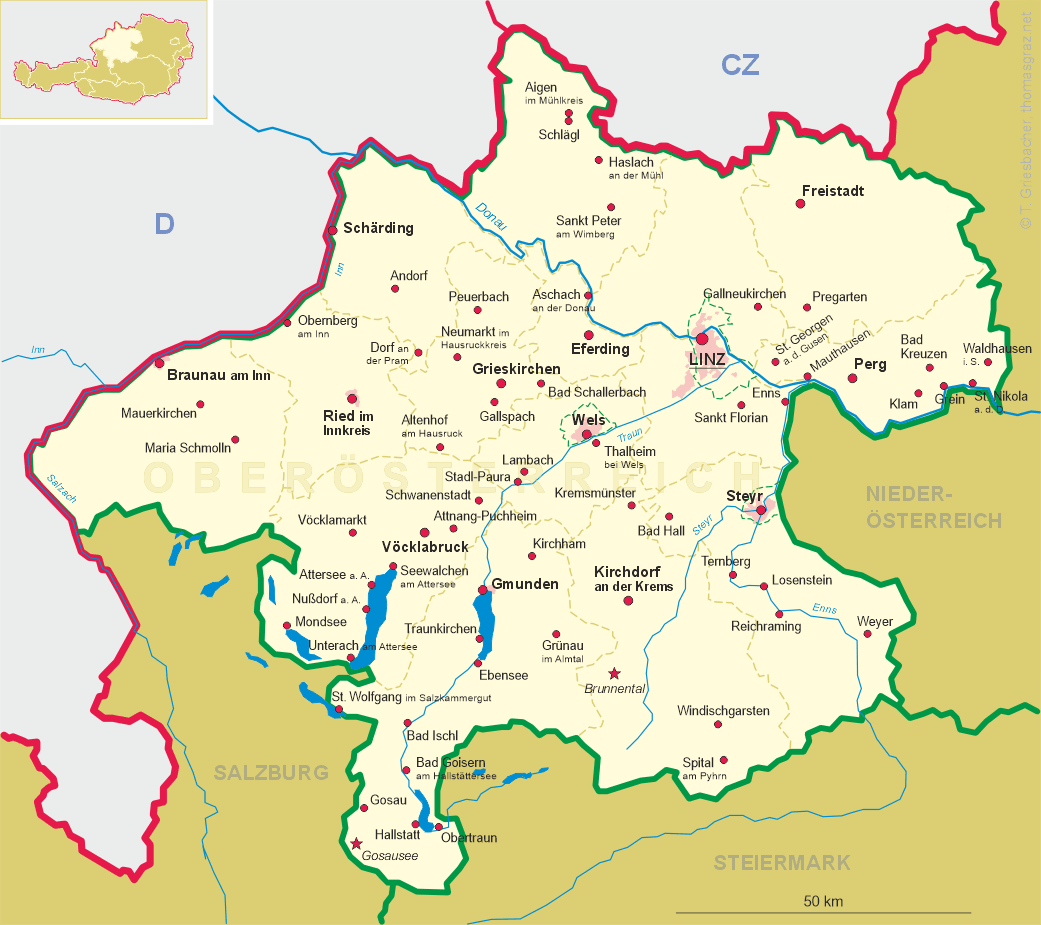
 Sierning is situated at an elevation of 367 m on the river Steyr, about 5 km west of the district town,
Steyr, and about 30 km south of Linz, the capital of Austria's
state of upper Austria. The municipality has a population of about 9,900 (2025).
Sierning is situated at an elevation of 367 m on the river Steyr, about 5 km west of the district town,
Steyr, and about 30 km south of Linz, the capital of Austria's
state of upper Austria. The municipality has a population of about 9,900 (2025).
Isolated archaeological finds show that the area was settled already in Roman times. Slavic settlers moved into the area towards the end of the Migration Period. Sirnicha was first mentioned in a written document dating from AD 777. The parish was established before 985/991. Originally situated in the eastern part of the Duchy of Bavaria, the town became part of the Duchy of Austria from the 12th century onwards. From 1490, it was incorporated into the Principality, and subsequently the Crown Land, of Austria ob der Enns (Upper Austria). In 1891, the Pergern–Bad Hall branch line of the Steyr Valley Railway was built here; this was a narrow-gauge line linking the Rudolfsbahn in the Enns valley and the Kremstalbahn. In 1933, it was reduced to a spur line to Sierning, and was finally closed in 1967. The main Steyrtalbahn line on the other bank of the Steyr has also been operated solely as a heritage railway since the 1980s. In 1938, Sierning became part of Steyr, but regained oits status as an independent municipality in 1945. In 977, to mark the 1,200th anniversary of the parish, it was granted the status of a market town.
The  parish church of Sankt Stephan [left, no. 0000: background right, barely visible]
presuably goes back to a simple baptismal church that is thought to have been built in the 8th century. The central nave,
originally covered by a flat wooden roof, was built around 1000. the Gothic vaulting was completed in 1288. In 1487 the church
was remodeled into a three-naved Gothic hall church with an adjoining sacristy. The tower was remodeled in the Baroque style in
the 17th century, followed by the interior decorations in 1777. In 1904, the old Baroque high altar was replaced by the present
altar of the neo-Gothic style. Since 2025, following the territorial reorganisation of the diocese of Linz, the church is the
parish church of the Steyr Valley parish.
parish church of Sankt Stephan [left, no. 0000: background right, barely visible]
presuably goes back to a simple baptismal church that is thought to have been built in the 8th century. The central nave,
originally covered by a flat wooden roof, was built around 1000. the Gothic vaulting was completed in 1288. In 1487 the church
was remodeled into a three-naved Gothic hall church with an adjoining sacristy. The tower was remodeled in the Baroque style in
the 17th century, followed by the interior decorations in 1777. In 1904, the old Baroque high altar was replaced by the present
altar of the neo-Gothic style. Since 2025, following the territorial reorganisation of the diocese of Linz, the church is the
parish church of the Steyr Valley parish.
[https://de.wikipedia.org/wiki/Sierning;
https://de.wikipedia.org/wiki/Pfarrkirche_Sierning]
![[scale]](lineal.jpg)