
|
|
| DEUTSCHLAND | GERMANY |
| Bundesland: Hessen | Hesse |
| Regierungsbezirk: Kassel | |
| Landkreis: Fulda |
map →
 Fulda is situated at an elevation of 262 m on the river Fulda in eastern Hesse.
Its history goes back to 744 AD, when Saint Bonifatius (Boniface, born as Winfrid or Wynfrith probably in Wessex
around 675 AD), also known as the Apostle of Germany, instructed his pupil Sturmius to build a Benedictine monastery
at this place. After being martyred in Friesland (near Dokkum, Netherlands), Boniface was buried in Utrecht, but his body
was later transferred to Mainz, and finally, according to a wish of St. Boniface himself,
was laid to rest in the monastery at Fulda, while one arm is an important relic guarded by the cathedral of
Eichstätt. In 774, the monastery and its territory became immediate to the empire. The old
basilica, which was built between 791 and 819 AD, was one of the largest churches in Christianity of that time. In
1220 the abbots of Fulda were granted the status of Imperial Princes. In 1752 the Prince Abbots were elevated to Prince
Bishops. During that period the bishops transformed Fulda into a splendid Baroque residence town. The old Romanesque
basilica was replaced in 1704–1712 by the magnificent Baroque cathedral built by the architect Johannes Dientzenhofer.
The political power of the bishops ended with the secularisation in 1802. At first Fulda was given to Nassau-Orange, then
to the new Grand Duchy of Frankfurt. In 1815 the territory passed to the Electorate of Hesse
(Hesse-Kassel), before becoming Prussian in 1866. As a bishopric Fulda is still influencial
within the Catholic church of Germany. The annual conference of the German bishops takes place in Fulda, the burial place
of St. Boniface.
Fulda is situated at an elevation of 262 m on the river Fulda in eastern Hesse.
Its history goes back to 744 AD, when Saint Bonifatius (Boniface, born as Winfrid or Wynfrith probably in Wessex
around 675 AD), also known as the Apostle of Germany, instructed his pupil Sturmius to build a Benedictine monastery
at this place. After being martyred in Friesland (near Dokkum, Netherlands), Boniface was buried in Utrecht, but his body
was later transferred to Mainz, and finally, according to a wish of St. Boniface himself,
was laid to rest in the monastery at Fulda, while one arm is an important relic guarded by the cathedral of
Eichstätt. In 774, the monastery and its territory became immediate to the empire. The old
basilica, which was built between 791 and 819 AD, was one of the largest churches in Christianity of that time. In
1220 the abbots of Fulda were granted the status of Imperial Princes. In 1752 the Prince Abbots were elevated to Prince
Bishops. During that period the bishops transformed Fulda into a splendid Baroque residence town. The old Romanesque
basilica was replaced in 1704–1712 by the magnificent Baroque cathedral built by the architect Johannes Dientzenhofer.
The political power of the bishops ended with the secularisation in 1802. At first Fulda was given to Nassau-Orange, then
to the new Grand Duchy of Frankfurt. In 1815 the territory passed to the Electorate of Hesse
(Hesse-Kassel), before becoming Prussian in 1866. As a bishopric Fulda is still influencial
within the Catholic church of Germany. The annual conference of the German bishops takes place in Fulda, the burial place
of St. Boniface.
 The
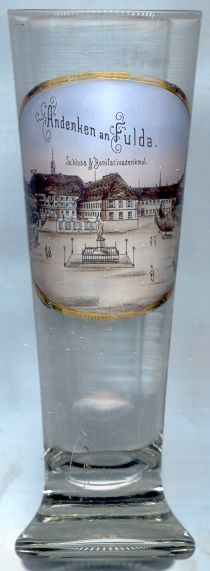
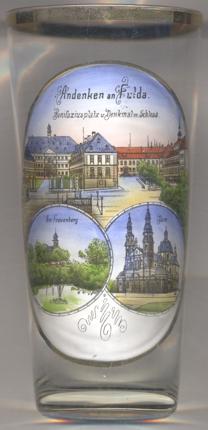
The  residential castle [left, no. 1319; right, no. 3549: top picture]
was first built by the prince abbots in 1294–1312. This castle was replaced in 1606–1612 by a Renaissance
residence, which was rebuilt and enlarged in 1706–1721 in Baroque style by the architect Johannes Dientzenhofer.
residential castle [left, no. 1319; right, no. 3549: top picture]
was first built by the prince abbots in 1294–1312. This castle was replaced in 1606–1612 by a Renaissance
residence, which was rebuilt and enlarged in 1706–1721 in Baroque style by the architect Johannes Dientzenhofer.
The bronze monument for St. Boniface [foreground] was created in 1842 by
Werner Henschel.
Fulda Cathedral [right, no. 3549: bottom right picture]
is the former abbey church of Fulda Abbey and the burial place of Saint Boniface. Since 1752 it has also been the cathedral
of the Diocese of Fulda, of which the Prince-Abbots of Fulda were created bishops. The abbey was dissolved in 1802 but the
diocese and its cathedral have continued. The dedication is to Christ the Saviour. The present cathedral stands on the site
of the Ratgar Basilica (once the largest basilica north of the Alps), which was the burial site of Saint Boniface and the
church of Fulda Abbey, functions which the new building was intended to continue. The plans of the new church were drawn up
in 1700 by one of the greatest German Baroque architects, Johann Dientzenhofer. Construction began in 1704 using in part
the the foundations of the earlier basilica. In 1707 the shell was completed, the roof was finished in 1708 and the interior
in 1712. In 1752 it was elevated to a cathedral on the creation of the Diocese of Fulda. In 1802 Fulda Abbey was dissolved
and the cathedral's function as the abbey church ceased, but it continued in operation as the seat of the Bishops of Fulda.
After damage caused by air raids during World War II the cathedral was closed for restoration until 1954.
The Frauenberg monastery [right, no. 3549: bottom left picture]
is said to have been founded on the hill where St.&nbsP;Boniface, when coming to Fulda, had sought refude from the
noise caused by the construction of the monastery that he had instructed his pupil Sturmius to build. To commemorate
Boniface, a new curch was built here in 809 AD. This church remained the parish church of Fulda until 1049.
The church was then given to the Benedictine order, and their provost church existe until the secularisation of 1802.
As the church was dedicated to Our Lady, the hill became known as 'Frauenberg' ('Our Lady's Mountain'). Destroyed
during the peasnts' revolt of 1525 the church was rebuilt in the beginnings of the 17th century. In 1623, the
church was given to the Franciscan order (however, until today, church and monastery stay in possession of the bishopric).
In 1875, the Franciscans were forced to leave because the Prussian law of 1875 stipulated that all religious orders
that did not engage in nursing had to leave Prussia. In 1979 the monastery was offered to the city of Fulda, which
purchased the premises. The Franciscans could return in 1884 and re-opened the monastery in 1887. During the Nazi period,
the monastery (except church and sacristy) were confiscated by the German Reich and the monks were again forced to leave.
The school of the SS Sicherheitsdienst occupied the monastery, but relocated to Prague in
1942. Luckily, the Frauenberg was spared from the bombings of 1944. After the end of the war, the Franciscans could
return. The church was renovated in 1973/1974, the monastery in 1999–2004. Today, parts of the monastery operate
as a guest house and meeting venue.
[https://en.wikipedia.org/wiki/Fulda_Cathedral, https://de.wikipedia.org/wiki/Kloster_Frauenberg_(Fulda)]
![[scale]](lineal.jpg)