
|
|
| ČESKÁ REPUBLIKA | CZECH REPUBLIC |
| Karlovarský kraj | Karlovy Vary region |
| Okres: Cheb |
map →
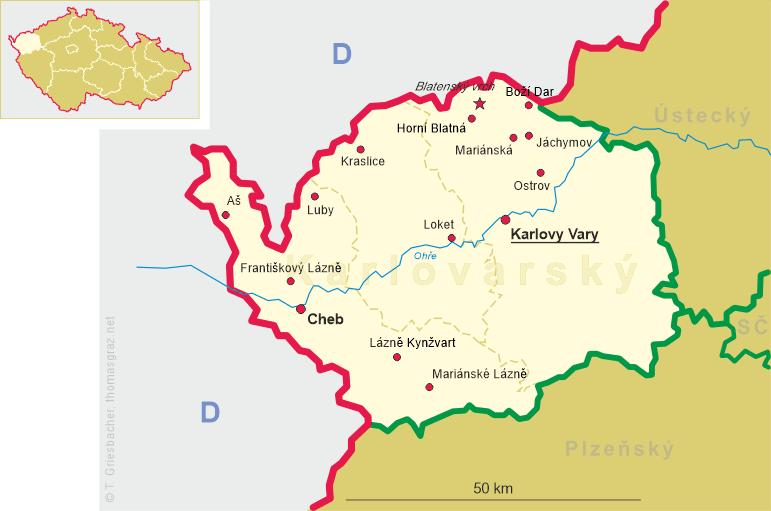
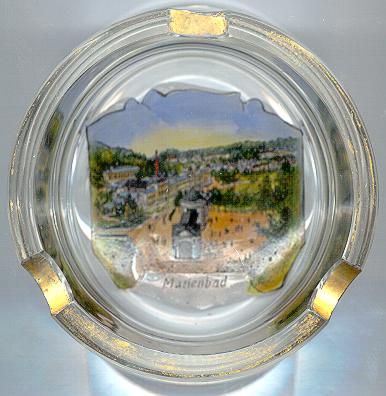 Mariánské Lázně (German: Marienbad) is situated at an elevation of 630 m
in the foothills of the Salvkovský les (Kaiserwald) mountains, in the Cheb district
of the Karlovy Vary region in western Czech Republic. The municipality of
Mariánské Lázně has a population of 13,000 (2017).
Mariánské Lázně (German: Marienbad) is situated at an elevation of 630 m
in the foothills of the Salvkovský les (Kaiserwald) mountains, in the Cheb district
of the Karlovy Vary region in western Czech Republic. The municipality of
Mariánské Lázně has a population of 13,000 (2017).
The mineral springs have been known for centuries and originally were known as 'Auschowitzer Salzquellen' (mineral springs of Úšovice, now part of the city). During the 18th century the area was in possession of the Premonstratensian monastery of Teplá (Tepl). The first bath houses were then built in 1807 and 1808. At this time the new name 'Marienbad' was introduced. In 1813 the location became a municipality and five years later it was officially recognized as a spa place. In 1865 Mariánské Lázně was granted the status of a town. The number of visitors increased steadily, especially after the opening in 1872 of the railroads from Vienna and Prague. Most of the splendid spa buildings date from this period. Mariánské Lázně was often refered to as the most splendid spa of the Austro-Hungarian monarchy. Today, 40 out of the 140 springs at this place are used for therapeutic purposes, especially for the treatment of respiratory and metabolic diseases, kidney diseases and diseases of the musculoskeletal system.
Throughout its history many world-famous people have visited the spa and it is certainly impossible to list them all. Among them probably the most famous were the composer Richard Wagner, the author Stefan Zweig, the philosopher Friedrich Nietzsche, King Edward VII (1904), and the author and poet Wolfgang von Goethe who wrote his famous Marienbader Elegie at his place.
In 2021, Mariánské Lázně was listed by UNESCO as a World Cultural Heritage site (see list) as one of the "Great Spas of Europe", together with Baden (Austria), Spa (Belgium), Františkovy Lázně and Karlovy Vary (Czech Republic), Bad Ems, Bad Kissingen and Baden-Baden (Germany), Montecatini Terme (Italy), and Bath (United Kingdom).
 The
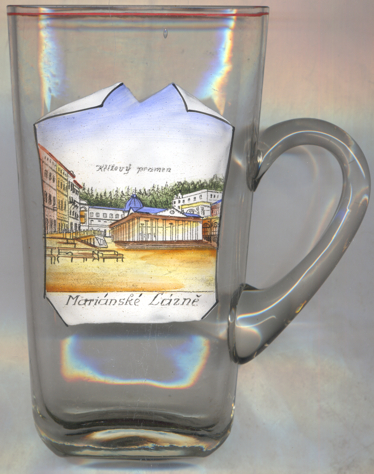
The  Křížový pramen (Kreuzbrunnen) (Cross spring)
[left, no. 3415] is the oldest known spring of Mariánské Lázně. The waters
contain high amounts of salt (10 milligram per litre) and other minerals. It was first mentioned in 1749. The pavillon
was built by the local architect Anton Thurner. The original light-weight construction was made of wood, bricks and stucco
so as not to damage the spring. It was replaced in 1912 by a predominantly concrete construction as a copy of the
original, including some Art Nouveau elements.
Křížový pramen (Kreuzbrunnen) (Cross spring)
[left, no. 3415] is the oldest known spring of Mariánské Lázně. The waters
contain high amounts of salt (10 milligram per litre) and other minerals. It was first mentioned in 1749. The pavillon
was built by the local architect Anton Thurner. The original light-weight construction was made of wood, bricks and stucco
so as not to damage the spring. It was replaced in 1912 by a predominantly concrete construction as a copy of the
original, including some Art Nouveau elements.
[https://marianske-lazne.info/de/kur/kreuzquelle, https://www.marianskelazne.cz/de/marienbad-entdecken/quellen/kreuzquelle/]
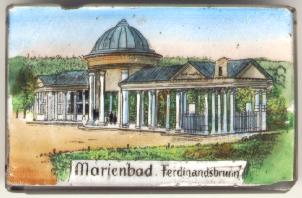
The Ferdinandův pramen (Ferdinandsbrunnen) (Ferdinand's spring) [right, no. 499]
had been known for centuries. It is documented that under Emperor Ferdinand I it was tried to produce salt out of the waters in 1528.
Together with the lesser concentrated Křížový pramen (Kreuzquelle) it is among the most concentrated mineral waters containing
sodium, iron, sulfate and bicarbonate. The spring actually comprises seven separate springs: spring I is used for drinking cures,
the waters of spring IV are sold in bottles, the waters of the other Ferdinand's springs are used for bathing cures.
The colonnade above the spring was built in 1826.
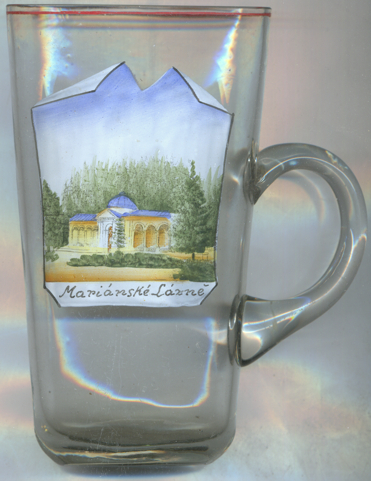
The Lesní pramen (Waldquelle) (Forest spring) [near left, no. 3307]
was already known in 1683 under the name Schneidsäuerling. In 1830 it was sheltered by a wooden pavilion,
in 1834 the northern and eastern sides were glazed. The new name, forest spring, was given to it around 1828.
In 1840 the old pavilion was replaced by a new, circular temple with 16 Corinthian columns. Today's classicist appearance
was given to the pavilion in 1869. At the beginning of the second half of the 20th century the building was glazed during
the reconstruction.
[https://cs.wikipedia.org/wiki/Lesní_pramen]
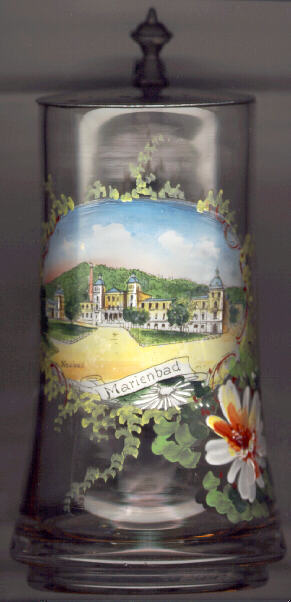
The Nové Lázně (Neubad) (New Bath) [left, no. 139] was built in
1893–1896 in monumental Renaissance Revival style, replacing the older, Classicist bath building of 1827–1828.
Both the original bath as well as the new building were financed by the monastery of Teplá. A special cabin was used by
King Edward VII at the occasion of his visit in 1904.
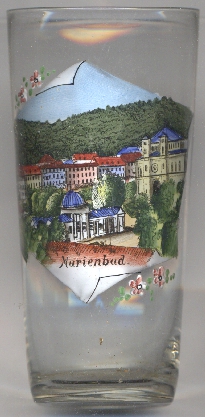
The Kolonáda Karolinina a Rudolfova pramene (Kollonade der Karolina- und Rudolphsquellen)
(Carolina collonade and Rudolph spring) [near left, no. 4293: foreground centre] is also called the 'small collonade'.
The Carolina spring was discovered in 1809 and was originally named 'new spring'. In 1819 it was renamed for Karoline Auguste of Bavaria, fourth wife of
Emperor Franz I of Austria. The Rudolph spring was originally named Wiesenquelle (Luční pramen, 'Meadow spring') but was renamed in
1867 for Crown Prince Rudolph of Austria. The spring itself is located in nearby Úšovice, but the spring was purchased by the spa in 1865
and a few years later the waters were led to the New Bath and later to the Carolina collonade. The collonade was built in 1870. In 1986–1990 the
collonade was broken off and rebuilt 12 metres nearer to the pavillon of the Cross spring.
[https://de.wikipedia.org/wiki/Heilquellen_in_Marienbad]
The Catholic deanery church of the Assumption of the Virgin Mary [near left, no. 4293: far right]
was built in 1848 by the architect Johann Gottfried Gutensohn. Thirty-three steps lead up to the church, representing the 33 years of Jesus Christ's
life.
[https://de.wikipedia.org/wiki/Marienbad, https://cs.wikipedia.org/wiki/Mari%C3%A1nsk%C3%A9_L%C3%A1zn%C4%9B]
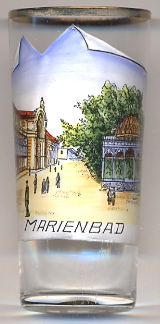
The collonade [left] was built in 1888/1889 in Neo-Baroque style after designs by the architects
Hans Miksch and Julian Niedzielski from Vienna. The cast-iron construction was produced in the iron works in Blansko.
The ceiling frescos were made by Josef Vyleťal, the bronze wall reliefs were created by Antonín Kuchař. The collonade was renovated
in 1973–1981.
[http://www.marianskelazne.cz/de/marienbad/bedeutende-orte-und-denkmaler/kolonnade]
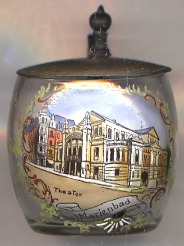
The Municipal Theatre (Městské divadlo) [near left, no. 2771]
was built in 1865–1868 in Renaissance revival style by the architect Friedrich Zickler. In 1905 it was rebuilt in
Art Nouveau style by Hubert J. Walcher. In 2007–2008 the theatre was thoroughly renovated and modernised. Its capacity is now 326 seats.
[http://www.marianskelazne.cz/de/freizeit-ausfluge-und-sport/kulturangebot/stadttheater/geschichte, http://www.andreas-praefcke.de/carthalia/index.html]
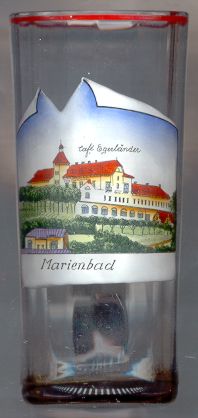
Glass no. 1545 [left] shows a view of the
Café
![[scale]](lineal.jpg)