
|
|
| DEUTSCHLAND | GERMANY |
| Bundesland: Brandenburg | |
| Stadt: Frankfurt (Oder) |
map →
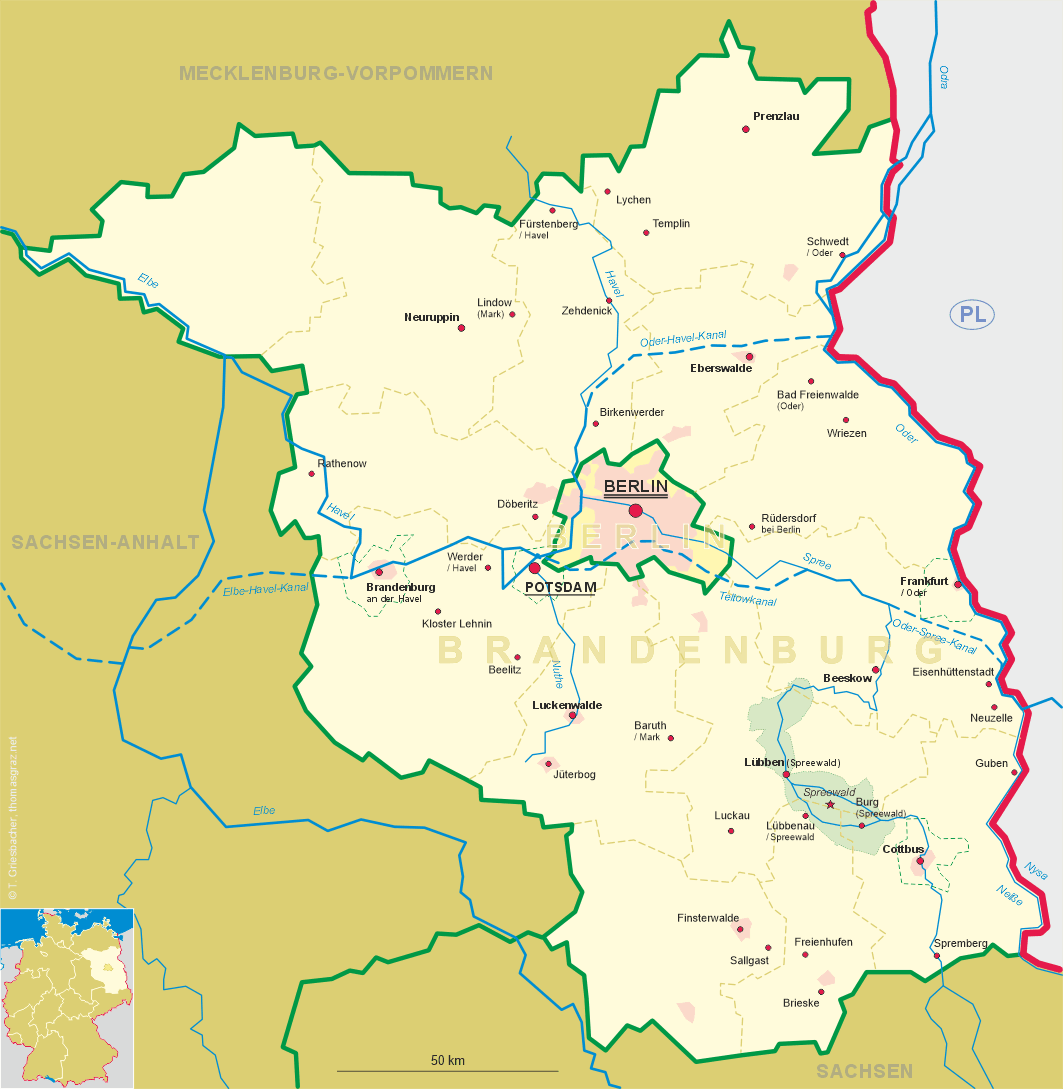
Frankfurt (Oder) is situated at an elevation of 40 m on the left bank of the river Oder in eastern Brandenburg at the border to
Poland. The first settlement seems to have been founded around 1226 at a ford across the river. The place was named after the church of
St. Nikolai. Around 1253 it received the status of a town. At that time the place was already called Vrankenvorde. It soon
developed into an important trading town and from 1430 or earlier until around 1500 belonged to the Hanse federation of trading towns. The
university was opened in 1506.
Among the first students were later humanist Ulrich von Hutten and the later reformer Thomas Müntzer. During the Thirty Years' War
(1618–1648) the town was besieged and occupied several times and its population dropped from about 12,000 to less than 2,400 in 1653.
Nevertheless, trading remained an important economic factor for the town in the following centuries. After the opening of the university in
Berlin, the university of
 The
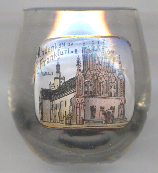
The  Town Hall [left, no. 3953] goes back to a first construction that
was started probably in 1253. It is likely that at first only the basement and ground floor were completed. The larger,
southern part with the vending hall, the archives and the splendid Gothic front (depicted on glass no. 3953) were
added only in about the mid-14th century. In 1607–1609 the town hall was remodeled in Baroque style, but in
1906 1911 it was remodeled again in Neo-Gothic style. During World War II, the town hall was largely destroyed
and finally burnt out. After the war, it was restored in 1951–1953.
[https://de.wikipedia.org/wiki/Rathaus_Frankfurt_(Oder)]
Town Hall [left, no. 3953] goes back to a first construction that
was started probably in 1253. It is likely that at first only the basement and ground floor were completed. The larger,
southern part with the vending hall, the archives and the splendid Gothic front (depicted on glass no. 3953) were
added only in about the mid-14th century. In 1607–1609 the town hall was remodeled in Baroque style, but in
1906 1911 it was remodeled again in Neo-Gothic style. During World War II, the town hall was largely destroyed
and finally burnt out. After the war, it was restored in 1951–1953.
[https://de.wikipedia.org/wiki/Rathaus_Frankfurt_(Oder)]
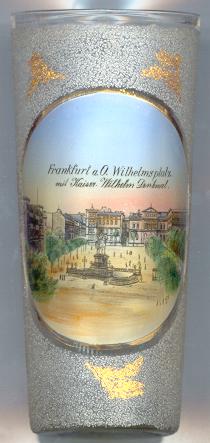 The monument for Emperor Wilhem I [left, no. 956: centre, and no. 936, below: bottom
right picture] on the square Wilhelmsplatz (today 'Platz der Republik') was created by the sculptor Max Unger in 1900. The bronze
equestrian statue of Wilhelm I (1797–1888), King of Prussia since 1861 and first German Emperor after the foundation of the
German Empire in 1871 had a height of 4.5 metres, the total height of the monument including the pedestal had a height of
8.5 metres. The monument was destroyed during World War II in 1944, the pedestal was removed after 1945.
[https://de.wikipedia.org/wiki/Liste_der_Kaiser-Wilhelm-I.-Reiterdenkm%C3%A4ler]
The monument for Emperor Wilhem I [left, no. 956: centre, and no. 936, below: bottom
right picture] on the square Wilhelmsplatz (today 'Platz der Republik') was created by the sculptor Max Unger in 1900. The bronze
equestrian statue of Wilhelm I (1797–1888), King of Prussia since 1861 and first German Emperor after the foundation of the
German Empire in 1871 had a height of 4.5 metres, the total height of the monument including the pedestal had a height of
8.5 metres. The monument was destroyed during World War II in 1944, the pedestal was removed after 1945.
[https://de.wikipedia.org/wiki/Liste_der_Kaiser-Wilhelm-I.-Reiterdenkm%C3%A4ler]
Several glasses of this collection show other monuments for Wilhelm I.
The Stadttheater (municipal theatre) [background right] was built in 1842. The building was destroyed in 1945.
Heinrich von KLEIST (1777–1811), one of the greatest dramatists of German literature, was born in Frankfurt an der Oder. His comedies include Der zerbrochne Krug (1806, The Broken Pitcher) and Amphitryon (1807). Among his passionate tragedies is Penthesilea (1808). Käthchen von Heilbronn is a tale of chivalry. His masterpiece is Der Prinz von Homburg (1821), a historical tragedy. The best-known of his novellas are Michael Kohlhaas (1810/11) and Die Marquise von O. (1810/11). Kleist led an unhappy life that ended in his suicide together with Henriette Vogel near Potsdam at the lake Kleiner Wannsee (today part of Berlin).
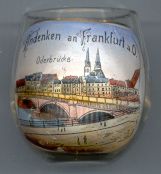 The picture on glass no. 1774 [right] shows a panoramic view of Oder bridge.
The Nikolaikirche [right, no. 1774: background] was begun before 1253 and thus is the
oldest church of
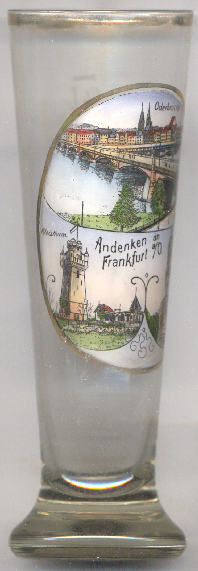
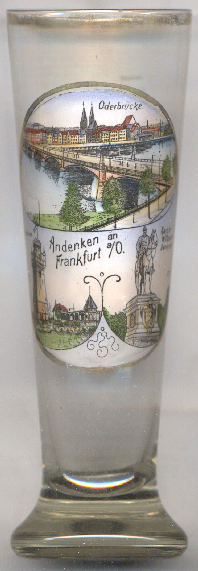
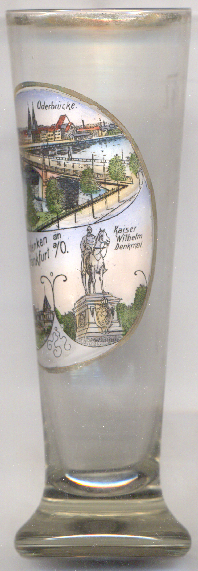 Glass no. 3936 [left] shows views of the Oder bridge and Nikolai church [top picture] and the
monument for Emperor Wilhelm I [bottom right picture] already described above.
Glass no. 3936 [left] shows views of the Oder bridge and Nikolai church [top picture] and the
monument for Emperor Wilhelm I [bottom right picture] already described above.
The bottom left picture on glass no. 3936 [left] and the bottom right picture on glass no. 3937
[right] show a view of the
Kleist
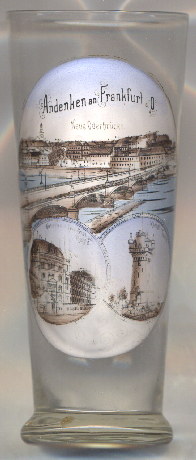
The bottom left picture on glass no. 3937 [right] shows a view of the
barracks
![[scale]](lineal.jpg)