
|
|
| DEUTSCHLAND | GERMANY |
| Bundesland: Saarland | |
| Landkreis: Neunkirchen |
map →
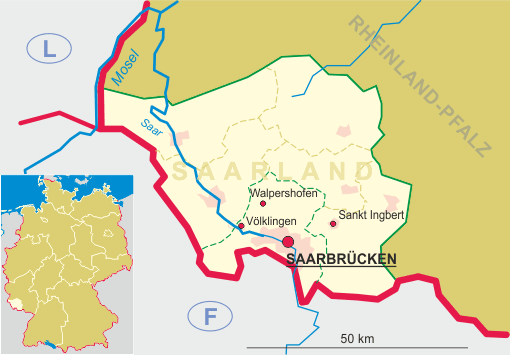
Neunkirchen is situated at an elevation of 252 m on the river Blies, about 19 km northeast of Saarbrücken, the capital of Germany's state of Rheinland-Pflaz (Rhineland-Palatinate), and about 6 km south of Ottweiler, the administrative seat of the district Neunkirchen. The municipality has a population of about 47,300 (2024).
Wiebelskirchen, today part of Neunkirchen, was first mentioned already in AD 765; Neunkirchen was first mentioned in
1281. The name originally did not mean 'nine churches' but goes back to 'an der neuen kirchen', i.e. 'at the new church',
which later evolved into the modern name. Almost all of the area at that time belonged to the Principality of
Nassau-Saabrücken. In 1593, the Neunkirchen ironworks was built in the Blies valley,
significantly shaping the town's fortunes. Johann Wolfgang von Goethe, who visited Neunkirchen as a student in 1770, describes
the town's picturesque location and iron smelting in his autobiography, Dichtung und Wahrheit ("Poetry and Truth").
 From 1820 onwards, coal deposits were developed, which, together with the iron ores (Minette) found in nearby Lorraine, led
to the development of a significant iron industry at Neunkirchen. Large parts of the historic inner city were destroyed
in 1945 during World War II; however, about a third of Neunkirchen's building still date from before 1945. The decline
of heavy industry in the 1970s hit Neunkirchen hard. The last coal mine closed as early as 1968. When the ironworks closed in
1982 (only the rolling mill continued operating), the town topped the German unemployment statistics for a while. Neunkirchen's
former importance as a railway hub also diminished after the partial closure of the marshalling yard.
From 1820 onwards, coal deposits were developed, which, together with the iron ores (Minette) found in nearby Lorraine, led
to the development of a significant iron industry at Neunkirchen. Large parts of the historic inner city were destroyed
in 1945 during World War II; however, about a third of Neunkirchen's building still date from before 1945. The decline
of heavy industry in the 1970s hit Neunkirchen hard. The last coal mine closed as early as 1968. When the ironworks closed in
1982 (only the rolling mill continued operating), the town topped the German unemployment statistics for a while. Neunkirchen's
former importance as a railway hub also diminished after the partial closure of the marshalling yard.
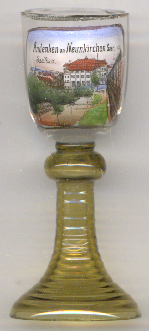
The building shown in the view depicted on glass no. 4954 [left] is labeled
 Saalbau
Other glasses in this collection show views from
Neunkirchen, Austria.
[https://de.wikipedia.org/wiki/Neunkirchen_(Saar);
https://www.saarbruecker-zeitung.de/saarland/100-jahre-das-groesste-dorf-preussens-wie-neunkirchen-zu-stadtrechten-kam_aid-67675179]
![[scale]](lineal.jpg)