
|
|
| FRANCE | FRANCE |
| région: Grand Est | |
| département: 68, Haut-Rhin |
map →
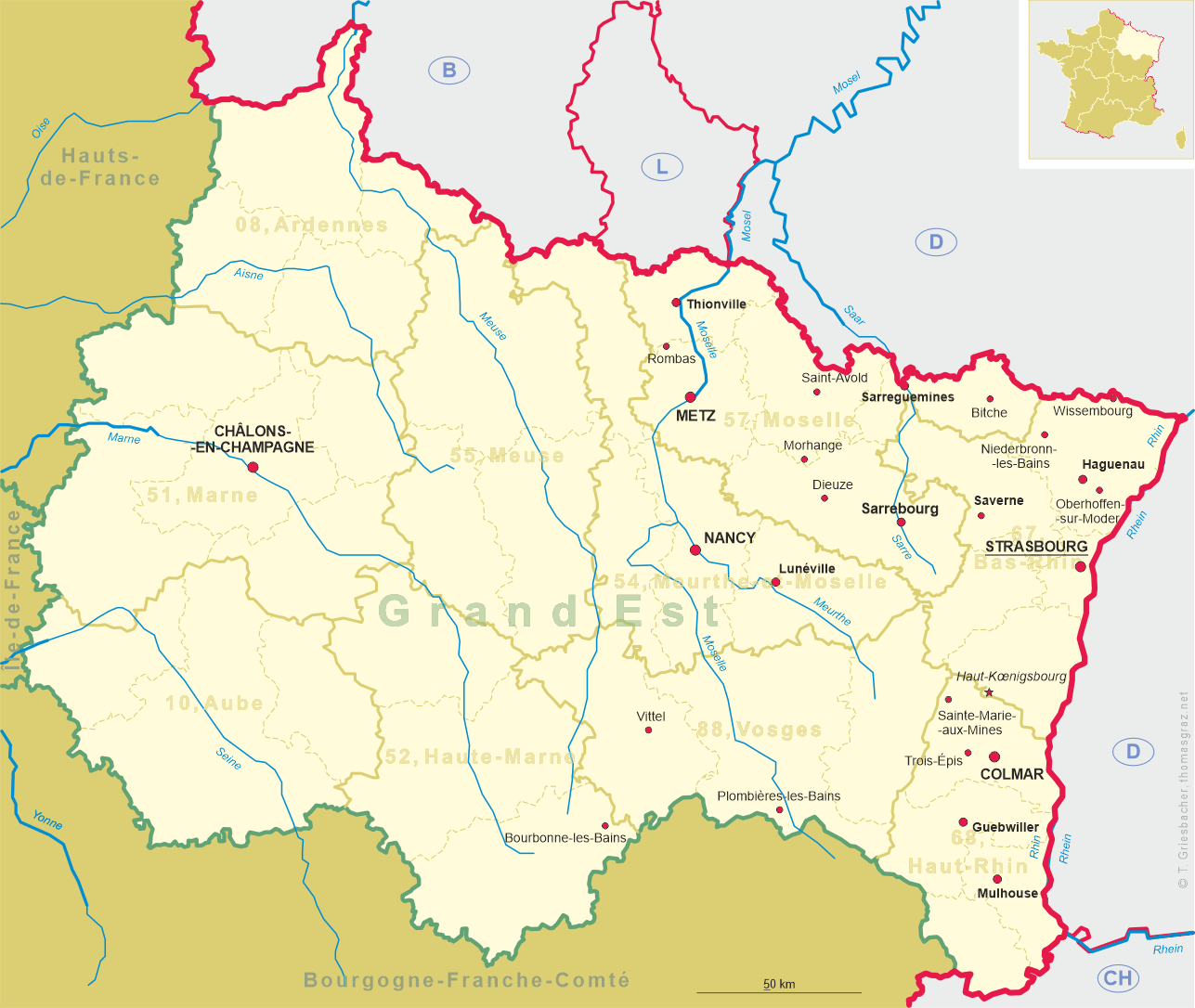
 Colmar is situated at an elevation of 186 m at the confluence of the rivers Lauch and Ill in the French département Haut-Rhin.
Colmar is the préfecture of the département, and also the capital (chef-lieu) of the arrondissement Colmar as well as the
cantons Colmar-Nord and Colmar-Sud. With a population of about 67,200 (2006), Colmar is the second-largest city (after Mulhouse) in the
département, and the third-largest (after Strasbourg and Mulhouse) in the former région Alsace.
Colmar is situated at an elevation of 186 m at the confluence of the rivers Lauch and Ill in the French département Haut-Rhin.
Colmar is the préfecture of the département, and also the capital (chef-lieu) of the arrondissement Colmar as well as the
cantons Colmar-Nord and Colmar-Sud. With a population of about 67,200 (2006), Colmar is the second-largest city (after Mulhouse) in the
département, and the third-largest (after Strasbourg and Mulhouse) in the former région Alsace.
The oldest written source mentioning Columbarium dates from AD 823. In 1226 Colmar obtained the status of a Free Imperial Town within the Holy Roman Empire. In the 14th century, Colmar joined the Décapole, an alliance of ten towns of the Holy Roman Empire in Alsace (Haguenau, Colmar, Wissembourg, Turckheim, Obernai, Kaysersberg, Rosheim, Munster, Sélestat and Mulhouse, later also Seltz and Landau in der Pfalz) that had been founded in 1354. In 1673 Colmar was occupied by French troops. After the Peace of Nijmegen (1679), Colmar officially became part of France. In 1791 it became the capital of the départemant Haut-Rhin. After the French German War of 1870/1871 Alsace and Lorraine were annexed by Germany (Imperial Territory Alsace-Lorraine). After World War I, the territory was returned to France. During World War II, the regionw was again occupied by Germany and the Alsace region was incorporated into the Reichsgau Baden-Elsass. After the Battle of the Colmar Pocket in 1945 it was returned to France again.
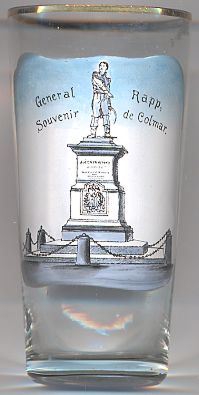
The picture on glass no. 2422 shows the
 monument
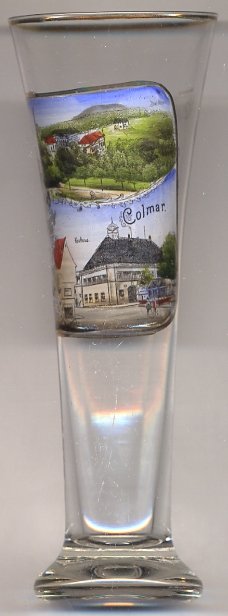
The Koïfhus (German: Kaufhaus; 'Warehouse') or Ancienne Douane (Old Custom House) [left, no. 2777: bottom right picture]
is located in a strategic place where the Grand'rue and the rue des Marchand, two of the medieval town's principal streets met.
Planned since 1433, the contruction of the current building was completed in 1480. Two adjacent buildings were added in the 16th century.
The condition of the building was so bad in the 19th century, that it was considered to demolish it. However, this plan was abandoned and restoration works
took place between 1895 to 1898. The turret and glazed tiles date from this period. Several renovations took place in the subsequent decades; during the last one, in 2002,
the original Renaissance sandstone balustrade, which had been removed in 1976, was restored. The Koïfhus is the oldest local ublic building.
From its inception, it served a dual function. The ground floor was used as a warehouse and place of taxation of goods imported and exported.
The upper floor was used as a meeting place for delegates of the Décapole as well as of the city's magistrate. After the French Revolution, which abolished
the trade privileges , the building was devoted to other purposes.
[http://www.ot-colmar.fr/fr/patrimoine-architectural/235008797_koifhus-ou-ancienne-douane-colmar?view=ficheproduit&layout=ficheproduit&produit=235008797]
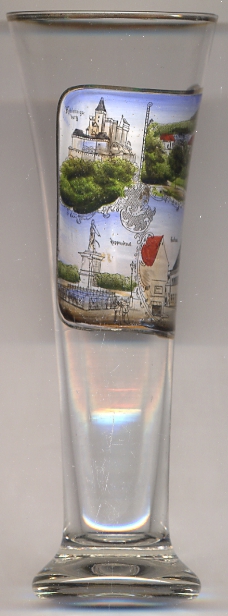
The bottom left picture on glass no. 2777 shows a view of the monument for General Rapp (see above).
The top left picture on glass no. 2777 shows a view of the château du Haut-Kœnigsbourg, about 20 km
north of Colmar.
The top right picture on glass no. 2777 shows a view of the pilgrimage site Trois-Épis, about 10 km
west of Colmar.
![[scale]](lineal.jpg)