
|
|
| РОССИЯ ROSSIJA | RUSSIA |
| Калининградская область / Kaliningradskaja oblast' | Kaliningrad province |
|
районы: Ленинградский,
Московский,
Центральный
| Leningrad district, Moscow district, Central district |
map →
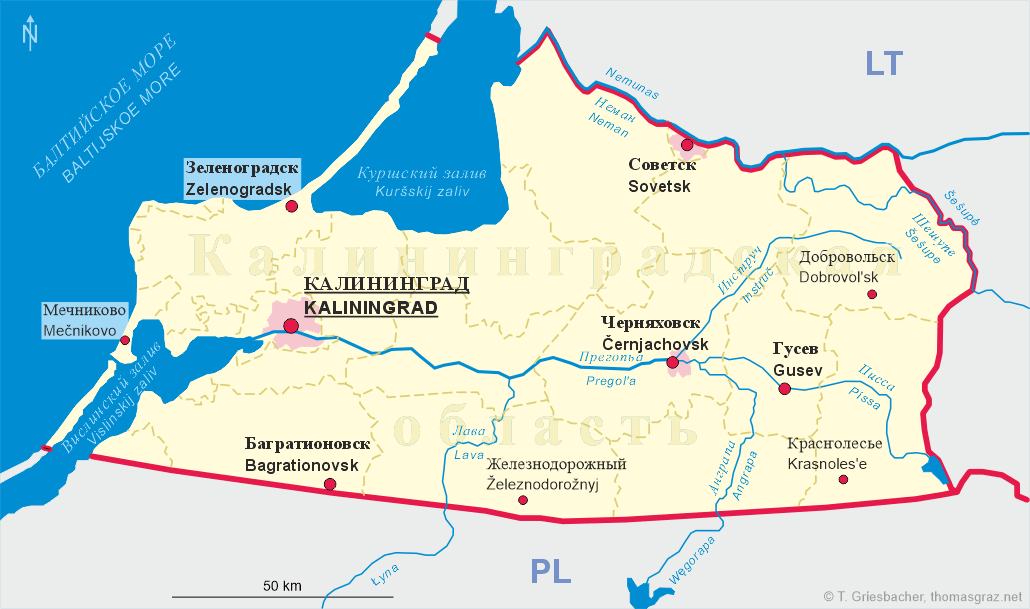
Kaliningrad is situated on the river Pregol'a (German: Pregel), a few kilometers before its mouth into the Vistula Lagoon (Vislinskij Zaliv, German: Frisches Haff, polish: Zalew Wiślany). The earliest traces of human habitation go back to about 1500 BC. A settlement, called Tuwangste by the native (Baltic) Prussians, had been a trading place already during the 11th and 12th century. In 1242 tradesmen from Lübeck founded a trading post. The Teutonic Order founded the town Königsberg in 1255 and named it after King (German: König) Přemysl Otakar II of Bohemia. Near the old town (Altstadt), two further settlements (Löbenicht and Kneiphof) were founded by craftsmen and traders. The castle became the seat of a marshall of the order and also the seat of a bishop. The world-famous cathedral was built between 1333 and 1380. In 1340, Altstadt-Königsberg joined the Hanse federation of trading towns, followed by Löbenicht and Kneiphof in 1389. In 1457, after the Teutonic Order had lost its residence Marienburg (today Malbork) to Poland, Königsberg became the new residence of the order. In 1525, the last Grand Master, Margrave Albrecht II of Brandenburg-Ansbach, converted to the Protestant faith and transformed the lands of the order into the Duchy of Prussia. (The Teutonic Master, from then on Grand and Teutonic Master, took his residence in Mergentheim.) Prussia and Brandenburg were united in 1601. With permission of Emperor Leopold I, Elector Friedrich III of Brandenburg crowned himself King (Friedrich I) in Prussia in Königsberg castle in 1701. Under the reign of his son, King Friedrich Wilhelm I, Altstadt-Königsberg, Löbenicht and Kneiphof were united in 1724 and received the title Royal Prussian Capital. At that time, Königsberg was about twice as large as Berlin. The second to crown himself King of Prussia in the castle was Wilhelm I in 1861. In 1871, Wilhelm I became the first German Emperor. When West Prussia became part of Poland after World War I, Königsberg suddenly was located in an exclave separated from the main country. Nevertheless, the opening of Germany's first civil airfield in 1919 and a rew role as a place of important trade fairs secured its economical position. During World War II, Königsberg was largely destroyed by a two-night bomb raid by British and American aircrafts. The town was finally occupied by Russian troops in 1945. In 1947, the town was renamed Калининград (Kaliningrad) for Michail Ivanovič Kalinin (1875–1946), first head of state of the Soviet Union. Until 1948, all remaining German-speaking inhabitants of the town were expelled or deported. Because Kaliningrad had an extremely important strategic position as an ice-free harbour, the town and the whole area were completely closed off between 1947 and 1991.


The famous  Königsberg castle [left, no. 4672, and right, no. 1450]
was begun by the Teutonic Order soon after the order had obtained Königsberg in 1125. In 1312 the castle
became the seat of a marshall of the order, and in 1457 became the residence of the Grand Master.
During the 16th century it was enlarged to become the residence of Albrecht II of Brandenburg-Ansbach, the first
Duke in Prussia. During the reign of Margrave Georg Friedrich of Brandenburg-Ansbach, who was regent for
Albrecht's mentally ill son, Albrecht Friedrich, further parts of the castle were erected.
King Friedrich I wanted to transform the castle into a representative palace for the Kings in Prussia, but the
construction was stopped by his son Friedrich Wilhelm I and was never taken up again. Only after 1810 parts
of the north wing of the castle were demolished to make room for a new court of justice building.
castle-tower (Schlossturm)
Königsberg castle [left, no. 4672, and right, no. 1450]
was begun by the Teutonic Order soon after the order had obtained Königsberg in 1125. In 1312 the castle
became the seat of a marshall of the order, and in 1457 became the residence of the Grand Master.
During the 16th century it was enlarged to become the residence of Albrecht II of Brandenburg-Ansbach, the first
Duke in Prussia. During the reign of Margrave Georg Friedrich of Brandenburg-Ansbach, who was regent for
Albrecht's mentally ill son, Albrecht Friedrich, further parts of the castle were erected.
King Friedrich I wanted to transform the castle into a representative palace for the Kings in Prussia, but the
construction was stopped by his son Friedrich Wilhelm I and was never taken up again. Only after 1810 parts
of the north wing of the castle were demolished to make room for a new court of justice building.
castle-tower (Schlossturm)
Glass no. 4672 [far left] also bears the inscription
§ 11

The monument for Emperor Wilhelm I [near left, no. 1023] was unveiled on 4 September 1894 in the presence of his grand-son,
Emperor Wilhelm II. The monument is one of the best-known works of the sculptor Friedrich Reusch. The metal sculpture had a height of 5 metres
(6.80 m up to the tip of the sword) and showed the emperor in the ornate for his coronation as king in Prussia on 2 January 1861. The monument was not
damaged during World War II. Photos dating from 1948 show the statue lacking head and sword. The monument was finally removed by the Soviet authorities in early 1950.
[https://de.wikipedia.org/wiki/Kaiser-Wilhelm-I.-Denkmal_(Königsberg)]
(Several glasses of this collection show other monuments for Wilhelm I)

The University of Königsberg (German: Albertus-Universität Königsberg) was founded in 1544 as the
world's second Protestant academy (after the University of Marburg) by Duke Albert of Prussia, and was commonly known as the
Albertina. Following World War II, when Königsberg had been transferred to the Soviet Union under the 1945 Potsdam
Agreement and the city had been renamed Kaliningrad in 1946, the Albertina was closed. In the course of the celebrations for the 250-year anniversary of
the city, the university was renamed Immanuel Kant Baltic Federal University, which today claims to maintain the traditions of the Albertina.
Celebrating the university's 300 years jubilee on 31 August 1844, King Friedrich Wilhelm IV of Prussia laid the foundation for the
main
The most famous son of Königsberg certainly is the great philosopher, Immanuel Kant (1724–1804). In 1770, he began to teach at the old university (founded in 1544). Kant lived in Königsberg throughout his entire life.
A number of well-known mathematicians also were born in Königsberg, among them David Hilbert (1862–1943).
![[scale]](lineal.jpg)